Comparison

Orchard Swallowtail vs Common Mormon

Orchard Swallowtail (Papilio aegeus) and Common Mormon (Papilio polytes) both belong to the genus Papilio (swallowtails) and part ways below it. Both are recorded in 3 countries.
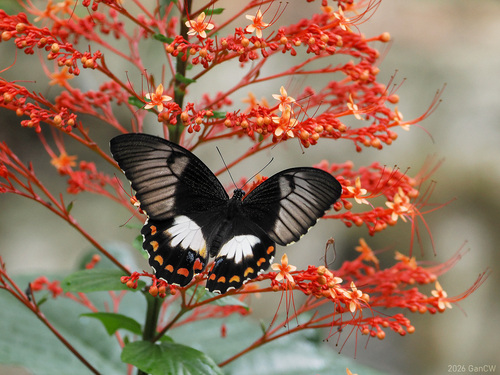
Orchard Swallowtail

Orchard Swallowtail

Papilio aegeus

(c) Cheongweei Gan, some rights reserved (CC BY), uploaded by Cheongweei Gan, CC BY 4.0, via iNaturalist

Common Mormon

Papilio polytes

Side by side

Orchard SwallowtailCommon Mormon
Scientific namePapilio aegeus Donovan, 1805Papilio polytes Linnaeus, 1758
English nameOrchard SwallowtailCommon Mormon
GroupInsectsInsects
ClassInsecta InsectInsecta Insect
OrderLepidopteraLepidoptera
FamilyPapilionidae Swallowtail ButterflyPapilionidae Swallowtail Butterfly
GenusPapilio SwallowtailsPapilio Swallowtails
Named in18051758
Countries on record6 countries22 countries
GBIF occurrence records15,454 records30,529 records

Rows where the two agree are shown in grey.

Where each is found

Both recorded in 3 countries

Only Orchard Swallowtail (3)

Only Common Mormon (19)

From Catalogue of Life checklists and GBIF occurrence records. A country missing from a list means no record is held, which is not proof of absence.

Checked facts

Orchard SwallowtailCommon Mormon
Appearance
  • Both sexes have black forewings marked with a white stripe, with females displaying more white. English Wikipedia
  • The hindwings are black with a white band across the middle. English Wikipedia
  • Female hindwings have marginal chains of red-to-orange and blue crescent markings. English Wikipedia
  • The underside of the wings has markings similar to those on the upper surface. English Wikipedia
  • Unlike many other swallowtails, this species lacks the distinctive tails on its hindwings. English Wikipedia
  • The pupa can be grey, green or brown, depending on the colour of the stem to which it is attached. English Wikipedia
  • Early larval instars are brown and have three white patches. English Wikipedia
  • Later larval instars are green with irregular white, yellow or brown diagonal markings. English Wikipedia
  • Female butterflies are polymorphic, with several forms that mimic other unpalatable butterfly species. animaldiversity.org
  • The pupa can be light green with yellow-green patches or light brown. animaldiversity.org
Size
  • Female individuals have a wingspan of approximately 140 millimetres. English Wikipedia
  • Male individuals have a wingspan of approximately 120 millimetres. English Wikipedia
No checked fact yet
Habitat
  • The species is commonly encountered in Brisbane where citrus trees provide food for its larvae. English Wikipedia
Diet
  • The larvae feed on citrus leaves. English Wikipedia
  • Larvae naturally use plants belonging to the genera Boronia, Citrus, Clausena, Dinosperma, Eriostemon, Flindersia, Geijera, Halfordia, Leionema, Micromelum, Philotheca, Zanthoxylum and Zieria as food plants. English Wikipedia
  • Larvae have also been recorded feeding on introduced plants belonging to Choisya, Citrus, Murraya, Poncirus and Zanthoxylum. English Wikipedia
  • Caterpillars accept leaves of parsley and Cryptocarya glauscens. English Wikipedia
  • Larvae feed on plants belonging to the family Rutaceae. English Wikipedia
  • Recorded larval food plants include bael, curry leaf, and several Citrus species. English Wikipedia
Behaviour
  • Larvae generally feed during daylight hours and rest on the upper surfaces of leaves at night. English Wikipedia
  • Resting larvae resemble fresh bird droppings. English Wikipedia
  • When disturbed, caterpillars extend a bright red osmeterium from behind the head to deter predators. English Wikipedia
  • The caterpillar's osmeterium releases a citrus-like smell when extended. English Wikipedia
  • Male butterflies patrol for females and also wait on branches or leaves for females to pass. animaldiversity.org
  • Male butterflies do not defend territories or gather in leks to attract mates. animaldiversity.org
  • Both sexes bask in sunlight on shrubs close to the ground with their wings held flat. English Wikipedia
  • Adult butterflies spend the night resting on vegetation with their wings open. English Wikipedia
  • The species exhibits Batesian mimicry, with edible females resembling toxic butterfly species. animaldiversity.org
Reproduction
  • Females lay creamy white, smooth, spherical eggs individually on the upper surfaces of host-plant leaves and shoots. English Wikipedia
  • The eggs have an approximate diameter of 0.5 millimetres. English Wikipedia
  • Eggs generally hatch approximately one week after being laid. English Wikipedia
  • The primary host plants used for egg laying belong to the Rutaceae family and include native and introduced citrus plants. English Wikipedia
  • After approximately four weeks, larvae may reach 60 millimetres in length and become ready to pupate. English Wikipedia
  • The pupa attaches to a host-plant stem using a cremaster. English Wikipedia
  • A thin silk girdle keeps the head end of the chrysalis uppermost during pupation. English Wikipedia
  • Adult butterflies emerge from the chrysalis approximately one to six months later, depending on the season. English Wikipedia
DistributionNo checked fact yet
Conservation
  • The larvae are sometimes regarded as pests because they feed on citrus leaves in suburban gardens. English Wikipedia
Other
  • Males of the subspecies Papilio aegeus aegeus have a red spot on the upper side of each hindwing, which is absent in males of Papilio aegeus ormenus. English Wikipedia
  • The caterpillar's osmeterium emerges when threatened and secretes chemicals that deter predators. animaldiversity.org

In brief

Orchard Swallowtail

The species occurs in eastern Australia and Papua New Guinea. Full profile

Common Mormon

Female butterflies have several forms that mimic other unpalatable butterfly species, exhibiting Batesian mimicry. Full profile

Compare something else

Page built on 27 November 2026 from the data on the two species pages, where every source is listed.

Cite this page

ScientificNames.org. (2026). Orchard Swallowtail vs Common Mormon. Retrieved November 27, 2026, from https://scientificnames.org/compare/orchard-swallowtail-vs-common-mormon