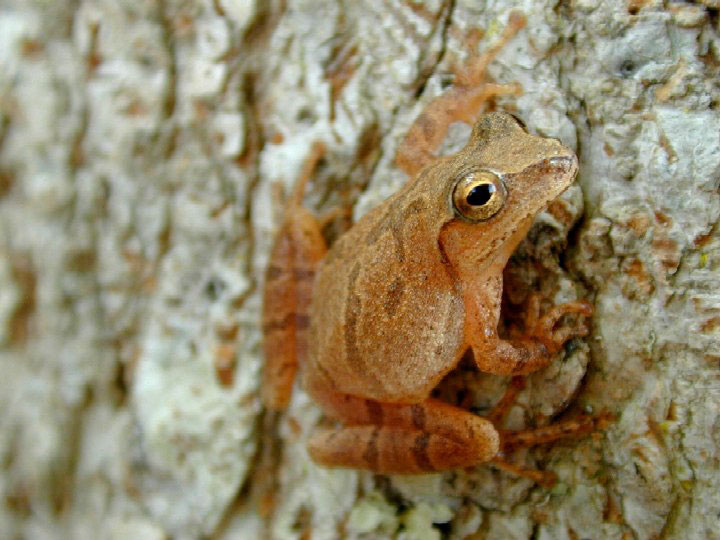
| Appearance | - The frog is typically reddish-brown or gray, although green and pinkish color forms also occur. English Wikipedia
- Its upper body usually has a broken longitudinal stripe or spots extending from the nose along the sides. English Wikipedia
- The upper lip has a distinct light-colored line. English Wikipedia
- Many individuals have a faint triangular marking on the top of the head. English Wikipedia
- The belly is pure white, and yellow spots are usually present in front of the hind legs. English Wikipedia
- The frog has a stout body and can be reddish brown, tan, grayish, or green. ncwildlife.gov
- A bold black stripe extends from each eye to the shoulder, accompanied by dark spots on the sides, lower back, and near the groin. ncwildlife.gov
- The groin and underside of each thigh have bright yellow spots. ncwildlife.gov
| - The spring peeper typically has pink, tan, light brown, or gray skin and an X-shaped marking on its back. mdc.mo.gov
- The species has a cream-colored belly, a dark line across its head, and dark bars on its legs. mdc.mo.gov
- Spring peepers have adhesive pads on their fingertips and toe tips. mdc.mo.gov
- Females are generally lighter-colored and have bulkier abdomens than males. English Wikipedia
- The skin coloration of spring peepers can change within 15 to 45 minutes in response to temperature and light. English Wikipedia
|
|---|
| Size | - Adults measure 25–38 mm in head-body length, with a recorded maximum size of 4 cm. English Wikipedia
| - Male spring peepers measure 18–30 mm in body length, while females measure 20–35 mm. English Wikipedia
|
|---|
| Habitat | - The species is most commonly found in the Southern Coastal Plain. English Wikipedia
- Its terrestrial habitats include pine stands, sandhills, and pine savannahs. English Wikipedia
- Woodland ponds, flooded fields, and roadside ditches can provide breeding habitat. English Wikipedia
- Breeding is especially common in ponds within sandhills, pine forests, and pine plantations. English Wikipedia
- Breeding sites commonly have open canopies and herbaceous vegetation. English Wikipedia
- Tadpole development requires seasonally flooded wetlands without fish for three to four months. English Wikipedia
- The species lives in pine stands and pine savannas in the southern Coastal Plain. ncwildlife.gov
| - Spring peepers inhabit marshy woodland and non-wooded lowlands near ponds and swamps. animaldiversity.org
- The species commonly inhabits forests and regenerating woodlands near temporary or semipermanent wetlands. English Wikipedia
- Spring peepers frequently breed in fishless ponds and temporary pools. mdc.mo.gov
- Spring peepers generally remain close to the ground or concealed in leaf litter despite their climbing ability. animaldiversity.org
|
|---|
| Diet | - The species is insectivorous and consumes small insects, insect larvae, worms, and other small invertebrates. English Wikipedia
| - Adult spring peepers eat small insects and spiders, including ants, beetles, and flies. animaldiversity.org
- Spring peeper tadpoles feed on algae, detritus, and microorganisms. animaldiversity.org
- Adult spring peepers forage among leaf litter and surface debris for small insects and spiders. mdc.mo.gov
|
|---|
| Behaviour | - Adults are nocturnal and are rarely observed outside the mating season. English Wikipedia
- Activity increases as temperatures decrease, when individuals begin migrating toward water for mating. English Wikipedia
- Most observations occur on winter nights during or after rainfall. English Wikipedia
- During spring and summer, individuals shelter in burrows, beneath logs, or under sandy soil. English Wikipedia
- Individuals sometimes produce mating calls while completely buried underground. English Wikipedia
- The species burrows using its forelimbs to move into the substrate. English Wikipedia
- Individuals prefer easily penetrated sandy soils for burrowing. English Wikipedia
- Individuals sometimes communicate through vocalizations while underground. English Wikipedia
- The species is primarily nocturnal and is seldom encountered outside its breeding season. ncwildlife.gov
- Its call is a shrill, bird-like peep that is faster, more metallic, and more monotonic than the call of a spring peeper. ncwildlife.gov
| - Male spring peepers produce clear, high-pitched calls that rise slightly in pitch at the end. mdc.mo.gov
- Male spring peepers repeat their calls approximately once per second. mdc.mo.gov
- Spring peeper choruses can resemble the sound of hundreds of small jingle bells. mdc.mo.gov
- Spring peepers are usually concealed during daylight and become active around dusk. mdc.mo.gov
- Spring peepers may become active during daylight when heavy rain persists. mdc.mo.gov
- Spring peepers generally migrate at night. English Wikipedia
- Male spring peepers establish small territories around breeding pools and compete through frequent calling. animaldiversity.org
- Females preferentially select larger males as mates. animaldiversity.org
- Some males use a satellite strategy, remaining near calling males without calling themselves to intercept females. English Wikipedia
|
|---|
| Reproduction | | - Spring peepers in northern regions generally breed between March and June. English Wikipedia
- Spring peepers in southern regions breed between October and March, depending on local temperature. English Wikipedia
- Female spring peepers typically lay approximately 900 eggs per clutch, although clutches can contain up to 1,000 eggs. English Wikipedia
- Female spring peepers deposit their eggs individually or in groups of two or three. English Wikipedia
- Spring peeper eggs are attached individually to dead leaves, grasses, or sticks in shallow water. mdc.mo.gov
- Spring peeper eggs generally hatch within 6–12 days. animaldiversity.org
- Spring peeper tadpoles typically undergo metamorphosis after 45–90 days. animaldiversity.org
- Spring peepers generally reach sexual maturity at two years of age. mdc.mo.gov
- Male spring peepers provide no parental care after fertilization. animaldiversity.org
|
|---|
| Distribution | - The species is endemic to the Southeastern United States. English Wikipedia
- Its documented range extends from North Carolina westward to the far eastern part of Louisiana and southward into northern Florida. English Wikipedia
- The species is restricted to the southeastern Coastal Plain. amphibiaweb.org
| No checked fact yet |
|---|
| Conservation | - The species is classified as Least Concern by the IUCN. English Wikipedia
- More than 36% of historical populations may have been extirpated or may be experiencing declines with low persistence probabilities. English Wikipedia
- Extirpated populations have been recorded in every state within the species' distribution, particularly near range margins. English Wikipedia
- Populations in protected areas or locations with high habitat suitability have greater probabilities of persistence. English Wikipedia
- Habitat loss and degradation are associated with declines in the species across many parts of its range. auth1.dpr.ncparks.gov
- The species is listed as endangered in North Carolina. ncwildlife.gov
- Destruction of temporary wetlands in longleaf pine ecosystems is contributing to population losses in North Carolina. ncwildlife.gov
- Collection or taking of the species in North Carolina requires a special permit issued by the Wildlife Commission's Executive Director. ncwildlife.gov
| - Spring peepers are listed as protected in New Jersey and threatened in Kansas. animaldiversity.org
- Spring peepers have become threatened in some states where wetland habitat has declined. mdc.mo.gov
- Spring peepers may help control populations of insects. animaldiversity.org
|
|---|
| Uses | No checked fact yet | |
|---|
| Similar species | No checked fact yet | - Spring peepers differ from some other Pseudacris species by lacking white lines on their lips. English Wikipedia
|
|---|