Comparison
Osedax japonicus vs Osedax roseus
Osedax japonicus (Osedax japonicus) and Osedax roseus (Osedax roseus) both belong to the genus Osedax (boneworms) and part ways below it. Both are recorded in 1 country.
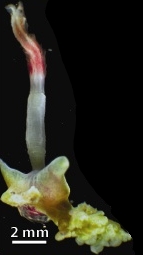
Osedax roseus
Robert C. Vrijenhoek, Shannon B. Johnson & Greg W. Rouse, CC BY 2.0, via Wikimedia Commons

Side by side
| Osedax japonicus | Osedax roseus | |
|---|---|---|
| Scientific name | Osedax japonicus Fujikura, Fujiwara & Kawato, 2006 | Osedax roseus Rouse, Worsaae, Johnson, Jones & Vrijenhoek, 2008 |
| Group | Other invertebrates | Other invertebrates |
| Class | Polychaeta | Polychaeta |
| Order | Sabellida | Sabellida |
| Family | Siboglinidae Beard Worms | Siboglinidae Beard Worms |
| Genus | Osedax Boneworms | Osedax Boneworms |
| Named in | 2006 | 2008 |
| Environment | marine | marine |
| Countries on record | 1 country | 2 countries |
| GBIF occurrence records | 42 records | 44 records |
Rows where the two agree are shown in grey.
Where each is found
Both recorded in 1 country
Only Osedax roseus (1)
From Catalogue of Life checklists and GBIF occurrence records. A country missing from a list means no record is held, which is not proof of absence.
Checked facts
| Osedax japonicus | Osedax roseus | |
|---|---|---|
| Appearance |
|
|
| Size |
| No checked fact yet |
| Habitat |
|
|
| Diet |
|
|
| Behaviour |
|
|
| Reproduction |
|
|
| Distribution |
|
|
In brief
Osedax japonicus
Osedax japonicus was recorded on a sperm whale carcass on the seabed at a depth of 200 metres off Kyushu, Japan. It obtains nutrients from whale bones through a branching root system containing symbiotic bacteria. Full profile
Osedax roseus
The species inhabits abyssal depths and is recorded from the northeastern Pacific Ocean. Females have a branching root-like network containing symbiotic bacteria, while microscopic males inhabit parchment-like tubes produced by females. Full profile
Compare something else
Page built on 29 November 2026 from the data on the two species pages, where every source is listed.
Cite this page
ScientificNames.org. (2026). Osedax japonicus vs Osedax roseus. Retrieved November 29, 2026, from https://scientificnames.org/compare/osedax-japonicus-vs-osedax-roseus
“Osedax japonicus vs Osedax roseus.” ScientificNames.org, 2026, scientificnames.org/compare/osedax-japonicus-vs-osedax-roseus. Accessed 29 Nov. 2026.
ScientificNames.org. “Osedax japonicus vs Osedax roseus.” Accessed November 29, 2026. https://scientificnames.org/compare/osedax-japonicus-vs-osedax-roseus.
@misc{scientificnames_osedax_japonicus_vs_osedax_roseus,
  author = {{ScientificNames.org}},
  title = {Osedax japonicus vs Osedax roseus},
  year = {2026},
  url = {https://scientificnames.org/compare/osedax-japonicus-vs-osedax-roseus},
  note = {Accessed 2026-11-29}
}