Species · Other invertebrates
Osedax japonicus
Osedax japonicus has no English name on record in the checklists used here. It is a species of animal in the family Siboglinidae (beard worms), order Sabellida. The name dates from 2006.
- Scientific name
- Osedax japonicus Fujikura, Fujiwara & Kawato, 2006
- Genus
- Osedax
- Family
- Siboglinidae (Beard Worms)
- Order
- Sabellida
- Class
- Polychaeta
- Environment
- marine
- Recorded in
- 1 country
- Name status
- accepted in the Catalogue of Life
Overview
Osedax japonicus was recorded on a sperm whale carcass on the seabed at a depth of 200 metres off Kyushu, Japan. It obtains nutrients from whale bones through a branching root system containing symbiotic bacteria.
Written 26 November 2026 from the sources listed below. Each statement was checked against the passage it cites; statements that could not be supported were removed.
Appearance
Adults have a ring-shaped crown of feathery plumes used for respiration, a trunk and a rooting structure containing symbiotic bacteria. The species lacks a digestive system and a segmented body structure.[1][2]
Males are minute compared with females.[3]
Habitat
The species was recorded on a sperm whale carcass that settled on the seabed at a depth of 200 metres off Kyushu, Japan.[4]
Diet
Osedax japonicus obtains nutrients from whale bones through a branching root system containing symbiotic bacteria. It has also been reported growing on tainted spermaceti, a waxy substance from the head of a sperm whale.[5][6]
Behaviour
The species uses branching roots containing symbiotic bacteria to extract nutrients from bones.[7]
Reproduction and life cycle
Female worms reach reproductive maturity at approximately six weeks of age. Males inhabit mucus tubes secreted by females around their trunks.[8][9]
Females retain their eggs in mucus, where fertilisation by males occurs. Embryos develop in the mucus before emerging as trochophore larvae.[10][11]
The larvae are planktonic and can survive for at least ten days in the open sea. Larvae settling on suitable vertebrate bones may develop into females, whereas larvae settling on bones already occupied by mature females may develop into males.[12][13]
Classification of Osedax japonicus
| Kingdom | Animalia |
|---|---|
| Phylum | Annelida |
| Class | Polychaeta |
| Subclass | Sedentaria |
| Infraclass | Canalipalpata |
| Order | Sabellida |
| Family | Siboglinidae (Beard Worms) |
| Genus | Osedax (Boneworms) |
| Species | Osedax japonicus Fujikura, Fujiwara & Kawato, 2006 |
Where Osedax japonicus is found
Checklists and occurrence records place Osedax japonicus in 1 country. GBIF holds 42 georeferenced records of it.
Countries
Regions and cities with the most records
- Gohyakkoku, Japan 19
- Kamiichi, Japan 19
- Kurobe-shi, Japan 19
- Namerikawa, Japan 19
- Nyūzen, Japan 19
- Toyama, Japan 19
- Uozu, Japan 19
A number beside a place is its count of GBIF occurrence records. A place without a number comes from a checklist alone. Records show where a species has been observed or collected, which can include escapes and vagrants.
Common names
Names in 1 other language
- Japanese
- ホネクイハナムシ
Related species
- Bone-eating Snot Flower WormOsedax mucofloris
-
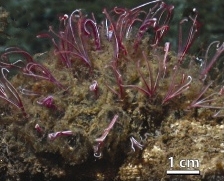 Osedax frankpressi
- Osedax priapus
-
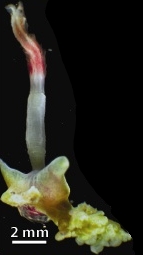 Osedax roseus
-
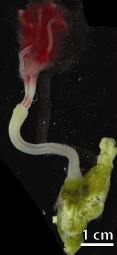 Osedax rubiplumus
-
 Osedax deceptionensis
- Osedax antarcticus
- Osedax braziliensis
Compare
Questions and answers
What do Osedax eat?
Osedax obtain nutrients from whale bones through branching roots containing symbiotic bacteria. Osedax japonicus has also been reported growing on tainted spermaceti, a waxy substance from the head of a sperm whale.[5][6]
What kind of worms eat whale bones?
Osedax japonicus obtains nutrients from whale bones using a branching root system containing symbiotic bacteria.[5][7]
Where do Osedax worms live?
Osedax japonicus was recorded on a sperm whale carcass that settled on the seabed at a depth of 200 metres off Kyushu, Japan.[4][14]
How do osedax worms reproduce?
Females retain their eggs in mucus, where fertilisation by males occurs. Embryos develop in the mucus before emerging as planktonic trochophore larvae. Larvae settling on suitable vertebrate bones may develop into females, while those settling on bones already occupied by mature females may develop into males.[10][11][12][13]
Sources
Passages the profile rests on
- Adults have a ring-shaped crown of feathery plumes used for respiration, a trunk, and a rooting structure containing symbiotic bacteria. Source passage: “An adult worm has a ringlike crown of feathery plumes which are involved in respiration, a trunk and a rooting structure which contains symbiotic bacteria.” — English Wikipedia
- The species lacks a digestive system and a segmented body structure. Source passage: “It has no digestive system nor a segmental structure as do most worms.” — English Wikipedia
- Males are minute compared with females. Source passage: “Male worms are minute by comparison with the females” — English Wikipedia
- The species was recorded on a sperm whale carcass that settled on the seabed at a depth of 200 metres off Kyushu, Japan. Source passage: “Osedax japonicus was first described in 2006 from a sperm whale carcase that fell to the seabed off Kyushu, Japan, settling at a depth of 200 m (656 ft).” — English Wikipedia
- The species obtains nutrients from whale bones through a branching root system containing symbiotic bacteria. Source passage: “The worms produce a branching network of "roots" that house symbiotic bacteria, which enable the worms to utilise the bones' nutrient content.” — English Wikipedia
- The species has also been reported growing on tainted spermaceti, a waxy substance from the head of a sperm whale. Source passage: “Fujikura et al. (2006) reported that Osedax japonicus also grew on ‘tainted spermaceti’, a waxy substance found in the head of a sperm whale.” — pmc.ncbi.nlm.nih.gov
- The species uses branching roots that contain symbiotic bacteria to extract nutrients from bones. Source passage: “The worms produce a branching network of "roots" that house symbiotic bacteria, which enable the worms to utilise the bones' nutrient content.” — English Wikipedia
- Female worms reach reproductive maturity at approximately six weeks of age. Source passage: “Female worms reach maturity at about six weeks.” — English Wikipedia
- Males inhabit mucus tubes secreted by females around their trunks. Source passage: “They secrete mucus to form a tube that surrounds their trunk. Male worms are minute by comparison with the females and they take up residence inside the tubes.” — English Wikipedia
- Females retain their eggs in mucus, where fertilisation by males occurs. Source passage: “The females spawn eggs and retain them in the mucus where they are fertilised by the males.” — English Wikipedia
- Embryos develop in the mucus before emerging as trochophore larvae. Source passage: “Here they develop for a time before they swim out of the mucus as trochophore larvae.” — English Wikipedia
- The larvae are planktonic and can survive for at least ten days in the open sea. Source passage: “The larvae are then planktonic and can live for at least ten days in the open sea.” — English Wikipedia
- Larvae settling on suitable vertebrate bones may develop into females, whereas larvae settling on bones already occupied by mature females may develop into males. Source passage: “It seems that if they settle on a suitable vertebrate bone they will develop into female worms but if mature females are already present on the bone, they will develop into males.” — English Wikipedia
- The species was first described from a sperm whale carcass off Kyushu, Japan. Source passage: “Osedax japonicus was first described in 2006 from a sperm whale carcase that fell to the seabed off Kyushu, Japan” — English Wikipedia
Data
- Catalogue of Life, 2026-10-16 XR cc by
- Global Biodiversity Information Facility CC BY 4.0
- Wikidata CC0
- GeoNames CC BY 4.0
- Within the Catalogue of Life, this name comes from World Register of Marine Species cc by
References
- Fujikura, K., Fujiwara, Y., & Kawato, M. (2006). A new species of Osedax (Annelida: Siboglinidae) associated with whale carcasses off Kyushu, Japan. Zoological Science, 23. https://doi.org/10.2108/zsj.23.733 Link where the name was published
This species in other databases
- Catalogue of Life 6SZ84
- Wikidata Q3155476
- iNaturalist 1141706
- WoRMS urn:lsid:marinespecies.org:taxname:390051
Page built on 27 November 2026. See how the catalog is made and all sources and licences.
Cite this page
ScientificNames.org. (2026). Osedax japonicus. Retrieved November 27, 2026, from https://scientificnames.org/species/osedax-japonicus
“Osedax japonicus.” ScientificNames.org, 2026, scientificnames.org/species/osedax-japonicus. Accessed 27 Nov. 2026.
ScientificNames.org. “Osedax japonicus.” Accessed November 27, 2026. https://scientificnames.org/species/osedax-japonicus.
@misc{scientificnames_osedax_japonicus,
  author = {{ScientificNames.org}},
  title = {Osedax japonicus},
  year = {2026},
  url = {https://scientificnames.org/species/osedax-japonicus},
  note = {Accessed 2026-11-27}
}