Comparison

Otis cafra vs Australian Bustard

Otis cafra (Otis cafra) and Australian Bustard (Ardeotis australis) both belong to the family Otididae (bustard) and part ways below it.
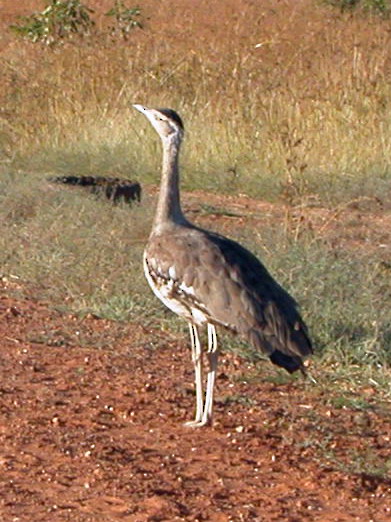
Australian Bustard

Australian Bustard

Ardeotis australis

Glen Fergus, CC BY-SA 2.5, via Wikimedia Commons

Side by side

Otis cafraAustralian Bustard
Scientific nameOtis cafraArdeotis australis (J. E. Gray, 1829)
English nameNot recordedAustralian Bustard
GroupBirdsBirds
ClassAves BirdAves Bird
OrderOtidiformes BustardsOtidiformes Bustards
FamilyOtididae BustardOtididae Bustard
GenusOtis Great BustardsArdeotis Large Bustards
Named inNot recorded1829
Red List categoryNot recordedLeast Concern
EnvironmentterrestrialNot recorded
Countries on recordNot recorded2 countries
GBIF occurrence recordsNot recorded41,206 records

Rows where the two agree are shown in grey.

Where each is found

Only Australian Bustard (2)

From Catalogue of Life checklists and GBIF occurrence records. A country missing from a list means no record is held, which is not proof of absence.

Checked facts

Otis cafraAustralian Bustard
AppearanceNo checked fact yet
  • The Australian bustard has a black crown and nape, a pale grey front to its long neck, and brown plumage on its wings and upper body. English Wikipedia
  • The species has a white abdomen separated from its grey neck by a black feather band. English Wikipedia
  • Its wing coverts have irregular black-and-white markings visible both at rest and in flight. English Wikipedia
  • The Australian bustard has a white iris and a bill ranging from whitish to brown. English Wikipedia
  • Its long legs are yellow to cream in colour. English Wikipedia
  • Females resemble males in coloration but are smaller in stature, wingspan and weight. English Wikipedia
  • The Australian bustard is a large terrestrial bird with a form resembling an American turkey. English Wikipedia
SizeNo checked fact yet
  • Male Australian bustards can reach 1.2 metres in height and have wingspans of up to 2.3 metres. English Wikipedia
  • Male body mass averages 6.3 kilograms, with a recorded range of 4.3 to 12.76 kilograms. English Wikipedia
  • Females reach approximately 80 centimetres in height and have wingspans of about 1.8 metres. English Wikipedia
  • Female body mass averages 3.2 kilograms, with a recorded range of 2.4 to 6.35 kilograms. English Wikipedia
  • The largest recorded male Australian bustard weighed 14.5 kilograms and was obtained in Victoria. English Wikipedia
  • The Australian bustard is the largest extant flying land bird in Australia. English Wikipedia
HabitatNo checked fact yet
  • The species inhabits open grasslands, including areas with scattered trees. English Wikipedia
  • Spinifex plains and low shrublands are favoured habitats of the Australian bustard. English Wikipedia
  • Australian bustards enter denser vegetation following fires. English Wikipedia
  • The species also uses artificial clearings such as golf courses and farmland. English Wikipedia
  • The species avoids forests and densely vegetated areas. English Wikipedia
  • The species occurs in savanna, shrubland, grassland, inland wetlands and artificial terrestrial habitats. iucnredlist.org
DietNo checked fact yet
  • The Australian bustard is omnivorous and primarily consumes plant fruits and seeds. English Wikipedia
  • Its plant diet includes shoots, roots, leaves, flowerheads, seeds and fruits. English Wikipedia
  • Grasshoppers, beetles and caterpillars are among the insects eaten by the species. English Wikipedia
  • The Australian bustard eats lizards, young birds and small rodents. English Wikipedia
  • The species is strongly attracted to the fruits of Capparis nummularia, known as myandee or moonflower in northwestern Australia. English Wikipedia
BehaviourNo checked fact yet
  • Australian bustards are predominantly terrestrial and usually walk slowly alone or in pairs. English Wikipedia
  • When disturbed, Australian bustards may hold their necks erect and point their bills skywards as camouflage. English Wikipedia
  • When alarmed, the species may walk away gradually or run, generally taking flight only as a last resort. English Wikipedia
  • Australian bustards can travel long distances despite the apparent effort required for flight. English Wikipedia
  • The species is nomadic and moves to locations where food becomes plentiful. English Wikipedia
  • Australian bustards roost at elevated locations on open plains or in trees when available. English Wikipedia
  • Male Australian bustards perform conspicuous breeding displays accompanied by loud booming calls. English Wikipedia
  • Displaying males expand a neck sac and spread their feathers into a swaying skirt while holding their wings downward and arching their tails over their backs. English Wikipedia
  • Courting males produce a call transliterated as 'who-o-o-o'. English Wikipedia
ReproductionNo checked fact yet
  • The Australian bustard does not construct a nest. English Wikipedia
  • Females usually lay one egg per clutch, although clutches of two eggs sometimes occur. English Wikipedia
  • Eggs are laid on bare ground near a small shrub or bush. English Wikipedia
  • Australian bustard eggs measure approximately 75 by 55 millimetres. English Wikipedia
  • Female Australian bustards are responsible for incubating the eggs. English Wikipedia
  • Newly hatched chicks leave the hatching site to reduce their risk of predation. English Wikipedia
DistributionNo checked fact yet
  • The Australian bustard occurs across a wide area of the Australian continent. English Wikipedia
  • Its distribution occasionally extends into southern Papua New Guinea and Indonesia. English Wikipedia
  • The species remains relatively common and widespread across most of northern Australia. English Wikipedia
  • The species' range has contracted in southeastern Australia. English Wikipedia
  • Local populations in wetter regions are more permanent and geographically restricted than populations in more arid regions. English Wikipedia
ConservationNo checked fact yet
  • The IUCN assessed the Australian bustard as Least Concern in 2024. English Wikipedia
  • The IUCN assessment recorded a declining population trajectory for the species in 2024. English Wikipedia
  • The global population of Australian bustards is estimated to exceed 10,000 individuals but not to exceed 100,000. English Wikipedia
  • The species is classified as near threatened in Western Australia and the Northern Territory. English Wikipedia
  • The Australian bustard is classified as endangered in South Australia and New South Wales. English Wikipedia
  • The species is classified as critically endangered on Victoria's 2007 advisory list of threatened vertebrate fauna, with the same advice retained in 2016. English Wikipedia
  • The Australian bustard is classified as Least Concern in Queensland. English Wikipedia
  • The species is not listed as threatened under Australia's Environment Protection and Biodiversity Conservation Act 1999. English Wikipedia
  • The IUCN assessment identifies invasive non-native species and diseases among the threats relevant to the species. iucnredlist.org
  • The IUCN assessment records continuing decline in the extent or quality of the species' habitat. iucnredlist.org
UsesNo checked fact yet
  • Aboriginal people in Central Australia use the Australian bustard as an important food source. English Wikipedia
  • The species' white feathers are used for ceremonial purposes. English Wikipedia
  • Australian bustards have historically been hunted and shot for food. australian.museum
OtherNo checked fact yet
  • The Australian bustard is also known as the plains turkey and bush turkey. English Wikipedia

In brief

Australian Bustard

The Australian Bustard (Ardeotis australis) is a large terrestrial bird in the family Otididae and order Otidiformes. It occurs across a wide area of the Australian continent, primarily inhabiting open grasslands, spinifex plains and low shrublands. It is distinguished by a black crown and nape, a long grey neck, brown upper plumage, a white abdomen and long yellow to cream legs. Full profile

Compare something else

Page built on 27 November 2026 from the data on the two species pages, where every source is listed.

Cite this page

ScientificNames.org. (2026). Otis cafra vs Australian Bustard. Retrieved November 27, 2026, from https://scientificnames.org/compare/otis-cafra-vs-australian-bustard