Comparison
Inland Taipan vs Common Krait
Inland Taipan (Oxyuranus microlepidotus) and Common Krait (Bungarus caeruleus) both belong to the family Elapidae (cobras) and part ways below it.



How they differ
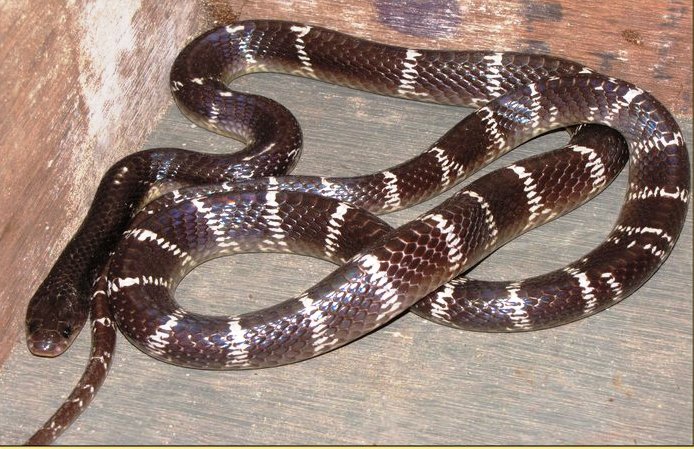
The inland taipan has a seasonally changing colour ranging from dark brown to brownish light green, while the common krait generally has a black or bluish-black body with narrow white crossbands. The inland taipan generally attempts to escape when threatened and raises its anterior body into a low, tight S-shaped curve when cornered, while the common krait may coil tightly with its head tucked underneath. The inland taipan feeds almost exclusively on small to medium-sized mammals in the wild, while the common krait feeds primarily on other snakes and also consumes small rodents, lizards, birds and frogs. The inland taipan is endemic to semiarid regions of central-eastern Australia, while the common krait occurs in India, Pakistan, Bangladesh, Sri Lanka and Nepal.
| Inland Taipan | Common Krait | |
|---|---|---|
| Appearance | The inland taipan has varying shades of brown and grey on its back, flanks and tail, with broad blackish margins on many dorsal scales forming broken, backward-sloping chevron-like markings. | The common krait generally has a black or bluish-black body with approximately 40 thin white crossbars. |
| Scale arrangement | The inland taipan has 23 rows of dorsal scales at midbody, and its dorsal scales are smooth and lack keels. | The common krait has highly polished scales arranged in 15–17 rows, with an enlarged hexagonal vertebral row. |
| Threat response | The inland taipan usually attempts to escape when threatened and raises its anterior body into a low, tight S-shaped curve when cornered or prevented from escaping. | The common krait generally avoids confrontation, is non-aggressive and may coil tightly with its head tucked underneath when threatened. |
| Diet | The inland taipan feeds almost exclusively on small to medium-sized mammals in the wild, including long-haired rats, plains rats and the introduced house mouse. | The common krait feeds primarily on other snakes, including venomous kraits and vipers, and also consumes small rodents, lizards, birds and frogs. |
| Distribution | The inland taipan is endemic to semiarid regions of central-eastern Australia, with recorded Queensland localities including Diamantina National Park, Durrie Station, Morney Plains Station and Astrebla Downs National Park. | The common krait occurs in India, Pakistan, Bangladesh, Sri Lanka and Nepal, with a reported western range extending to Afghanistan and potentially parts of Iran. |
| Conservation | The inland taipan was assessed as Least Concern on the IUCN Red List in 2018 and is legally protected in Australia. | The common krait is reported to have a stable population despite localized habitat fragmentation and persecution. |
Written from the checked facts listed further down. Statements that the sources did not support were removed.
Side by side
| Inland Taipan | Common Krait | |
|---|---|---|
| Scientific name | Oxyuranus microlepidotus (Mccoy, 1879) | Bungarus caeruleus (Schneider, 1801) |
| English name | Inland Taipan | Common Krait |
| Group | Reptiles | Reptiles |
| Class | Reptilia Reptile | Reptilia Reptile |
| Order | Squamata Snakes | Squamata Snakes |
| Family | Elapidae Cobras | Elapidae Cobras |
| Genus | Oxyuranus Taipan | Bungarus Deathpickers |
| Named in | 1879 | 1801 |
| Red List category | Least Concern | Least Concern |
| Countries on record | 1 country | 8 countries |
| GBIF occurrence records | 275 records | 1,003 records |
Rows where the two agree are shown in grey.
Where each is found
Only Inland Taipan (1)
Only Common Krait (8)
From Catalogue of Life checklists and GBIF occurrence records. A country missing from a list means no record is held, which is not proof of absence.
Checked facts
| Inland Taipan | Common Krait | |
|---|---|---|
| Appearance |
|
|
| Size |
|
|
| Habitat |
|
|
| Diet |
|
|
| Behaviour |
|
|
| Reproduction |
|
|
| Distribution |
|
|
| Conservation |
|
|
| Other | No checked fact yet |
|
In brief
Inland Taipan
Oxyuranus microlepidotus inhabits semiarid regions of central-eastern Australia, including cracking-clay plains near the Queensland–South Australia border. It is a dietary specialist that feeds almost exclusively on small to medium-sized mammals in the wild. Full profile
Common Krait
The Common Krait (Bungarus caeruleus) is a highly venomous snake in the family Elapidae, order Squamata and class Reptilia. It occurs in India, Pakistan, Bangladesh, Sri Lanka and Nepal, with a reported western extent including Afghanistan and potentially parts of Iran. It is predominantly nocturnal and feeds primarily on other snakes, including venomous kraits and vipers. Full profile
Compare something else
Page built on 24 November 2026 from the data on the two species pages, where every source is listed.
Cite this page
ScientificNames.org. (2026). Inland Taipan vs Common Krait. Retrieved November 24, 2026, from https://scientificnames.org/compare/inland-taipan-vs-common-krait
“Inland Taipan vs Common Krait.” ScientificNames.org, 2026, scientificnames.org/compare/inland-taipan-vs-common-krait. Accessed 24 Nov. 2026.
ScientificNames.org. “Inland Taipan vs Common Krait.” Accessed November 24, 2026. https://scientificnames.org/compare/inland-taipan-vs-common-krait.
@misc{scientificnames_inland_taipan_vs_common_krait,
  author = {{ScientificNames.org}},
  title = {Inland Taipan vs Common Krait},
  year = {2026},
  url = {https://scientificnames.org/compare/inland-taipan-vs-common-krait},
  note = {Accessed 2026-11-24}
}