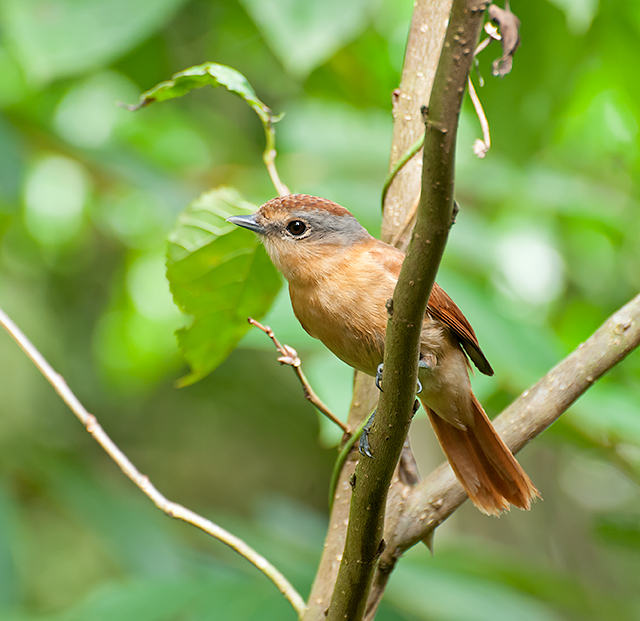
| Appearance | - The species has a somewhat shaggy crown without an obvious raised crest. English Wikipedia
- The species exhibits sexual dimorphism. English Wikipedia
- Adult males of the nominate subspecies have predominantly dark grayish to nearly black upperparts, wings, and tail. English Wikipedia
- Adult males of the nominate subspecies have a partially concealed white patch on their backs. English Wikipedia
- Adult females of the nominate subspecies have a bright rufous nape and predominantly rufous upperparts and tail. English Wikipedia
- Adult females of the nominate subspecies have yellowish cinnamon throats and dull buffy cinnamon underparts. English Wikipedia
- Both sexes have dark brown irises, black upper bills, medium gray lower bills, and dark gray legs and feet. English Wikipedia
- The species is described as a large and robust becard. ebird.org
| - Adult nominate-subspecies individuals have a dark chestnut-rufous crown with a scaly appearance. English Wikipedia
- The nominate subspecies has mostly cinnamon-rufous upperparts. English Wikipedia
- The nominate subspecies has pale cinnamon-buff underparts, with a paler throat. English Wikipedia
- Both sexes have the same plumage. English Wikipedia
- All subspecies have dark irises, blackish bills, and dusky legs and feet. English Wikipedia
|
|---|
| Size | | |
|---|
| Habitat | - The species inhabits semi-arid to semi-humid woodlands and montane forests. English Wikipedia
- The species favors forest canopies, forest edges, and wet ravines. English Wikipedia
- In Brazil, the species occurs from sea level to elevations of 2,000 m. English Wikipedia
- In Peru, the species occurs at elevations between 1,700 and 3,400 m. English Wikipedia
- The species is associated with humid and montane forest canopies and edges. ebird.org
| - In the Amazon Basin, the species inhabits humid terra firme and várzea lowland forests. English Wikipedia
- The species favors forest edges and clearings containing tall trees. English Wikipedia
- The species also inhabits riparian forests, secondary woodland, and coffee plantations in the Amazon Basin. English Wikipedia
- The species occurs from sea level to 1,000 m elevation and locally higher in Brazil. English Wikipedia
- In Venezuela, the species occurs locally at elevations up to 1,700 m. English Wikipedia
|
|---|
| Diet | | |
|---|
| Behaviour | | - The species is a year-round resident. English Wikipedia
- The species typically forages in pairs but sometimes feeds alone. English Wikipedia
- The species usually does not participate in mixed-species feeding flocks. English Wikipedia
- The species forages mostly in the upper levels of forests. English Wikipedia
- The species obtains food by gleaning while perched and making short sallies from perches, sometimes hovering briefly. English Wikipedia
|
|---|
| Reproduction | - The breeding season has not been fully established, although it includes November through January in Argentina. English Wikipedia
- The species builds a bulky spherical nest with an entrance on the side or near the bottom. English Wikipedia
- The nest is constructed from dead leaves and plant fibers. English Wikipedia
- The nest usually hangs from the end of a branch. English Wikipedia
- The species lays a clutch of four eggs. English Wikipedia
| - The breeding season varies geographically, with records in May in Colombia, March and July in Ecuador, and October and February in Argentina. English Wikipedia
- The species builds a messy, globe-shaped nest with a downward-facing entrance at the bottom. English Wikipedia
- The nest is constructed from grass and plant fibers. English Wikipedia
- The nest is usually wedged into a branch fork between the forest's middle story and canopy. English Wikipedia
|
|---|
| Distribution | - The species occurs in Argentina, Bolivia, Brazil, Paraguay, and Peru. English Wikipedia
- The nominate subspecies occurs in Brazil south and east of a line running approximately from Rondônia through Tocantins to northeastern Pará. English Wikipedia
- The nominate subspecies extends south through Brazil to northern Rio Grande do Sul. English Wikipedia
- The nominate subspecies also occurs in eastern Bolivia, Paraguay, and northeastern Argentina as far as Santa Fe Province. English Wikipedia
- The subspecies P. v. audax occurs in the Peruvian departments of Junín, Ayacucho, and Cuzco. English Wikipedia
- The range of P. v. audax extends through northwestern, central, and southern Bolivia. English Wikipedia
- The range of P. v. audax reaches northwestern Argentina as far south as Córdoba Province. English Wikipedia
- The nominate subspecies occurs as a rare austral migrant in extreme southeastern Peru. English Wikipedia
- An unconfirmed record from extreme southern Ecuador has been tentatively assigned to P. v. audax. English Wikipedia
| - The species has a disjunct geographical distribution. English Wikipedia
- The species occurs in Argentina, Bolivia, Brazil, Colombia, Ecuador, Peru, Paraguay, and Venezuela. English Wikipedia
- Subspecies P. c. saturatus occurs from southeastern Colombia through eastern Ecuador and eastern Peru into northern Bolivia. English Wikipedia
- Subspecies P. c. saturatus also occurs in western Brazil as far east as the Manaus region and Purus River. English Wikipedia
- Subspecies P. c. intermedius occurs in northern Venezuela, including Lara, Falcón, Yaracuy, Anzoátegui, Sucre, and Monagas. English Wikipedia
- Subspecies P. c. parui is restricted to Cerro Parú in southern Venezuela's Amazonas state. English Wikipedia
- Subspecies P. c. amazonus occurs along the Amazon River in Brazil, from eastern Amazonas to the Tocantins River and Maranhão state. English Wikipedia
- The nominate subspecies occurs in eastern and southeastern Brazil, southeastern Paraguay, and northeastern Argentina's Misiones Province. English Wikipedia
|
|---|
| Conservation | | |
|---|
| Similar species | No checked fact yet | - The chestnut-crowned becard and the cinnamon becard (Pachyramphus cinnamomeus) are sister species that form a superspecies. English Wikipedia
|
|---|
| Other | - A published study reports the first documented case of bill deformity in this species. academia.edu
- The reported frequency of bill deformities among wild birds is less than 0.5%. academia.edu
| No checked fact yet |
|---|