Species · Birds
Chestnut-crowned Becard Pachyramphus castaneus
The scientific name of the Chestnut-crowned Becard is Pachyramphus castaneus. It is a species of bird in the family Tityridae (becards), order Passeriformes. The name dates from 1827.
- Scientific name
- Pachyramphus castaneus (Jardine & Selby, 1827)
- Common name
- Chestnut-crowned Becard
- Genus
- Pachyramphus
- Family
- Tityridae (Becards)
- Order
- Passeriformes
- Class
- Aves
- Red List category
- LC Least Concern
- Recorded in
- 8 countries
- Name status
- accepted in the Catalogue of Life
Overview
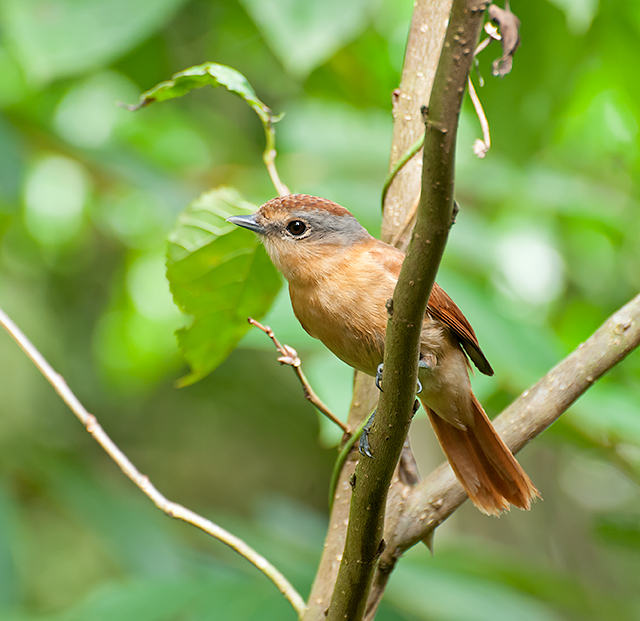
The Chestnut-crowned Becard is a bird species measuring approximately 14–15 cm in length. It inhabits humid terra firme and várzea lowland forests in the Amazon Basin. Adults of the nominate subspecies have a dark chestnut-rufous crown with a scaly appearance and mostly cinnamon-rufous upperparts.
Written 26 November 2026 from the sources listed below. Each statement was checked against the passage it cites; statements that could not be supported were removed.
Appearance
Adults of the nominate subspecies have a dark chestnut-rufous crown with a scaly appearance and mostly cinnamon-rufous upperparts. Their underparts are pale cinnamon-buff, with a paler throat.[1][2][3]
Both sexes have the same plumage. All subspecies have dark irises, blackish bills, and dusky legs and feet.[4][5]
The species measures approximately 14–15 cm in length and weighs approximately 17 g.[6][7]
Habitat
In the Amazon Basin, the species inhabits humid terra firme and várzea lowland forests. It favors forest edges and clearings containing tall trees.[8][9]
It also inhabits riparian forests, secondary woodland, and coffee plantations in the Amazon Basin.[10]
In Brazil, it occurs from sea level to 1,000 m elevation and locally higher. In Venezuela, it occurs locally at elevations up to 1,700 m.[11][12]
Diet
The species feeds on large insects, including caterpillars. It occasionally includes berries in its diet.[13][14]
Behaviour
The Chestnut-crowned Becard is a year-round resident. It typically forages in pairs but sometimes feeds alone.[15][16]
It usually does not participate in mixed-species feeding flocks and forages mostly in the upper levels of forests.[17][18]
The species obtains food by gleaning while perched and making short sallies from perches, sometimes hovering briefly.[19]
Reproduction and life cycle
The breeding season varies geographically, with records in May in Colombia, March and July in Ecuador, and October and February in Argentina.[20]
The species builds a messy, globe-shaped nest with a downward-facing entrance at the bottom. The nest is constructed from grass and plant fibers.[21][22]
The nest is usually wedged into a branch fork between the forest's middle story and canopy.[23]
Conservation
The species is classified as Least Concern by the IUCN and has an extremely large geographical range. Its population size is unknown and is believed to be decreasing.[24][25][26]
No immediate threats to the species have been identified. It occurs in numerous public and private protected areas throughout its range.[27][28]
The species has a medium dependency on forest.[29]
Similar species
The Chestnut-crowned Becard and the cinnamon becard (Pachyramphus cinnamomeus) are sister species that form a superspecies.[30]
Classification of the Chestnut-crowned Becard
| Kingdom | Animalia |
|---|---|
| Phylum | Chordata |
| Subphylum | Vertebrata |
| Infraphylum | Gnathostomata |
| Parvphylum | Osteichthyes |
| Megaclass | Tetrapoda |
| Class | Aves (Bird) |
| Order | Passeriformes (Passerine) |
| Family | Tityridae (Becards) |
| Genus | Pachyramphus (Becard) |
| Species | Pachyramphus castaneus (Jardine & Selby, 1827) |
Where the Chestnut-crowned Becard is found
Checklists and occurrence records place Pachyramphus castaneus in 8 countries across South America. GBIF holds 30,832 georeferenced records of it.
Countries
- Argentina 948
- Bolivia 178
- Brazil 24,462
- Colombia 977
- Ecuador 825
- Paraguay 130
- Peru 980
- Venezuela 2,332
Regions and cities with the most records
- São Paulo, Brazil 10,192
- Rio de Janeiro, Brazil 5,496
- Santa Catarina, Brazil 1,739
- Espírito Santo, Brazil 1,640
- Minas Gerais, Brazil 1,534
- Itatiaia, Brazil 1,377
- Guapiara, Brazil 1,366
- Paraná, Brazil 1,305
- Resende, Brazil 1,288
- Cachoeiras de Macacu, Brazil 1,003
- São Pedro, Brazil 989
- Teresópolis, Brazil 986
- Nova Friburgo, Brazil 941
- Ubatuba, Brazil 939
- Misiones, Argentina 889
- Embu-Guaçu, Brazil 788
- El Hatillo, Venezuela 761
- Guapimirim, Brazil 761
- Chacao, Venezuela 755
- Los Dos Caminos, Venezuela 752
- Baruta, Venezuela 745
- Caracas, Venezuela 744
- Juquitiba, Brazil 728
- Bahia, Brazil 709
- Petrópolis, Brazil 709
- Petare, Venezuela 700
- San Antonio de Los Altos, Venezuela 693
- Paraty, Brazil 644
- Salesópolis, Brazil 620
- Caucagüito, Venezuela 616
- Miranda, Venezuela 597
- São Lourenço da Serra, Brazil 584
- Campos do Jordão, Brazil 554
- Itapecerica da Serra, Brazil 522
- Pará, Brazil 480
- Amazonas, Brazil 455
Range as the checklists state it
South America
A number beside a place is its count of GBIF occurrence records. A place without a number comes from a checklist alone. Records show where a species has been observed or collected, which can include escapes and vagrants.
Common names
English
- Chestnut-crowned Becard
Names in 24 other languages
- Catalan
- anambé castany
- Chinese
- 栗頂比卡雀, 栗顶厚嘴霸鹟
- Croatian
- kestenjastokapi satir
- Czech
- tityra šedotýlá
- Danish
- Gråbåndet Bekard
- Dutch
- Kastanjebekarde
- Esperanto
- kaŝankrona titiro
- Finnish
- harmaakulmabekardi, harmaakulmatyranni
- French
- Bécarde à calotte rousse
- German
- Graunackenbekarde, Kastanienbekarde
- Italian
- Beccaio capocastano
- Japanese
- ハチマキカザリドリモドキ
- Lithuanian
- kaštoninis bekardas
- Norwegian
- kransbekard
- Polish
- bekardzik rdzawy
- Portuguese
- Caneleiro, caneleiro-castanho
- Russian
- Каштановый бекард
- Serbian
- Bekard sa kestenjastom kapicom
- Slovak
- tityra gaštanová
- Spanish
- Anambé castaño
- Swedish
- rostkronad bekard
- Turkish
- Kestane Tepeli Bekard
- Ukrainian
- бекард каштановий
- Welsh
- becard pengoch
Synonyms
2 other scientific names have been used for this species and are now treated as synonyms of Pachyramphus castaneus.
- Tityra castanea Jardine & Selby, 1827
- Pachyrhamphus rufus misapplied
Subspecies and varieties
- Pachyramphus castaneus amazonus subspecies
- Pachyramphus castaneus castaneus subspecies
- Pachyramphus castaneus intermedius subspecies
- Pachyramphus castaneus parui subspecies
- Pachyramphus castaneus saturatus subspecies
Related species
-
 Rose-throated BecardPachyramphus aglaiae
-
 White-winged BecardPachyramphus polychopterus
-
 Cinnamon BecardPachyramphus cinnamomeus
-
 Barred BecardPachyramphus versicolor
-
 Cinereous BecardPachyramphus rufus
-
 Black-and-white BecardPachyramphus albogriseus
-
 Green-backed BecardPachyramphus viridis
-
 Black-capped BecardPachyramphus marginatus
Compare
Questions and answers
What is the scientific name of the Chestnut-crowned Becard?
The scientific name of the Chestnut-crowned Becard is Pachyramphus castaneus. Written with its author, the full name is Pachyramphus castaneus (Jardine & Selby, 1827).
Which family does the Chestnut-crowned Becard belong to?
Pachyramphus castaneus belongs to the family Tityridae, in the order Passeriformes and the class Aves.
Where is the Chestnut-crowned Becard found?
Checklists and occurrence records place Pachyramphus castaneus in 8 countries, including Brazil, Venezuela, Peru, Colombia, Argentina and Ecuador.
What is the conservation status of the Chestnut-crowned Becard?
The IUCN Red List category recorded for Pachyramphus castaneus is Least Concern (LC).
Where does the Chestnut-crowned Becard occur?
The species has a disjunct geographical distribution and occurs in Argentina, Bolivia, Brazil, Colombia, Ecuador, Peru, Paraguay, and Venezuela.[31][32]
Where do the different subspecies occur?
P. c. saturatus occurs from southeastern Colombia through eastern Ecuador and eastern Peru into northern Bolivia, and in western Brazil as far east as the Manaus region and Purus River. P. c. intermedius occurs in northern Venezuela, including Lara, Falcón, Yaracuy, Anzoátegui, Sucre, and Monagas, while P. c. parui is restricted to Cerro Parú in southern Venezuela's Amazonas state. P. c. amazonus occurs along the Amazon River in Brazil, from eastern Amazonas to the Tocantins River and Maranhão state. The nominate subspecies occurs in eastern and southeastern Brazil, southeastern Paraguay, and northeastern Argentina's Misiones Province.[33][34][35][36][37][38]
When does the Chestnut-crowned Becard breed?
The breeding season varies geographically, with records in May in Colombia, March and July in Ecuador, and October and February in Argentina.[20]
Sources
Passages the profile rests on
- Adult nominate-subspecies individuals have a dark chestnut-rufous crown with a scaly appearance. Source passage: “Adults of the nominate subspecies P. c. castaneus have a dark chestnut-rufous crown with a scaly appearance” — English Wikipedia
- The nominate subspecies has mostly cinnamon-rufous upperparts. Source passage: “Their upperparts are mostly cinnamon-rufous.” — English Wikipedia
- The nominate subspecies has pale cinnamon-buff underparts, with a paler throat. Source passage: “Their underparts are pale cinnamon-buff that is paler on the throat.” — English Wikipedia
- Both sexes have the same plumage. Source passage: “The sexes have the same plumage.” — English Wikipedia
- All subspecies have dark irises, blackish bills, and dusky legs and feet. Source passage: “All subspecies have a dark iris, a blackish bill, and dusky legs and feet.” — English Wikipedia
- The species measures approximately 14–15 cm in length. Source passage: “The chestnut-crowned becard is about 14 to 15 cm (5.5 to 5.9 in) long” — English Wikipedia
- The species weighs approximately 17 g. Source passage: “weighs about 17 g (0.60 oz).” — English Wikipedia
- In the Amazon Basin, the species inhabits humid terra firme and várzea lowland forests. Source passage: “In the Amazon Basin the chestnut-crowned becard inhabits humid terra firme and várzea lowland forest” — English Wikipedia
- The species favors forest edges and clearings containing tall trees. Source passage: “where it favors the edges and clearings with tall trees.” — English Wikipedia
- The species also inhabits riparian forests, secondary woodland, and coffee plantations in the Amazon Basin. Source passage: “There it also inhabits riparian forest, secondary woodland, and coffee plantations.” — English Wikipedia
- The species occurs from sea level to 1,000 m elevation and locally higher in Brazil. Source passage: “In elevation it ranges from sea level to 1,000 m (3,300 ft) and locally higher in Brazil.” — English Wikipedia
- In Venezuela, the species occurs locally at elevations up to 1,700 m. Source passage: “and 1,700 m (5,600 ft) in Venezuela.” — English Wikipedia
- The species feeds on large insects, including caterpillars. Source passage: “The chestnut-crowned becard feeds on large insects including caterpillars” — English Wikipedia
- The species occasionally includes berries in its diet. Source passage: “occasionally includes berries in its diet.” — English Wikipedia
- The species is a year-round resident. Source passage: “The chestnut-crowned becard is a year-round resident.” — English Wikipedia
- The species typically forages in pairs but sometimes feeds alone. Source passage: “It typically forages in pairs though sometimes singly” — English Wikipedia
- The species usually does not participate in mixed-species feeding flocks. Source passage: “and usually does not join mixed-species feeding flocks.” — English Wikipedia
- The species forages mostly in the upper levels of forests. Source passage: “It forages mostly in the forest's upper levels” — English Wikipedia
- The species obtains food by gleaning while perched and making short sallies from perches, sometimes hovering briefly. Source passage: “where it gleans food while perched and with short sallies from the perch and sometimes while briefly hovering.” — English Wikipedia
- The breeding season varies geographically, with records in May in Colombia, March and July in Ecuador, and October and February in Argentina. Source passage: “includes May in Colombia, March and July in Ecuador, and October and February in Argentina.” — English Wikipedia
- The species builds a messy, globe-shaped nest with a downward-facing entrance at the bottom. Source passage: “Its nest is a messy globe with a downward-facing entrance hole at the bottom” — English Wikipedia
- The nest is constructed from grass and plant fibers. Source passage: “and made from grass and plant fibers.” — English Wikipedia
- The nest is usually wedged into a branch fork between the forest's middle story and canopy. Source passage: “It is usually wedged in a branch fork at a level from the forest's mid-story to its canopy.” — English Wikipedia
- The species is classified as Least Concern by the IUCN. Source passage: “The IUCN has assessed the chestnut-crowned becard as being of Least Concern.” — English Wikipedia
- The species has an extremely large geographical range. Source passage: “It has an extremely large range;” — English Wikipedia
- The population size of the species is unknown and is believed to be decreasing. Source passage: “its population size is not known and is believed to be decreasing.” — English Wikipedia
- No immediate threats to the species have been identified. Source passage: “No immediate threats have been identified.” — English Wikipedia
- The species occurs in numerous public and private protected areas throughout its range. Source passage: “It occurs in many protected areas both public and private throughout its range.” — English Wikipedia
- The species has a medium dependency on forest. Source passage: “This species is considered to have a medium dependency on forest” — datazone.birdlife.org
- The chestnut-crowned becard and the cinnamon becard (Pachyramphus cinnamomeus) are sister species that form a superspecies. Source passage: “The chestnut-crowned becard and the cinnamon becard (P. cinnamomeus) are sister species and form a superspecies.” — English Wikipedia
- The species has a disjunct geographical distribution. Source passage: “The chestnut-crowned becard has a disjunct distribution.” — English Wikipedia
- The species occurs in Argentina, Bolivia, Brazil, Colombia, Ecuador, Peru, Paraguay, and Venezuela. Source passage: “It is found in Argentina, Bolivia, Brazil, Colombia, Ecuador, Peru, Paraguay, and Venezuela.” — English Wikipedia
- Subspecies P. c. saturatus occurs from southeastern Colombia through eastern Ecuador and eastern Peru into northern Bolivia. Source passage: “from southeastern Colombia south through eastern Ecuador and eastern Peru into northern Bolivia” — English Wikipedia
- Subspecies P. c. saturatus also occurs in western Brazil as far east as the Manaus region and Purus River. Source passage: “east from there in western Brazil to the Manaus region and the Purus River” — English Wikipedia
- Subspecies P. c. intermedius occurs in northern Venezuela, including Lara, Falcón, Yaracuy, Anzoátegui, Sucre, and Monagas. Source passage: “northern Venezuela from the north end of the Andes in Lara and east through Falcón, and Yaracuy, and the Coast Ranges in Anzoátegui, Sucre, and Monagas” — English Wikipedia
- Subspecies P. c. parui is restricted to Cerro Parú in southern Venezuela's Amazonas state. Source passage: “Cerro Parú in southern Venezuela's Amazonas state” — English Wikipedia
- Subspecies P. c. amazonus occurs along the Amazon River in Brazil, from eastern Amazonas to the Tocantins River and Maranhão state. Source passage: “Brazil along the Amazon from eastern Amazonas east to the Tocantins River and Maranhão state” — English Wikipedia
- The nominate subspecies occurs in eastern and southeastern Brazil, southeastern Paraguay, and northeastern Argentina's Misiones Province. Source passage: “eastern and southeastern Brazil south of a line roughly from Mato Grosso do Sul northeast to northern Bahia and from there south to northern Rio Grande do Sul and into southeastern Paraguay and far northeastern Argentina's Misiones Province” — English Wikipedia
Data
- Catalogue of Life, 2026-10-16 XR cc by
- Global Biodiversity Information Facility CC BY 4.0
- Wikidata CC0
- GeoNames CC BY 4.0
- Wikimedia Commons per image; credit shown with each image
- Within the Catalogue of Life, this name comes from The Integrated Taxonomic Information System cc0
References
- Gill, Frank, & and Minturn Wright. (2006). Birds of the World: Recommended English Names.
This species in other databases
Page built on 29 November 2026. See how the catalog is made and all sources and licences.
Cite this page
ScientificNames.org. (2026). Pachyramphus castaneus (Chestnut-crowned Becard). Retrieved November 29, 2026, from https://scientificnames.org/species/pachyramphus-castaneus
“Pachyramphus castaneus (Chestnut-crowned Becard).” ScientificNames.org, 2026, scientificnames.org/species/pachyramphus-castaneus. Accessed 29 Nov. 2026.
ScientificNames.org. “Pachyramphus castaneus (Chestnut-crowned Becard).” Accessed November 29, 2026. https://scientificnames.org/species/pachyramphus-castaneus.
@misc{scientificnames_pachyramphus_castaneus_chestnut_crowned_becard,
  author = {{ScientificNames.org}},
  title = {Pachyramphus castaneus (Chestnut-crowned Becard)},
  year = {2026},
  url = {https://scientificnames.org/species/pachyramphus-castaneus},
  note = {Accessed 2026-11-29}
}