Comparison
Baltic Prawn vs Common Prawn
Baltic Prawn (Palaemon adspersus) and Common Prawn (Palaemon serratus) both belong to the genus Palaemon (glass shrimps) and part ways below it. Both are recorded in 13 countries.

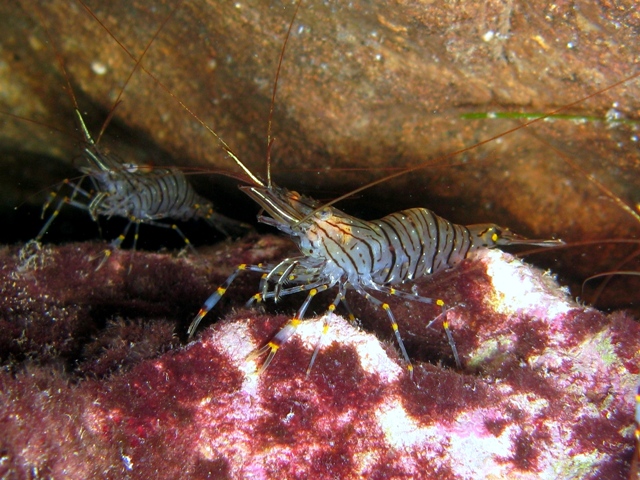


Side by side
| Baltic Prawn | Common Prawn | |
|---|---|---|
| Scientific name | Palaemon adspersus Rathke, 1837 | Palaemon serratus (Pennant, 1777) |
| English name | Baltic Prawn | Common Prawn |
| Group | Crustaceans | Crustaceans |
| Class | Malacostraca | Malacostraca |
| Order | Decapoda | Decapoda |
| Family | Palaemonidae Palaemonids | Palaemonidae Palaemonids |
| Genus | Palaemon Glass Shrimps | Palaemon Glass Shrimps |
| Named in | 1837 | 1777 |
| Environment | marine | marine |
| Countries on record | 22 countries | 18 countries |
| GBIF occurrence records | 2,586 records | 13,112 records |
Rows where the two agree are shown in grey.
Where each is found
Both recorded in 13 countries
- Belgium
- Croatia
- Denmark
- France
- Germany
- Greece
- Ireland
- Italy
- Norway
- Portugal
- Spain
- The Netherlands
- United Kingdom
Only Baltic Prawn (9)
Only Common Prawn (5)
From Catalogue of Life checklists and GBIF occurrence records. A country missing from a list means no record is held, which is not proof of absence.
Checked facts
| Baltic Prawn | Common Prawn | |
|---|---|---|
| Appearance |
|
|
| Habitat |
|
|
| Diet |
| No checked fact yet |
| Behaviour |
|
|
| Reproduction |
| No checked fact yet |
| Lifespan | No checked fact yet |
|
| Distribution | No checked fact yet |
|
| Conservation |
|
|
| Uses |
|
|
| Similar species |
| No checked fact yet |
| Other | No checked fact yet |
|
In brief
Baltic Prawn
Palaemon adspersus inhabits shallow sandy areas containing algal and eelgrass beds and is characteristic of brackish water. It has a yellowish-grey body and a distinct rostrum with five to seven dorsal teeth and usually three ventral teeth. Full profile
Common Prawn
Palaemon serratus occurs in the Atlantic Ocean between Denmark and Mauritania, as well as in the Mediterranean Sea and Black Sea. It has an upward-curving rostrum with a bifurcated tip and pinkish-brown coloration with reddish patterns. Full profile
Compare something else
Page built on 28 November 2026 from the data on the two species pages, where every source is listed.
Cite this page
ScientificNames.org. (2026). Baltic Prawn vs Common Prawn. Retrieved November 28, 2026, from https://scientificnames.org/compare/baltic-prawn-vs-common-prawn
“Baltic Prawn vs Common Prawn.” ScientificNames.org, 2026, scientificnames.org/compare/baltic-prawn-vs-common-prawn. Accessed 28 Nov. 2026.
ScientificNames.org. “Baltic Prawn vs Common Prawn.” Accessed November 28, 2026. https://scientificnames.org/compare/baltic-prawn-vs-common-prawn.
@misc{scientificnames_baltic_prawn_vs_common_prawn,
  author = {{ScientificNames.org}},
  title = {Baltic Prawn vs Common Prawn},
  year = {2026},
  url = {https://scientificnames.org/compare/baltic-prawn-vs-common-prawn},
  note = {Accessed 2026-11-28}
}