Comparison

Common Prawn vs Migrant Prawn

Common Prawn (Palaemon serratus) and Migrant Prawn (Palaemon macrodactylus) both belong to the genus Palaemon (glass shrimps) and part ways below it. Both are recorded in 6 countries.
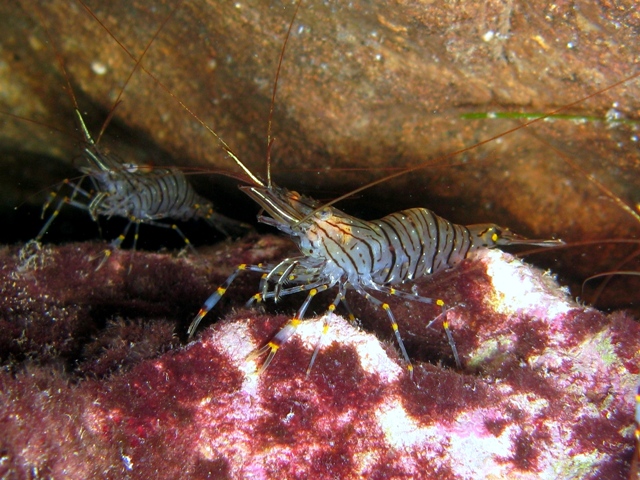
Common Prawn

Common Prawn

Palaemon serratus

Etrusko25, Public domain, via Wikimedia Commons

Migrant Prawn

Migrant Prawn

Palaemon macrodactylus

Smithsonian Environmental Research Center, CC BY 2.0, via Wikimedia Commons

Side by side

Common PrawnMigrant Prawn
Scientific namePalaemon serratus (Pennant, 1777)Palaemon macrodactylus M. J. Rathbun, 1902
English nameCommon PrawnMigrant Prawn
GroupCrustaceansCrustaceans
ClassMalacostracaMalacostraca
OrderDecapodaDecapoda
FamilyPalaemonidae PalaemonidsPalaemonidae Palaemonids
GenusPalaemon Glass ShrimpsPalaemon Glass Shrimps
Named in17771902
Environmentmarinemarine
Countries on record18 countries14 countries
GBIF occurrence records13,112 records1,441 records

Rows where the two agree are shown in grey.

Where each is found

Both recorded in 6 countries

Only Common Prawn (12)

Only Migrant Prawn (8)

From Catalogue of Life checklists and GBIF occurrence records. A country missing from a list means no record is held, which is not proof of absence.

Checked facts

Common PrawnMigrant Prawn
Appearance
  • The rostrum curves upwards and has a bifurcated tip. English Wikipedia
  • The species has pinkish-brown coloration with reddish patterns. English Wikipedia
  • The species is a large, round-bodied prawn that can reach 11 centimetres in length. marlin.ac.uk
  • Its body is translucent and has variable markings, generally consisting of red or brown horizontal or oblique lines on the carapace and vertical lines on the abdomen. marlin.ac.uk
  • The first two pairs of walking legs have pincers and yellow-and-brown banding. marlin.ac.uk
  • The head region is covered by a carapace bearing a well-developed, distinctly upward-curving rostrum. marlin.ac.uk
  • The rostrum has 6–7 dorsal teeth, including two behind the eye socket, and 4–5 ventral teeth. marlin.ac.uk
  • The mandible has a three-segmented palp. marlin.ac.uk
  • Females have red spots on their body surfaces and white longitudinal stripes along their backs. English Wikipedia
  • Males have transparent bodies with reddish coloration around the tail fan and antennary region. English Wikipedia
SizeNo checked fact yet
Habitat
DietNo checked fact yet
Behaviour
  • The species prefers rubble, artificial structures, and vegetation when foraging. English Wikipedia
  • The species is attracted to structural elements regardless of whether they are natural or artificial. pmc.ncbi.nlm.nih.gov
  • The quantity of artificial structural material influences shrimp responses more strongly than its arrangement. pmc.ncbi.nlm.nih.gov
  • Shrimp responses to artificial structures correlate with their fractal dimension. pmc.ncbi.nlm.nih.gov
  • The species regulates its internal osmotic conditions. English Wikipedia
  • Cannibalism has been reported when densities of competing species reach a critical level. English Wikipedia
ReproductionNo checked fact yet
  • The species has separate male and female reproductive systems. English Wikipedia
  • Mating involves indirect sperm transfer through olfactory and tactile cues. English Wikipedia
  • During mating, the male transfers its spermatophore onto the female's abdomen. English Wikipedia
  • Females begin producing eggs 6–20 hours after mating. English Wikipedia
  • The mating season extends from mid-April to early October. English Wikipedia
  • Egg-bearing females carry approximately 150–2,000 eggs. English Wikipedia
  • The reproductive rate of females and the timing and duration of breeding are influenced by environmental temperature. English Wikipedia
  • The optimal temperature range for breeding is 15–27 °C. English Wikipedia
  • Embryonic development in vitro is more successful under high-salinity conditions. English Wikipedia
LifespanNo checked fact yet
Distribution
  • Palaemon serratus occurs in the Atlantic Ocean between Denmark and Mauritania, as well as in the Mediterranean Sea and Black Sea. English Wikipedia
  • The species is native to Japan, Korea, northern China, and the Far East region of Russia. English Wikipedia
  • The species was first introduced outside its native range to San Francisco Bay in 1957. English Wikipedia
  • In North America, the species has been recorded in Washington, Oregon, Virginia, Connecticut, and New York. English Wikipedia
  • The species appeared in Australia and Argentina in the early 2000s. English Wikipedia
  • The species occurs along Atlantic European coasts in southwestern Spain, southeastern England, France, Belgium, and the Netherlands. English Wikipedia
  • The species has been introduced to both the eastern and western coasts of North America. invasions.si.edu
Conservation
  • The species is subject to concern that current fishing exploitation levels may constitute overfishing. English Wikipedia
  • A minimum landing size is among the measures being considered to limit fishing catches. English Wikipedia
  • The species is listed as threatened in the China Red Data Book. English Wikipedia
  • The species is considered invasive in California, where it is abundant. English Wikipedia
  • No specific surveillance program for monitoring the species' spread is available. English Wikipedia
Uses
  • A small commercial fishery for this species operates along the west coast of Great Britain, particularly in West Wales. English Wikipedia
  • Commercial fishing for this species in Ireland began at Baltimore, County Cork, during the 1970s. English Wikipedia
  • Irish landings of this species reached a recorded peak of 548 tonnes in 1999. English Wikipedia
  • Galway, Kerry, Cork and Waterford together account for more than 90% of the Irish catch. English Wikipedia
OtherNo checked fact yet

In brief

Common Prawn

Palaemon serratus occurs in the Atlantic Ocean between Denmark and Mauritania, as well as in the Mediterranean Sea and Black Sea. It has an upward-curving rostrum with a bifurcated tip and pinkish-brown coloration with reddish patterns. Full profile

Migrant Prawn

The migrant prawn is native to Japan, Korea, northern China, and the Far East region of Russia, and has been introduced to locations in North America, Australia, Argentina, and Atlantic Europe. It inhabits brackish and marine coastal waters, primarily in low-salinity estuaries, and has separate male and female reproductive systems. Full profile

Compare something else

Page built on 27 November 2026 from the data on the two species pages, where every source is listed.

Cite this page

ScientificNames.org. (2026). Common Prawn vs Migrant Prawn. Retrieved November 27, 2026, from https://scientificnames.org/compare/common-prawn-vs-migrant-prawn