Comparison
Panamanian Night Monkey vs Peruvian Night Monkey
Panamanian Night Monkey (Aotus zonalis) and Peruvian Night Monkey (Aotus miconax) both belong to the genus Aotus (night monkeys) and part ways below it.
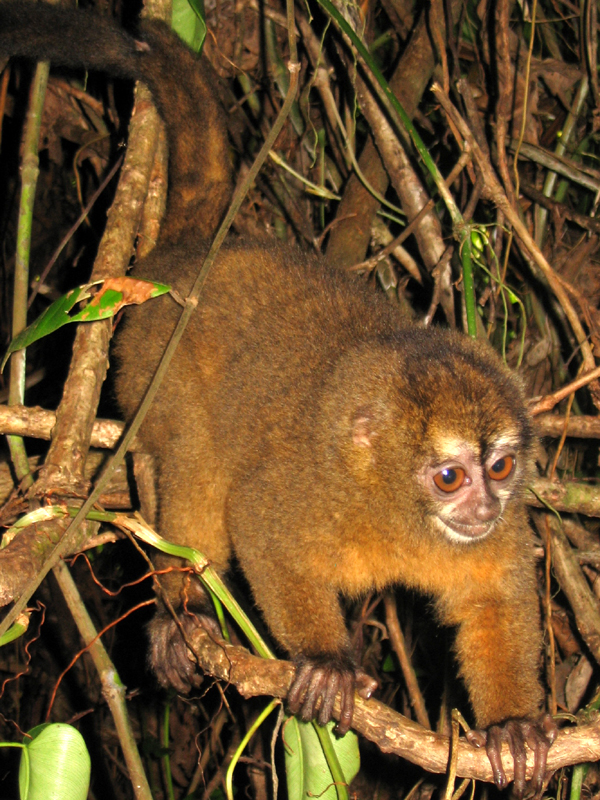


Side by side
| Panamanian Night Monkey | Peruvian Night Monkey | |
|---|---|---|
| Scientific name | Aotus zonalis Goldman, 1914 | Aotus miconax Thomas, 1927 |
| English name | Panamanian Night Monkey | Peruvian Night Monkey |
| Group | Mammals | Mammals |
| Class | Mammalia Mammal | Mammalia Mammal |
| Order | Primates Primate | Primates Primate |
| Family | Aotidae Owl Monkeys | Aotidae Owl Monkeys |
| Genus | Aotus Night Monkeys | Aotus Night Monkeys |
| Named in | 1914 | 1927 |
| Red List category | Near Threatened | Endangered |
| Countries on record | 2 countries | 1 country |
| GBIF occurrence records | 292 records | 57 records |
Rows where the two agree are shown in grey.
Where each is found
Only Panamanian Night Monkey (2)
Only Peruvian Night Monkey (1)
From Catalogue of Life checklists and GBIF occurrence records. A country missing from a list means no record is held, which is not proof of absence.
Checked facts
| Panamanian Night Monkey | Peruvian Night Monkey | |
|---|---|---|
| Appearance |
|
|
| Size |
|
|
| Habitat |
|
|
| Diet | No checked fact yet |
|
| Behaviour |
|
|
| Reproduction |
| No checked fact yet |
| Distribution |
|
|
| Conservation |
|
|
| Uses |
| No checked fact yet |
| Similar species |
|
|
| Other | No checked fact yet |
|
In brief
Panamanian Night Monkey
The Panamanian Night Monkey is an arboreal species that lives in groups of two to six individuals. It occurs in Panama and the Chocó region of Colombia, with confirmed records from the Atlantic lowlands of Panama near the Costa Rican border. Full profile
Peruvian Night Monkey
Aotus miconax is endemic to northern Peru and is thought to inhabit cloud forests at elevations between 900 and 2,800 metres above sea level. It is nocturnal and belongs to the red-necked group of owl monkeys. Full profile
Compare something else
Page built on 28 November 2026 from the data on the two species pages, where every source is listed.
Cite this page
ScientificNames.org. (2026). Panamanian Night Monkey vs Peruvian Night Monkey. Retrieved November 28, 2026, from https://scientificnames.org/compare/panamanian-night-monkey-vs-peruvian-night-monkey
“Panamanian Night Monkey vs Peruvian Night Monkey.” ScientificNames.org, 2026, scientificnames.org/compare/panamanian-night-monkey-vs-peruvian-night-monkey. Accessed 28 Nov. 2026.
ScientificNames.org. “Panamanian Night Monkey vs Peruvian Night Monkey.” Accessed November 28, 2026. https://scientificnames.org/compare/panamanian-night-monkey-vs-peruvian-night-monkey.
@misc{scientificnames_panamanian_night_monkey_vs_peruvian_night_monkey,
  author = {{ScientificNames.org}},
  title = {Panamanian Night Monkey vs Peruvian Night Monkey},
  year = {2026},
  url = {https://scientificnames.org/compare/panamanian-night-monkey-vs-peruvian-night-monkey},
  note = {Accessed 2026-11-28}
}