Species · Mammals
Peruvian Night Monkey Aotus miconax
The scientific name of the Peruvian Night Monkey is Aotus miconax. It is a species of mammal in the family Aotidae (owl monkeys), order Primates. The name dates from 1927.

Overview
Aotus miconax is endemic to northern Peru and is thought to inhabit cloud forests at elevations between 900 and 2,800 metres above sea level. It is nocturnal and belongs to the red-necked group of owl monkeys.
Written 26 November 2026 from the sources listed below. Each statement was checked against the passage it cites; statements that could not be supported were removed.
Appearance
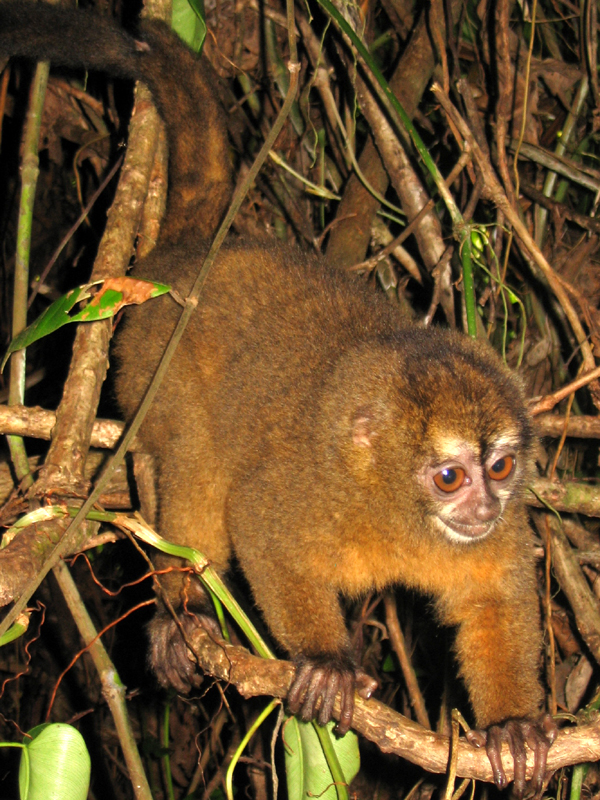
The Peruvian Night Monkey has grey to light brown fur with distinctive black and white facial markings. Its chest, belly and upper arms have an orange tinge.[1][2]
Adults can reach 50 cm in body length and weigh approximately 1 kg.[3][4]
Habitat
The Peruvian Night Monkey is thought to inhabit cloud forests at elevations between 900 and 2,800 metres above sea level. It has been observed in both primary and secondary forests.[5][6]
It has been observed in forests ranging from extensive continuous forest to small isolated patches.[7]
Diet
The Peruvian Night Monkey is generally frugivorous. It also consumes leaf buds and insects.[8][9]
Behaviour
The Peruvian Night Monkey is nocturnal and lives in small family groups containing two to six individuals.[10][11]
Reproduction and life cycle
The Peruvian Night Monkey is monogamous.[12]
Conservation
The Peruvian Night Monkey is classified as endangered by the IUCN and is also listed as endangered under Peruvian law.[13][14]
Continued human population growth and associated habitat destruction are the main threats to the species. Hunting for the pet trade and trophy hunting are additional threats.[15][16]
A community-based conservation study of the species is being conducted in La Esperanza, Amazonas. A network of community-managed reserves is intended to help conserve the species.[17][18]
Similar species
The yellow-tailed woolly monkey occurs alongside the Peruvian Night Monkey in the conservation area discussed.[19]
Classification of the Peruvian Night Monkey
| Kingdom | Animalia |
|---|---|
| Phylum | Chordata |
| Subphylum | Vertebrata |
| Infraphylum | Gnathostomata |
| Parvphylum | Osteichthyes |
| Megaclass | Tetrapoda |
| Class | Mammalia (Mammal) |
| Subclass | Theria |
| Infraclass | Eutheria |
| Order | Primates (Primate) |
| Suborder | Haplorrhini |
| Infraorder | Simiiformes |
| Family | Aotidae (Owl Monkeys) |
| Genus | Aotus (Night Monkeys) |
| Species | Aotus miconax Thomas, 1927 |
Where the Peruvian Night Monkey is found
Checklists and occurrence records place Aotus miconax in 1 country across South America. GBIF holds 57 georeferenced records of it.
Countries
Regions and cities with the most records
Range as the checklists state it
South America
A number beside a place is its count of GBIF occurrence records. A place without a number comes from a checklist alone. Records show where a species has been observed or collected, which can include escapes and vagrants.
Common names
English
- Peruvian Night Monkey
- Andean Night Monkey
- Mono Lechuza
Names in 12 other languages
- Arabic
- قرد الليل البيروفي
- Chinese
- 小夜猴
- Czech
- mirikina andská
- Dutch
- Andesnachtaapje
- Finnish
- perunyöapina
- French
- Douroucouli des Andes
- German
- Anden-Rotkehl-Nachtaffe, Andennachtaffe
- Japanese
- アンデスヨザル
- Norwegian Bokmål
- Andesnattape
- Polish
- ponocnica górska
- Portuguese
- Macaco-da-noite-dos-andes, Macaco-da-noite-peruano
- Spanish
- Mono Nocturno, Mono Nocturno Andino, Musmuqui, Tutamono
Related species
-
 Panamanian Night MonkeyAotus zonalis
-
 Azara's Night MonkeyAotus azarae
-
 Gray-bellied Night MonkeyAotus lemurinus
-
 Three-striped Night MonkeyAotus trivirgatus
-
 Gray-handed Night MonkeyAotus griseimembra
-
 Spix's Night MonkeyAotus vociferans
-
 Black-headed Night MonkeyAotus nigriceps
-
 Brumback's Night MonkeyAotus brumbacki
Compare
Questions and answers
What is the scientific name of the Peruvian Night Monkey?
The scientific name of the Peruvian Night Monkey is Aotus miconax. Written with its author, the full name is Aotus miconax Thomas, 1927.
Which family does the Peruvian Night Monkey belong to?
Aotus miconax belongs to the family Aotidae, in the order Primates and the class Mammalia.
Where is the Peruvian Night Monkey found?
Checklists and occurrence records place Aotus miconax in 1 country: Peru.
What is the conservation status of the Peruvian Night Monkey?
The IUCN Red List category recorded for Aotus miconax is Endangered (EN).
What other names does the Peruvian Night Monkey have?
Aotus miconax is also known in English as Andean Night Monkey and Mono Lechuza.
What does a night monkey eat?
The Peruvian Night Monkey is generally frugivorous. It also consumes leaf buds and insects.[8][9]
What type of diet do monkeys eat?
The Peruvian Night Monkey is generally frugivorous and also consumes leaf buds and insects.[8][9]
Sources
Passages the profile rests on
- The species has grey to light brown fur with distinctive black and white facial markings. Source passage: “Its colour is grey to light brown with characteristic black and white markings on the face.” — English Wikipedia
- The chest, belly and upper arms have an orange tinge. Source passage: “The chest, belly and upper arms are orange tinged” — English Wikipedia
- Adults can reach 50 cm in body length. Source passage: “measure up to 50 cm (20 in) in length.” — English Wikipedia
- Adults weigh approximately 1 kg. Source passage: “Adults weigh around 1 kg (2.2 lb)” — English Wikipedia
- The species is thought to inhabit cloud forests at elevations between 900 and 2,800 metres above sea level. Source passage: “inhabit areas of cloud forest at 900–2,800 m (3,000–9,200 ft) above sea level” — English Wikipedia
- The species has been observed in both primary and secondary forests. Source passage: “This species has been observed in primary and secondary forest” — English Wikipedia
- The species has been observed in forests ranging from extensive continuous forest to small isolated patches. Source passage: “from large areas of contiguous forest to small forest patches.” — English Wikipedia
- The species is generally frugivorous. Source passage: “it is known that it is generally frugivorous” — English Wikipedia
- The species also consumes leaf buds and insects. Source passage: “but also consumes leaf buds and insects.” — English Wikipedia
- The species is nocturnal. Source passage: “The Peruvian night monkey (Aotus miconax), also known as the Andean night monkey, is a nocturnal New World monkey endemic to northern Peru.” — English Wikipedia
- The species lives in small family groups containing two to six individuals. Source passage: “lives in small family groups of 2 to 6 individuals” — English Wikipedia
- The species is monogamous. Source passage: “The species is monogamous” — English Wikipedia
- The species is classified as endangered by the IUCN. Source passage: “This species is listed as endangered by the IUCN” — English Wikipedia
- The species is also listed as endangered under Peruvian law. Source passage: “and under Peruvian law.” — English Wikipedia
- Continued human population growth and associated habitat destruction are the main threats to the species. Source passage: “The main threat facing the Peruvian night monkey is the continued growth of human populations and associated habitat destruction.” — English Wikipedia
- Hunting for the pet trade and trophy hunting are additional threats to the species. Source passage: “it is still hunted for the pet trade and by trophy hunters.” — English Wikipedia
- A community-based conservation study of the species is being conducted in La Esperanza, Amazonas. Source passage: “currently running a conservation based study on the species in La Esperanza, Amazonas.” — English Wikipedia
- A network of community-managed reserves is intended to help conserve the species. Source passage: “A network of community run reserves is intended to help conserving the species” — English Wikipedia
- The yellow-tailed woolly monkey occurs alongside the Peruvian night monkey in the conservation area discussed in the document. Source passage: “as well as the sympatric, Critically Endangered yellow-tailed woolly monkey.” — English Wikipedia
Data
- Catalogue of Life, 2026-10-16 XR cc by
- Global Biodiversity Information Facility CC BY 4.0
- Wikidata CC0
- GeoNames CC BY 4.0
- Wikimedia Commons per image; credit shown with each image
- Within the Catalogue of Life, this name comes from The Integrated Taxonomic Information System cc0
References
- Ann. Mag. Nat. Hist., ser. 9 vol.19 p.365 where the name was published
- Wilson, Don E., and DeeAnn M. Reeder, eds. (1993). Mammal Species of the World: A Taxonomic and Geographic Reference, 2nd Ed., 3rd Printing.
- Wilson, Don E., and F. Russell Cole. (2000). Common Names of Mammals of the World.
- Wilson, Don E., and DeeAnn M. Reeder, eds. (2005). Mammal Species of the World: A Taxonomic and Geographic Reference, 3rd Ed., Vol. 1.
- Mittermeier, Rusell A., Anthony B. Rylands, and Don E. Wilson, eds. (2013). Handbook of the Mammals of the World. Volume 3. Primates.
This species in other databases
Page built on 26 November 2026. See how the catalog is made and all sources and licences.
Cite this page
ScientificNames.org. (2026). Aotus miconax (Peruvian Night Monkey). Retrieved November 26, 2026, from https://scientificnames.org/species/aotus-miconax
“Aotus miconax (Peruvian Night Monkey).” ScientificNames.org, 2026, scientificnames.org/species/aotus-miconax. Accessed 26 Nov. 2026.
ScientificNames.org. “Aotus miconax (Peruvian Night Monkey).” Accessed November 26, 2026. https://scientificnames.org/species/aotus-miconax.
@misc{scientificnames_aotus_miconax_peruvian_night_monkey,
  author = {{ScientificNames.org}},
  title = {Aotus miconax (Peruvian Night Monkey)},
  year = {2026},
  url = {https://scientificnames.org/species/aotus-miconax},
  note = {Accessed 2026-11-26}
}