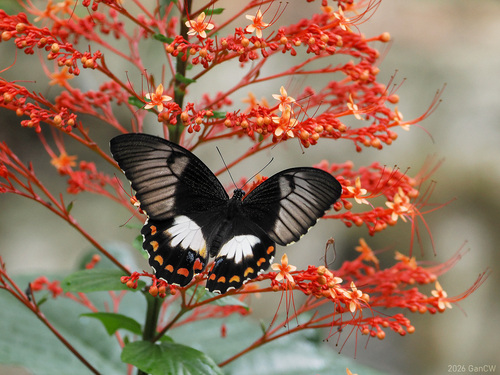
| Appearance | - Both sexes have black forewings marked with a white stripe, with females displaying more white. English Wikipedia
- The hindwings are black with a white band across the middle. English Wikipedia
- Female hindwings have marginal chains of red-to-orange and blue crescent markings. English Wikipedia
- The underside of the wings has markings similar to those on the upper surface. English Wikipedia
- Unlike many other swallowtails, this species lacks the distinctive tails on its hindwings. English Wikipedia
- The pupa can be grey, green or brown, depending on the colour of the stem to which it is attached. English Wikipedia
- Early larval instars are brown and have three white patches. English Wikipedia
- Later larval instars are green with irregular white, yellow or brown diagonal markings. English Wikipedia
| - Males have yellow wings with four black stripes on each forewing. English Wikipedia
- Females exhibit two principal color morphs, yellow and black. English Wikipedia
- Yellow females have a conspicuous blue band of spots along the hindwing. English Wikipedia
- The dark female morph has predominantly black or dark gray wings. English Wikipedia
- The hindwing margins have yellow spots, while their inner margins have small red and blue spots. English Wikipedia
- The wings have a large black border around their edges. animaldiversity.org
|
|---|
| Size | - Female individuals have a wingspan of approximately 140 millimetres. English Wikipedia
- Male individuals have a wingspan of approximately 120 millimetres. English Wikipedia
| |
|---|
| Habitat | - The species is commonly encountered in Brisbane where citrus trees provide food for its larvae. English Wikipedia
| |
|---|
| Diet | - The larvae feed on citrus leaves. English Wikipedia
- Larvae naturally use plants belonging to the genera Boronia, Citrus, Clausena, Dinosperma, Eriostemon, Flindersia, Geijera, Halfordia, Leionema, Micromelum, Philotheca, Zanthoxylum and Zieria as food plants. English Wikipedia
- Larvae have also been recorded feeding on introduced plants belonging to Choisya, Citrus, Murraya, Poncirus and Zanthoxylum. English Wikipedia
- Caterpillars accept leaves of parsley and Cryptocarya glauscens. English Wikipedia
| - Adult butterflies feed on nectar from flowers belonging particularly to Apocynaceae, Asteraceae, and Fabaceae. English Wikipedia
- Adult butterflies also consume dung, carrion, and urine. English Wikipedia
- Caterpillars feed externally on leaves of various woody plants. animaldiversity.org
- Recorded caterpillar food plants include cherry, tulip tree, ash, basswood, apple, maple, willow, and magnolia. animaldiversity.org
- Common caterpillar host plants include tulip tree, sweet bay magnolia, and wild black cherry. fs.usda.gov
|
|---|
| Behaviour | - Larvae generally feed during daylight hours and rest on the upper surfaces of leaves at night. English Wikipedia
- Resting larvae resemble fresh bird droppings. English Wikipedia
- When disturbed, caterpillars extend a bright red osmeterium from behind the head to deter predators. English Wikipedia
- The caterpillar's osmeterium releases a citrus-like smell when extended. English Wikipedia
| - Adults are active during daylight hours and are usually solitary. English Wikipedia
- Adults commonly fly high above the ground and above the tree canopy. English Wikipedia
- Males search for females by patrolling habitats containing larval host plants. English Wikipedia
- During courtship, males release pheromones that encourage females to mate. English Wikipedia
- Adults of both sexes obtain nectar from native and exotic garden plants. fs.usda.gov
|
|---|
| Reproduction | - Females lay creamy white, smooth, spherical eggs individually on the upper surfaces of host-plant leaves and shoots. English Wikipedia
- The eggs have an approximate diameter of 0.5 millimetres. English Wikipedia
- Eggs generally hatch approximately one week after being laid. English Wikipedia
- The primary host plants used for egg laying belong to the Rutaceae family and include native and introduced citrus plants. English Wikipedia
- After approximately four weeks, larvae may reach 60 millimetres in length and become ready to pupate. English Wikipedia
- The pupa attaches to a host-plant stem using a cremaster. English Wikipedia
- A thin silk girdle keeps the head end of the chrysalis uppermost during pupation. English Wikipedia
- Adult butterflies emerge from the chrysalis approximately one to six months later, depending on the season. English Wikipedia
| - Females lay their eggs individually on plants belonging to the Magnolia and rose families. fs.usda.gov
- Females prefer laying eggs on host plants located near nectar sources. English Wikipedia
- Eggs take approximately four to ten days to hatch. English Wikipedia
- The caterpillar passes through five instars. English Wikipedia
- The chrysalis stage lasts nine to eleven days or extends through winter hibernation. English Wikipedia
- The species produces two broods in northern populations and three in southern populations. fs.usda.gov
- The species produces two to three broods annually. English Wikipedia
|
|---|
| Distribution | | - The species is native to eastern North America. English Wikipedia
- Its range extends from southern Vermont south to Florida and west to eastern Texas and the Great Plains. English Wikipedia
- Populations also occur in several Mexican states. fs.usda.gov
|
|---|
| Conservation | - The larvae are sometimes regarded as pests because they feed on citrus leaves in suburban gardens. English Wikipedia
| - The species is not considered threatened because it has adapted to numerous habitats and host plants. English Wikipedia
|
|---|
| Other | - Males of the subspecies Papilio aegeus aegeus have a red spot on the upper side of each hindwing, which is absent in males of Papilio aegeus ormenus. English Wikipedia
| - The species is the state butterfly of Alabama, Delaware, Georgia, North Carolina, and South Carolina. English Wikipedia
- The species is designated as the state insect of Virginia. English Wikipedia
|
|---|