Comparison

Pebbly Fish vs Giant Tigerfish

Pebbly Fish (Alestes baremoze) and Giant Tigerfish (Hydrocynus goliath) both belong to the family Alestidae (african tetras) and part ways below it. Both are recorded in 2 countries.
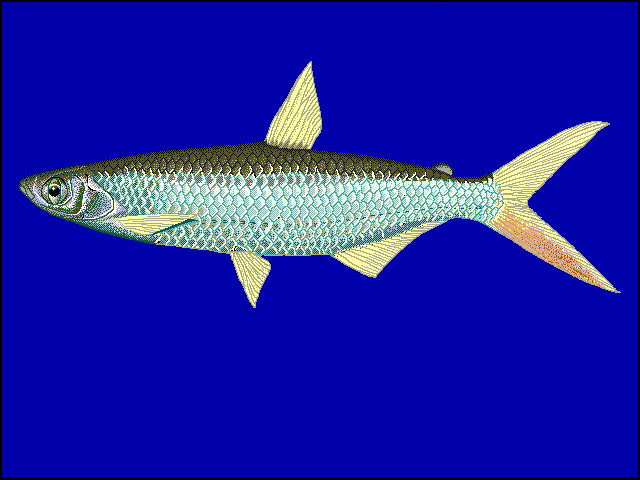
Pebbly Fish

Pebbly Fish

Alestes baremoze

Unknown author, Public domain, via Wikimedia Commons

Giant Tigerfish

Giant Tigerfish

Hydrocynus goliath

Sablegsd, CC BY-SA 3.0, via Wikimedia Commons

Side by side

Pebbly FishGiant Tigerfish
Scientific nameAlestes baremoze (Joannis, 1835)Hydrocynus goliath Boulenger, 1898
English namePebbly FishGiant Tigerfish
GroupFishesFishes
ClassTeleostei TeleostTeleostei Teleost
OrderCharaciformesCharaciformes
FamilyAlestidae African TetrasAlestidae African Tetras
GenusAlestes African CharacinsHydrocynus Tigerfish
Named in18351898
Red List categoryLeast ConcernLeast Concern
Environmentfreshwaterfreshwater
Countries on record20 countries3 countries
GBIF occurrence records639 records139 records

Rows where the two agree are shown in grey.

Where each is found

Both recorded in 2 countries

Only Pebbly Fish (18)

Only Giant Tigerfish (1)

From Catalogue of Life checklists and GBIF occurrence records. A country missing from a list means no record is held, which is not proof of absence.

Checked facts

Pebbly FishGiant Tigerfish
Appearance
  • The species has a silver-coloured body, a bluish-grey back, a white belly, greyish fins and an orange lower lobe of the caudal fin. English Wikipedia
  • The species has a silvery-gray back and flanks, black adipose fins, and a body shape resembling that of tuna. English Wikipedia
  • The species has large conical teeth shaped like daggers and spaced along its jaws. English Wikipedia
  • Its upper jaw has 12–20 teeth, while its lower jaw has 8–14 teeth. English Wikipedia
  • The teeth in each jaw quadrant are replaced simultaneously over approximately five days. English Wikipedia
  • Individual teeth can grow to approximately 2.5 cm long. English Wikipedia
SizeNo checked fact yet
Habitat
  • The species inhabits highly oxygenated, fast-flowing waters, including deep river channels and open lakes. English Wikipedia
  • The species breeds near riverbanks and lakeshores. English Wikipedia
Diet
  • The species has morphological adaptations associated with omnivorous feeding. English Wikipedia
  • The species shifts its diet from zooplankton to zoobenthos, detritus and macrophytes as plankton density decreases. English Wikipedia
  • The species feeds on fish that it can overpower, including smaller individuals of its own species. English Wikipedia
  • Larval individuals feed on animal plankton before switching to small fish and eventually larger fish. English Wikipedia
  • The species has been reported to take chunks from large fish, crocodiles, and humans. English Wikipedia
Behaviour
Reproduction
  • During breeding, both sexes occur in sheltered bays along lake shores. English Wikipedia
  • In Lake Chad, spawning occurs in the late afternoon and evening between 16:30 and 20:00. English Wikipedia
  • Females release their eggs in a single spawning batch. English Wikipedia
  • The single egg batch represents approximately 15% of the female's body weight. English Wikipedia
  • Mature females are dispersed rather than forming groups during spawning. English Wikipedia
Distribution
  • The species occurs in Lake Albert, the White Nile and Lake Turkana in eastern Africa. English Wikipedia
  • The species occurs in the Bahr el Ghazal River and Bahr el Jebel systems. English Wikipedia
  • The species occurs in the White and Blue Niles in Sudan, extending north to Lake Nasser. English Wikipedia
  • The species has been recorded in Ethiopia's Baro River. English Wikipedia
  • The species occurs in the Chad, Niger, Volta, Comoé, Bandama, Sassandra, Geba, Gambia and Senegal river basins. English Wikipedia
  • The species occurs in the Congo River Basin and Lake Tanganyika. English Wikipedia
  • Its documented Congo River Basin distribution includes the Lualaba River and Lake Upemba. English Wikipedia
ConservationNo checked fact yet
  • The species was assessed as Least Concern in the 2010 IUCN Red List assessment. English Wikipedia
  • The document describes the species' current conservation status as unknown. English Wikipedia
Uses
  • The species is commercially exploited as a food fish. English Wikipedia
  • The species is highly marketable and valued in Northern Uganda, South Sudan, Sudan and the Democratic Republic of Congo. English Wikipedia
  • The fish is caught and salted in the Nile, particularly in Egypt. English Wikipedia
  • Salting is used both to extend the fish's shelf life and to produce fish products that meet consumer demand. English Wikipedia
  • The species is caught using seine nets and gill nets in Lake Chad. English Wikipedia
  • The species is sometimes kept as a display fish in home aquariums. English Wikipedia
  • A tank capacity of approximately 15,000 litres is recommended for keeping the species in an aquarium. English Wikipedia
  • The species strongly prefers live prey when fed in captivity. English Wikipedia
OtherNo checked fact yet
  • The Nile crocodile is identified as the only known natural predator of mature individuals. English Wikipedia
  • The species is identified as the largest tigerfish in the genus Hydrocynus. English Wikipedia

In brief

Pebbly Fish

Alestes baremoze occurs in Lake Albert, the White Nile, Lake Turkana and several river basins in Africa. It has a silver-coloured body, bluish-grey back, white belly, greyish fins and an orange lower lobe of the caudal fin. Full profile

Giant Tigerfish

The Giant Tigerfish is the largest tigerfish in the genus Hydrocynus. It occurs in the Congo River Basin and Lake Tanganyika. It has large, dagger-shaped conical teeth spaced along its jaws, with individual teeth growing to approximately 2.5 cm long. Full profile

Compare something else

Page built on 27 November 2026 from the data on the two species pages, where every source is listed.

Cite this page

ScientificNames.org. (2026). Pebbly Fish vs Giant Tigerfish. Retrieved November 27, 2026, from https://scientificnames.org/compare/pebbly-fish-vs-giant-tigerfish