Comparison

Pallas' Spadefoot Toad vs Syrian Spadefoot

Pallas' Spadefoot Toad (Pelobates vespertinus) and Syrian Spadefoot (Pelobates syriacus) both belong to the genus Pelobates (european spadefoot toad) and part ways below it. Both are recorded in 1 country.

Pallas' Spadefoot Toad

Pallas' Spadefoot Toad

Pelobates vespertinus

Dufresnes C, Strachinis I, Tzoras E, Litvinchuk SN, Denoël M (2019) Call a spade a spade: taxonomy and distribution of Pelobates, with description of a new Balkan endemic. ZooKeys 859: 131-158. https, CC BY 4.0, via Wikimedia Commons

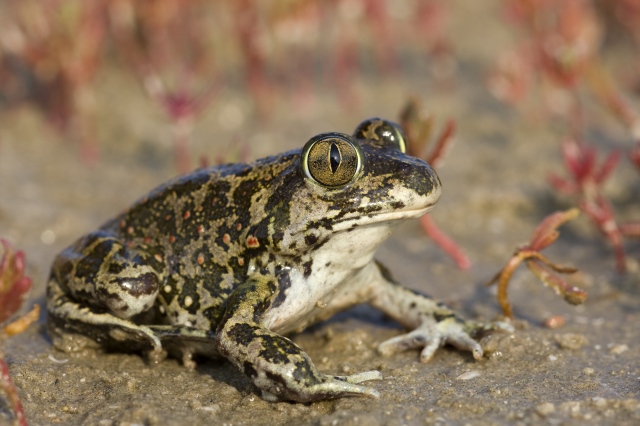
Syrian Spadefoot

Syrian Spadefoot

Pelobates syriacus

F. C. Robiller / naturlichter.de, CC BY-SA 3.0, via Wikimedia Commons

Side by side

Pallas' Spadefoot ToadSyrian Spadefoot
Scientific namePelobates vespertinus (Pallas, 1771)Pelobates syriacus Boettger, 1889
English namePallas' Spadefoot ToadSyrian Spadefoot
GroupAmphibiansAmphibians
ClassAmphibia AmphibiansAmphibia Amphibians
OrderAnura FrogsAnura Frogs
FamilyPelobatidae European Spadefoot ToadPelobatidae European Spadefoot Toad
GenusPelobates European Spadefoot ToadPelobates European Spadefoot Toad
Named in17711889
Red List categoryNot recordedLeast Concern
EnvironmentNot recordedfreshwater, terrestrial
Countries on record2 countries12 countries
GBIF occurrence records1,360 records1,107 records

Rows where the two agree are shown in grey.

Where each is found

Both recorded in 1 country

Only Pallas' Spadefoot Toad (1)

Only Syrian Spadefoot (11)

From Catalogue of Life checklists and GBIF occurrence records. A country missing from a list means no record is held, which is not proof of absence.

Checked facts

Pallas' Spadefoot ToadSyrian Spadefoot
Appearance
  • The species has a robust body and a relatively short, rounded snout. English Wikipedia
  • Its typical coloration is brownish or grayish with darker markings that vary between individuals. English Wikipedia
  • Each hind foot has a keratinized tubercle shaped like a spade. English Wikipedia
  • Its eyes are prominent and directed slightly upward. English Wikipedia
  • The Syrian Spadefoot has a plump body, a large head with a flat-topped skull, protruding eyes, and vertical slit-like pupils. English Wikipedia
  • Its skin is smooth and bears scattered small warts. English Wikipedia
  • The male has a gland behind each foreleg that enlarges during the breeding season. English Wikipedia
  • The front feet have four toes, while the hind feet have five toes with deeply indented webbing between them. English Wikipedia
  • Each hind foot has a yellowish bony protuberance called an inner metatarsal tubercle or spade. English Wikipedia
  • The dorsal coloration is often pale grey with large, irregular greenish blotches, while the belly is pale grey. English Wikipedia
Size
Habitat
  • The species inhabits open and semi-open lowland environments, including steppes and forest-steppes. English Wikipedia
  • River valleys and floodplains are among the species' habitats. English Wikipedia
  • The species prefers loose sandy or loamy soils that allow it to burrow. English Wikipedia
  • Breeding takes place in temporary or permanent ponds, ditches, and slow-moving water bodies. English Wikipedia
  • It inhabits light woodland, bushy areas, semi-deserts, badlands, agricultural fields, and dunes. English Wikipedia
  • It prefers loose soil that allows it to dig underground burrows. English Wikipedia
  • It also occurs in rocky habitats and pebbly clay soils. English Wikipedia
  • Its distribution is partly limited by the availability of sufficiently large ponds without fish. English Wikipedia
  • Its distribution is restricted by mean annual temperature and rainfall conditions. English Wikipedia
Diet
Behaviour
  • The species is nocturnal and returns to the same burrow after nightly foraging. English Wikipedia
  • It excavates its own burrows. amphibiaweb.org
  • Besides digging its own burrow, it sometimes shelters in rodent holes or rock crevices. English Wikipedia
  • The species hibernates during winter among tree roots or beneath rocks, sometimes in groups. English Wikipedia
  • Its distinctive call is generally produced underwater and may continue throughout the night. English Wikipedia
  • Its call consists of rapid, staccato sounds resembling repeated clock-like notes. English Wikipedia
  • Some juveniles overwinter as tadpoles, while many others burrow into mud at pond edges. English Wikipedia
Reproduction
  • Breeding occurs between February and May, depending on geographical location. English Wikipedia
  • Ditches and stagnant pools are preferred locations for mating embraces. English Wikipedia
  • Females lay several thousand eggs in broad bands of gelatinous material. English Wikipedia
  • The gelatinous egg bands can reach 2 centimetres in thickness and 1 metre in length. English Wikipedia
  • Tadpoles hatch approximately three days after the eggs are laid. English Wikipedia
  • The tadpole stage lasts approximately three to four months before metamorphosis. English Wikipedia
Distribution
  • The species is native to Eastern Europe and parts of Central Asia. English Wikipedia
  • Its geographical range extends from eastern Ukraine and southern Russia to western Siberia and northern Kazakhstan. English Wikipedia
  • Its recorded native range includes Armenia, Azerbaijan, Georgia, Greece, Iran, Israel, Lebanon, Russia, Syria, and Turkey, with Bulgaria also listed provisionally. English Wikipedia
  • The species is considered extinct in Jordan, while its status in Iraq is uncertain. English Wikipedia
  • The species is described as quite common in Iran but uncommon across much of its remaining range. English Wikipedia
  • The species was rediscovered in Syria through collaboration between Syrian community scientists and Illinois researchers. herpetology.inhs.illinois.edu
  • An adult was discovered in a greenhouse in Burj Arab, Tartous Governorate, Syria, on March 18, 2022. herpetology.inhs.illinois.edu
Conservation
  • As of 2025, the species is classified as Least Concern on the IUCN Red List. English Wikipedia
  • The population trend of the species is considered decreasing. English Wikipedia
  • The species remains common in many parts of its geographical range. English Wikipedia
  • Agricultural habitat degradation, wetland drainage, and infrastructure development are potential local threats. English Wikipedia
  • The species is classified as Least Concern on the IUCN Red List. English Wikipedia
  • Habitat loss caused by land-use changes and drainage of breeding areas is its principal identified threat. English Wikipedia
  • Although its range is fragmented, its population is believed to be large and declining slowly. English Wikipedia
  • Some isolated populations are vulnerable to local extinction, particularly in arid regions. English Wikipedia
Similar species
  • Pelobates vespertinus is morphologically similar to Pelobates fuscus. English Wikipedia
  • The hybrid zone between Pelobates vespertinus and Pelobates fuscus is generally less than 20 km wide. English Wikipedia
No checked fact yet

In brief

Pallas' Spadefoot Toad

Pelobates vespertinus occurs from eastern Ukraine and southern Russia to western Siberia and northern Kazakhstan. It has keratinized, spade-shaped tubercles on its hind feet that it uses for burrowing. Full profile

Syrian Spadefoot

The recorded native range includes Armenia, Azerbaijan, Georgia, Greece, Iran, Israel, Lebanon, Russia, Syria, and Turkey, with Bulgaria also listed provisionally. It has a yellowish bony spade on each hind foot, a flat-topped skull, and a plump body. Full profile

Compare something else

Page built on 28 November 2026 from the data on the two species pages, where every source is listed.

Cite this page

ScientificNames.org. (2026). Pallas' Spadefoot Toad vs Syrian Spadefoot. Retrieved November 28, 2026, from https://scientificnames.org/compare/pallas-spadefoot-toad-vs-syrian-spadefoot