Species · Amphibians
Syrian Spadefoot Pelobates syriacus
The scientific name of the Syrian Spadefoot is Pelobates syriacus. It is a species of amphibian in the family Pelobatidae (european spadefoot toad), order Anura. The name dates from 1889.
- Scientific name
- Pelobates syriacus Boettger, 1889
- Common name
- Syrian Spadefoot
- Genus
- Pelobates
- Family
- Pelobatidae (European Spadefoot Toad)
- Order
- Anura
- Class
- Amphibia
- Red List category
- LC Least Concern
- Environment
- freshwater, terrestrial
- Recorded in
- 12 countries
- Name status
- accepted in the Catalogue of Life
Overview
The recorded native range includes Armenia, Azerbaijan, Georgia, Greece, Iran, Israel, Lebanon, Russia, Syria, and Turkey, with Bulgaria also listed provisionally. It has a yellowish bony spade on each hind foot, a flat-topped skull, and a plump body.
Written 26 November 2026 from the sources listed below. Each statement was checked against the passage it cites; statements that could not be supported were removed.
Appearance
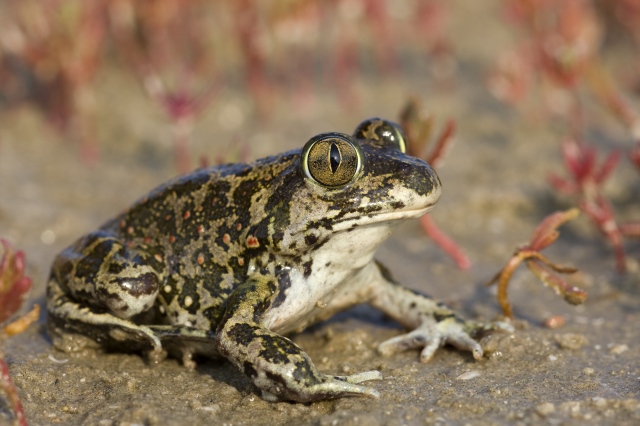
The Syrian Spadefoot has a plump body, a large head with a flat-topped skull, protruding eyes, and vertical slit-like pupils. Adults can reach approximately 9 centimetres in length.[1][2]
Its skin is smooth and bears scattered small warts. The male has a gland behind each foreleg that enlarges during the breeding season.[3][4]
The front feet have four toes, while the hind feet have five toes with deeply indented webbing between them. Each hind foot has a yellowish bony protuberance called an inner metatarsal tubercle or spade.[5][6]
The dorsal coloration is often pale grey with large, irregular greenish blotches, while the belly is pale grey.[7]
Habitat
The Syrian Spadefoot inhabits light woodland, bushy areas, semi-deserts, badlands, agricultural fields, and dunes. It also occurs in rocky habitats and pebbly clay soils.[8][9]
It prefers loose soil that allows it to dig underground burrows. Its distribution is partly limited by the availability of sufficiently large ponds without fish.[10][11]
Its distribution is also restricted by mean annual temperature and rainfall conditions.[12]
Diet
Adults forage on molluscs, spiders, insects, and other small arthropods.[13]
Tadpoles feed on algae and aquatic weeds.[14]
Behaviour
The Syrian Spadefoot is nocturnal and returns to the same burrow after nightly foraging. It excavates its own burrows and sometimes shelters in rodent holes or rock crevices.[15][16][17]
The species hibernates during winter among tree roots or beneath rocks, sometimes in groups.[18]
Its distinctive call is generally produced underwater and may continue throughout the night. The call consists of rapid, staccato sounds resembling repeated clock-like notes.[19][20]
Some juveniles overwinter as tadpoles, while many others burrow into mud at pond edges.[21]
Reproduction and life cycle
Breeding occurs between February and May, depending on geographical location. Ditches and stagnant pools are preferred locations for mating embraces.[22][23]
Females lay several thousand eggs in broad bands of gelatinous material. These bands can reach 2 centimetres in thickness and 1 metre in length.[24][25]
Tadpoles hatch approximately three days after the eggs are laid. The tadpole stage lasts approximately three to four months before metamorphosis.[26][27]
Conservation
The Syrian Spadefoot is classified as Least Concern on the IUCN Red List. Although its range is fragmented, its population is believed to be large and declining slowly.[28][29]
Habitat loss caused by land-use changes and drainage of breeding areas is its principal identified threat. Some isolated populations are vulnerable to local extinction, particularly in arid regions.[30][31]
The species is considered extinct in Jordan, while its status in Iraq is uncertain. It is described as quite common in Iran but uncommon across much of its remaining range.[32][33]
The species was rediscovered in Syria through collaboration between Syrian community scientists and Illinois researchers. An adult was discovered in a greenhouse in Burj Arab, Tartous Governorate, Syria, on March 18, 2022.[34][35]
Classification of the Syrian Spadefoot
| Kingdom | Animalia |
|---|---|
| Phylum | Chordata |
| Subphylum | Vertebrata |
| Infraphylum | Gnathostomata |
| Parvphylum | Osteichthyes |
| Megaclass | Tetrapoda |
| Class | Amphibia (Amphibians) |
| Order | Anura (Frogs) |
| Family | Pelobatidae (European Spadefoot Toad) |
| Genus | Pelobates (European Spadefoot Toad) |
| Species | Pelobates syriacus Boettger, 1889 |
Where the Syrian Spadefoot is found
Checklists and occurrence records place Pelobates syriacus in 12 countries. GBIF holds 1,107 georeferenced records of it.
Countries
- Armenia 41
- Azerbaijan 45
- Bulgaria 35
- Georgia 79
- Greece 76
- Iran 35
- Israel 614
- Romania 4
- Russia 47
- Serbia 9
- Syria 4
- Turkey 118
Regions and cities with the most records
- Even Yehuda, Israel 85
- Kadima Zoran, Israel 85
- Hod HaSharon, Israel 76
- Ramat HaSharon, Israel 76
- Qalqīlyah, Palestinian Territory 75
- Ra'anana, Israel 75
- Herzliya, Israel 74
- Eṭ Ṭīra, Israel 72
- Kfar Saba, Israel 72
- Haifa, Israel 71
- Qalansuwa, Israel 68
- Kfar Yona, Israel 66
- Netanya, Israel 62
- Central District, Israel 61
- Ganei Tikva, Israel 61
- Givatayim, Israel 61
- Kiryat Ono, Israel 61
- Tamra, Israel 61
- Bnei Brak, Israel 59
- Giv'at Shmuel, Israel 59
- Ramat Gan, Israel 59
- Tbilisi, Georgia 59
- Qiryat Ata, Israel 58
- Shefar‘am, Israel 58
- Judeida Makr, Israel 57
- Or Yehuda, Israel 56
- Qiryat Bialik, Israel 56
- Yehud Monosson, Israel 56
- Yehud-Monosson, Israel 56
- Acre, Israel 55
- Eṭ Ṭaiyiba, Israel 55
- Qiryat Motsqin, Israel 55
- Qiryat Tiv‘on, Israel 55
- Qiryat Yam, Israel 55
- Rekhasim, Israel 55
- Daliyat al Karmel, Israel 54
A number beside a place is its count of GBIF occurrence records. A place without a number comes from a checklist alone. Records show where a species has been observed or collected, which can include escapes and vagrants.
Common names
English
- Syrian Spadefoot
- Eastern Spadefoot
- Syrian Spade-foot Toad
- Syrian Spadefoot Toad
Names in 20 other languages
- Arabic
- علجوم مجرفي القدم السوري, علجوم مجرفي القدم الشرقي
- Armenian
- Սիրիական սխտորագորտ, Սխտորագորտ սիրիական
- Bulgarian
- Сирийска чесновница
- Chinese
- 敘利亞鋤足蟾
- Czech
- blatnice syrská
- Danish
- Syrisk Løgfrø
- Dutch
- Syrische Knoflookpad
- Finnish
- syyriankaivajasammakko
- French
- Pélobate syriaque
- German
- Syrische Knoblauchkröte, Syrische Schaufelkröte
- Greek
- Ανατολικός πηλοβάτης, Πηλοβάτης
- Hebrew
- חפרית מצויה, חפרית עין החתול
- Hungarian
- szíriai ásóbéka
- Japanese
- シリアニンニクガエル
- Polish
- grzebiuszka syryjska
- Romanian
- Broască de pământ verde
- Russian
- Сирийская чесночница
- Slovenian
- sirijska česnovka
- Spanish
- Sapo de espuelas sirio
- Turkish
- Sarımsaklı Kurbağa, Toprak Kurbağası
Synonyms
5 other scientific names have been used for this species and are now treated as synonyms of Pelobates syriacus.
- Pelobates syriacus boettgeri Mertens, 1923
- Pelobates syriacus syriacus Boettger, 1889
- Pelobates syriacus syriacus Boettgeri, 1989
- Pelobates transcaucasicus Delwig, 1928
- Pseudopelobates transcaucasicus (Delwig, 1928)
Related species
-
 Common Spadefoot ToadPelobates fuscus
-
 Western SpadefootPelobates cultripes
-
 Moroccan Spadefoot ToadPelobates varaldii
-
 Pallas' Spadefoot ToadPelobates vespertinus
-
 Balkan SpadefootPelobates balcanicus
Compare
Questions and answers
What is the scientific name of the Syrian Spadefoot?
The scientific name of the Syrian Spadefoot is Pelobates syriacus. Written with its author, the full name is Pelobates syriacus Boettger, 1889.
Which family does the Syrian Spadefoot belong to?
Pelobates syriacus belongs to the family Pelobatidae, in the order Anura and the class Amphibia.
Where is the Syrian Spadefoot found?
Checklists and occurrence records place Pelobates syriacus in 12 countries, including Israel, Turkey, Georgia, Greece, Russia and Azerbaijan.
What is the conservation status of the Syrian Spadefoot?
The IUCN Red List category recorded for Pelobates syriacus is Least Concern (LC).
What other names does the Syrian Spadefoot have?
Pelobates syriacus is also known in English as Eastern Spadefoot, Syrian Spade-foot Toad and Syrian Spadefoot Toad.
Are spadefoot toads rare?
The Syrian Spadefoot is quite common in Iran but uncommon across much of its remaining range. Its population is believed to be large and declining slowly, although some isolated populations are vulnerable to local extinction, particularly in arid regions.[33][29][31]
Why are they called spadefoot toads?
Each hind foot has a yellowish bony protuberance called an inner metatarsal tubercle or spade.[6]
What do spadefoot toads eat?
Adult Syrian Spadefoots forage on molluscs, spiders, insects, and other small arthropods. Tadpoles feed on algae and aquatic weeds.[13][14]
Where do spadefoot toads live?
The Syrian Spadefoot's recorded native range includes Armenia, Azerbaijan, Georgia, Greece, Iran, Israel, Lebanon, Russia, Syria, and Turkey, with Bulgaria also listed provisionally. It inhabits light woodland, bushy areas, semi-deserts, badlands, agricultural fields, dunes, rocky habitats, and pebbly clay soils.[36][8][9]
Sources
Passages the profile rests on
- The Syrian Spadefoot has a plump body, a large head with a flat-topped skull, protruding eyes, and vertical slit-like pupils. Source passage: “The eastern spadefoot is a plump toad with a large head with a flat topped skull, large, protruding eyes and vertical slit-like pupils.” — English Wikipedia
- Adults can reach approximately 9 centimetres in length. Source passage: “It can grow to a length of about 9 centimetres (3.5 in).” — English Wikipedia
- Its skin is smooth and bears scattered small warts. Source passage: “The skin is smooth with a scattering of small warts.” — English Wikipedia
- The male has a gland behind each foreleg that enlarges during the breeding season. Source passage: “The male has a large gland at the back of his fore legs which becomes enlarged in the breeding season.” — English Wikipedia
- The front feet have four toes, while the hind feet have five toes with deeply indented webbing between them. Source passage: “The front foot has four toes and the back foot has five with deeply indented webbing between them.” — English Wikipedia
- Each hind foot has a yellowish bony protuberance called an inner metatarsal tubercle or spade. Source passage: “at the back of each hind foot is a yellowish bony protuberance, the inner metatarsal tubercle or spade” — English Wikipedia
- The dorsal coloration is often pale grey with large, irregular greenish blotches, while the belly is pale grey. Source passage: “the back often being pale grey with large, greenish, irregularly shaped blotches and the belly being pale grey.” — English Wikipedia
- It inhabits light woodland, bushy areas, semi-deserts, badlands, agricultural fields, and dunes. Source passage: “It lives in light woodland, bushy and semi-desert areas, badlands, arable fields and dunes.” — English Wikipedia
- It also occurs in rocky habitats and pebbly clay soils. Source passage: “but is also found in rocky areas and pebbly clay soils.” — English Wikipedia
- It prefers loose soil that allows it to dig underground burrows. Source passage: “It prefers loose soil where it can use its spades to dig the burrow in which it lives” — English Wikipedia
- Its distribution is partly limited by the availability of sufficiently large ponds without fish. Source passage: “the distribution is additionally limited by presence of sufficiently large but fishless ponds.” — English Wikipedia
- Its distribution is restricted by mean annual temperature and rainfall conditions. Source passage: “The range of eastern spadefoot is limited by mean annual temperature and rainfall” — English Wikipedia
- Adults forage on molluscs, spiders, insects, and other small arthropods. Source passage: “foraging for molluscs, spiders, insects and other small arthropods.” — English Wikipedia
- Tadpoles feed on algae and aquatic weeds. Source passage: “eat algae and water weeds” — English Wikipedia
- The species is nocturnal and returns to the same burrow after nightly foraging. Source passage: “The eastern spadefoot is nocturnal and returns to the same lair each night when it has finished foraging” — English Wikipedia
- It excavates its own burrows. Source passage: “The burrows are made in the same manner as the Common Spadefoot” — amphibiaweb.org
- Besides digging its own burrow, it sometimes shelters in rodent holes or rock crevices. Source passage: “As well as digging its own burrow, it sometimes makes use of a rodent hole or a crevice under a rock.” — English Wikipedia
- The species hibernates during winter among tree roots or beneath rocks, sometimes in groups. Source passage: “In the winter it hibernates among tree roots or under rocks, sometimes several toads huddling together.” — English Wikipedia
- Its distinctive call is generally produced underwater and may continue throughout the night. Source passage: “The eastern spadefoot has a distinctive call, usually emitted from underwater and often continuing all night.” — English Wikipedia
- Its call consists of rapid, staccato sounds resembling repeated clock-like notes. Source passage: “It is a rapid, staccato "clock...clock...clock"” — English Wikipedia
- Some juveniles overwinter as tadpoles, while many others burrow into mud at pond edges. Source passage: “Many of these burrow into the mud at the edge of ponds to overwinter but some may overwinter as tadpoles.” — English Wikipedia
- Breeding occurs between February and May, depending on geographical location. Source passage: “Breeding takes place from February to May depending on location.” — English Wikipedia
- Ditches and stagnant pools are preferred locations for mating embraces. Source passage: “Ditches and stagnant pools are favoured locations for amplexus.” — English Wikipedia
- Females lay several thousand eggs in broad bands of gelatinous material. Source passage: “Several thousand eggs are laid in broad bands of gelatinous material” — English Wikipedia
- The gelatinous egg bands can reach 2 centimetres in thickness and 1 metre in length. Source passage: “that may be 2 cm (0.8 in) thick and 1 metre (3 ft 3 in) long.” — English Wikipedia
- Tadpoles hatch approximately three days after the eggs are laid. Source passage: “The tadpoles hatch after three days” — English Wikipedia
- The tadpole stage lasts approximately three to four months before metamorphosis. Source passage: “grow for three or four months before they undergo metamorphosis into juvenile toads.” — English Wikipedia
- The species is classified as Least Concern on the IUCN Red List. Source passage: “The eastern spadefoot is considered of "Least concern" by the IUCN Red List of Threatened Species.” — English Wikipedia
- Although its range is fragmented, its population is believed to be large and declining slowly. Source passage: “It has a wide distribution and is believed to have a large population, so, although its range is rather fragmented, it is thought to be declining sufficiently slowly” — English Wikipedia
- Habitat loss caused by land-use changes and drainage of breeding areas is its principal identified threat. Source passage: “The chief threat it faces is habitat loss due to changes in land use and the drainage of areas in which it breeds.” — English Wikipedia
- Some isolated populations are vulnerable to local extinction, particularly in arid regions. Source passage: “some of its separate populations are susceptible to local extinction due to adverse conditions, especially in arid areas.” — English Wikipedia
- The species is considered extinct in Jordan, while its status in Iraq is uncertain. Source passage: “It is thought to be extinct in Jordan and its status is unclear in Iraq.” — English Wikipedia
- The species is described as quite common in Iran but uncommon across much of its remaining range. Source passage: “It is quite common in Iran but is uncommon over much of its range.” — English Wikipedia
- The species was rediscovered in Syria through collaboration between Syrian community scientists and Illinois researchers. Source passage: “The Syrian Spadefoot Toad has been rediscovered in the war-torn country with the help of Syrian community scientists and Illinois researchers.” — herpetology.inhs.illinois.edu
- An adult was discovered in a greenhouse in Burj Arab, Tartous Governorate, Syria, on March 18, 2022. Source passage: “Adult Syrian Spadefoot Toad discovered in a greenhouse in Burj Arab, Tartous Governorate, Syria, March 18, 2022.” — herpetology.inhs.illinois.edu
- Its recorded native range includes Armenia, Azerbaijan, Georgia, Greece, Iran, Israel, Lebanon, Russia, Syria, and Turkey, with Bulgaria also listed provisionally. Source passage: “native to Armenia, Azerbaijan, Bulgaria?, Georgia, Greece?, Iran, Israel, Lebanon, Russian Federation, Syria and Turkey.” — English Wikipedia
Data
- Catalogue of Life, 2026-10-16 XR cc by
- Global Biodiversity Information Facility CC BY 4.0
- Wikidata CC0
- GeoNames CC BY 4.0
- Wikimedia Commons per image; credit shown with each image
- Within the Catalogue of Life, this name comes from The Integrated Taxonomic Information System cc0
References
- Boettger, O. (1889). Ein neuer Pelobates aus Syrien. Zoologischer Anzeiger. 12: 144–147. where the name was published
This species in other databases
- Catalogue of Life 76CZJ
- Wikidata Q1187199
- iNaturalist 25313
- WoRMS urn:lsid:marinespecies.org:taxname:1729547
Page built on 26 November 2026. See how the catalog is made and all sources and licences.
Cite this page
ScientificNames.org. (2026). Pelobates syriacus (Syrian Spadefoot). Retrieved November 26, 2026, from https://scientificnames.org/species/pelobates-syriacus
“Pelobates syriacus (Syrian Spadefoot).” ScientificNames.org, 2026, scientificnames.org/species/pelobates-syriacus. Accessed 26 Nov. 2026.
ScientificNames.org. “Pelobates syriacus (Syrian Spadefoot).” Accessed November 26, 2026. https://scientificnames.org/species/pelobates-syriacus.
@misc{scientificnames_pelobates_syriacus_syrian_spadefoot,
  author = {{ScientificNames.org}},
  title = {Pelobates syriacus (Syrian Spadefoot)},
  year = {2026},
  url = {https://scientificnames.org/species/pelobates-syriacus},
  note = {Accessed 2026-11-26}
}