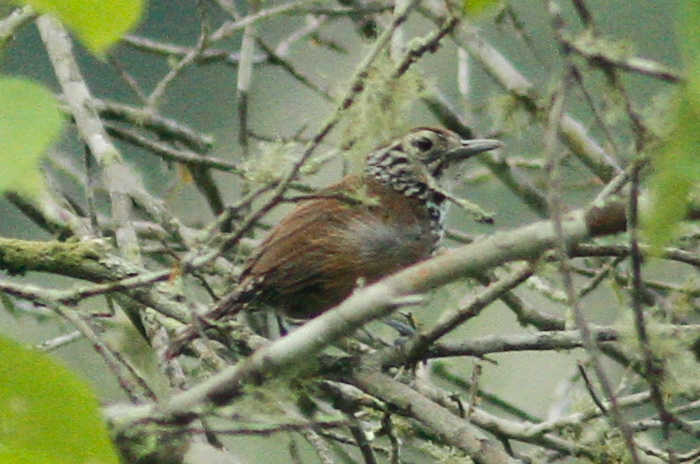
| Appearance | - Adult nominate-subspecies birds have a reddish-brown crown and medium-brown back and rump. English Wikipedia
- The nominate subspecies has a tail with alternating gray and dull-black bars. English Wikipedia
- The nominate subspecies has a narrow white supercilium and a dark eyestripe. English Wikipedia
- The nominate subspecies has black-and-white mottling on the sides of its face and neck. English Wikipedia
- The nominate subspecies has fine black-and-white barring across its underparts from the chin to the lower belly. English Wikipedia
- The nominate subspecies has diffuse barring on its lower belly and flanks, with a buff wash on the flanks. English Wikipedia
- Juvenile nominate-subspecies birds resemble adults but have underside barring that extends less far down the belly. English Wikipedia
- Adult Pheugopedius sclateri columbianus has uniformly brown upperparts with a rufous tinge on the crown. English Wikipedia
- Pheugopedius sclateri columbianus has broad dark bars on its tail. English Wikipedia
- Pheugopedius sclateri columbianus has a narrow white supercilium and a face and most underparts marked with black bars and spots on white. English Wikipedia
- The flanks of Pheugopedius sclateri columbianus are dark buff. English Wikipedia
- Adult Pheugopedius sclateri paucimaculatus has uniformly brown upperparts and black bars on its tail. English Wikipedia
- Pheugopedius sclateri paucimaculatus has a narrow white supercilium and black-and-white speckled cheeks. English Wikipedia
- The underparts of adult Pheugopedius sclateri paucimaculatus are mostly whitish, with a heavily black-speckled breast and rufescent flanks. English Wikipedia
- Juvenile Pheugopedius sclateri paucimaculatus resembles the adult but has a less heavily speckled breast. English Wikipedia
- The species is described as a distinctive, medium-sized wren. ebird.org
| - Adults of the nominate subspecies have reddish-brown crowns and upperparts, with a chestnut-colored rump. English Wikipedia
- The Spot-breasted Wren has a dull brown tail marked with narrow dark bars. English Wikipedia
- The Spot-breasted Wren has a white supercilium and black-and-white streaking across the rest of its face and neck. English Wikipedia
- Its throat, chest, and central belly are pale gray with black spots. English Wikipedia
- Its flanks and lower belly are orange-buff and lack spots. English Wikipedia
- Juveniles are paler than adults and have less extensive and dimmer facial markings and spots. English Wikipedia
- The subspecies microstictus has smaller and fewer breast spots than the nominate subspecies. English Wikipedia
- The subspecies canobrunneus has a paler appearance and a light buffy-cinnamon crown compared with the nominate subspecies. English Wikipedia
- The subspecies umbrinus is larger and darker than the nominate subspecies. English Wikipedia
|
|---|
| Size | No checked fact yet | |
|---|
| Habitat | - The species occurs from sea level to approximately 1,600 m elevation, locally at higher elevations. ebird.org
- Pheugopedius sclateri sclateri inhabits the understory of dry forest up to approximately 1,600 m elevation. English Wikipedia
- Pheugopedius sclateri columbianus inhabits dense understory along forest borders and in open woodland between 1,300 and 2,000 m elevation. English Wikipedia
- Pheugopedius sclateri paucimaculatus inhabits the interior and edges of deciduous semi-humid woodland, particularly where the understory is dense. English Wikipedia
- In Ecuador, Pheugopedius sclateri paucimaculatus occurs from lowlands to approximately 1,600 m elevation. English Wikipedia
- In Peru, Pheugopedius sclateri paucimaculatus occurs up to approximately 2,000 m elevation. English Wikipedia
| - The Spot-breasted Wren inhabits humid coastal forests and dry forests, including intact, disturbed, and regenerating forests. English Wikipedia
- The Spot-breasted Wren occurs in cocoa and citrus plantations. English Wikipedia
- The Spot-breasted Wren occurs in subtropical or tropical dry forests. inaturalist.org
- The Spot-breasted Wren inhabits vine tangles and thickets in tropical lowlands. ebird.org
- In Mexico and Honduras, the Spot-breasted Wren occurs from sea level to elevations of 1,300 m. English Wikipedia
- In Costa Rica, the Spot-breasted Wren occurs at elevations up to 200 m. English Wikipedia
|
|---|
| Diet | - Pheugopedius sclateri paucimaculatus is known to feed on insects. English Wikipedia
- The nominate subspecies and Pheugopedius sclateri columbianus are presumed to be mostly or entirely insectivorous. English Wikipedia
| - The Spot-breasted Wren's diet is not well defined but is thought to consist mainly of invertebrates. English Wikipedia
|
|---|
| Behaviour | - Pheugopedius sclateri paucimaculatus and the nominate subspecies are known to forage in the understory. English Wikipedia
- Pheugopedius sclateri paucimaculatus sometimes forages higher than the understory. English Wikipedia
- The nominate subspecies and Pheugopedius sclateri paucimaculatus usually forage in pairs. English Wikipedia
- The nominate subspecies and Pheugopedius sclateri paucimaculatus often join mixed-species foraging flocks. English Wikipedia
- Pheugopedius sclateri columbianus is presumed to use a foraging strategy similar to the other two subspecies. English Wikipedia
- The songs of the three subspecies have no known differences. English Wikipedia
- The species' song consists of a series of fast, repeated phrases. English Wikipedia
- The species' call is described as a musical rising trill. English Wikipedia
| - The Spot-breasted Wren forages at low levels in dense vegetation, usually in pairs or family groups. English Wikipedia
- The Spot-breasted Wren is heard more frequently than it is seen. ebird.org
- The Spot-breasted Wren produces a cheerful series of clear whistling gurgles as its song. English Wikipedia
- The Spot-breasted Wren has a rollicking, cheerful-sounding whistled song. ebird.org
|
|---|
| Reproduction | - The breeding season of Pheugopedius sclateri paucimaculatus apparently extends from April through September. English Wikipedia
- The reported breeding-season dates for Pheugopedius sclateri paucimaculatus are based on observations of an active nest, adults carrying food, and recently fledged young. English Wikipedia
- A described nest of Pheugopedius sclateri paucimaculatus was enclosed and constructed from sticks, vines, leaves, and lichen. English Wikipedia
- The described nest of Pheugopedius sclateri paucimaculatus was situated on the ground. English Wikipedia
| - The breeding season of the Spot-breasted Wren varies according to latitude. English Wikipedia
- The Spot-breasted Wren builds a dome-shaped nest with a side entrance. English Wikipedia
- The Spot-breasted Wren typically places its nest in a tree crotch or among ferns. English Wikipedia
- The Spot-breasted Wren's nest may be located up to 6 m above the ground. English Wikipedia
- The Spot-breasted Wren lays clutches of three to four eggs. English Wikipedia
- Both sexes of the Spot-breasted Wren feed the young. English Wikipedia
|
|---|
| Distribution | - The species occurs in Colombia, Ecuador, and Peru. English Wikipedia
- The species' overall range extends from central Colombia to northwestern Peru. ebird.org
- Pheugopedius sclateri sclateri occurs in the Marañon River drainage of extreme southern Ecuador and northern Peru. English Wikipedia
- Pheugopedius sclateri columbianus occurs in Colombia, on the western slopes of the Central and Eastern Andes. English Wikipedia
| - The Spot-breasted Wren occurs in Belize, Costa Rica, El Salvador, Guatemala, Honduras, Mexico, and Nicaragua. English Wikipedia
|
|---|
| Conservation | - All three subspecies have been separately assessed as Least Concern by the IUCN. English Wikipedia
- All three subspecies have relatively small geographic ranges. English Wikipedia
- Pheugopedius sclateri sclateri and Pheugopedius sclateri paucimaculatus occur in several protected areas. English Wikipedia
- Pheugopedius sclateri sclateri and Pheugopedius sclateri paucimaculatus are fairly common to common. English Wikipedia
- The preferred habitats of Pheugopedius sclateri sclateri and Pheugopedius sclateri paucimaculatus appear to be sufficiently available. English Wikipedia
- The population of Pheugopedius sclateri columbianus is believed to be declining because of habitat fragmentation and destruction. English Wikipedia
| - The Spot-breasted Wren is classified as Least Concern by the IUCN. English Wikipedia
- The population of the Spot-breasted Wren is estimated to contain at least 500,000 individuals. English Wikipedia
- The population trend of the Spot-breasted Wren is difficult to determine because the effects of habitat modification on population sizes are uncertain. English Wikipedia
- The IUCN Red List most recently assessed the Spot-breasted Wren in 2020. iucnredlist.org
|
|---|
| Similar species | - The species has historically been treated as conspecific with the Rufous-breasted Wren (Pheugopedius rutilus) and Spot-breasted Wren (Pheugopedius maculipectus). English Wikipedia
| - The Spot-breasted Wren forms a superspecies with the Rufous-breasted Wren and the Speckle-breasted Wren. English Wikipedia
|
|---|
| Other | - The species forms a superspecies with the Rufous-breasted Wren and Spot-breasted Wren. English Wikipedia
- The International Ornithological Committee and Clements taxonomy recognize three subspecies of this species. English Wikipedia
- The three recognized subspecies are Pheugopedius sclateri sclateri, Pheugopedius sclateri columbianus, and Pheugopedius sclateri paucimaculatus. English Wikipedia
- BirdLife International treats the three subspecies as separate species. English Wikipedia
| - The Spot-breasted Wren has sometimes been treated as conspecific with the Rufous-breasted Wren and the Speckle-breasted Wren. English Wikipedia
|
|---|