Species · Birds
Speckle-breasted Wren Pheugopedius sclateri
The scientific name of the Speckle-breasted Wren is Pheugopedius sclateri. It is a species of bird in the family Troglodytidae (wren), order Passeriformes. The name dates from 1879.
- Scientific name
- Pheugopedius sclateri (Taczanowski, 1879)
- Common name
- Speckle-breasted Wren
- Genus
- Pheugopedius
- Family
- Troglodytidae (Wren)
- Order
- Passeriformes
- Class
- Aves
- Red List category
- LC Least Concern
- Recorded in
- 3 countries
- Name status
- accepted in the Catalogue of Life
Overview
Pheugopedius sclateri occurs in Colombia, Ecuador, and Peru, with an overall range extending from central Colombia to northwestern Peru. It is distinguished by its speckled or barred underparts, narrow white supercilium, and brown upperparts, with differences among its three subspecies.
Written 27 November 2026 from the sources listed below. Each statement was checked against the passage it cites; statements that could not be supported were removed.
Appearance
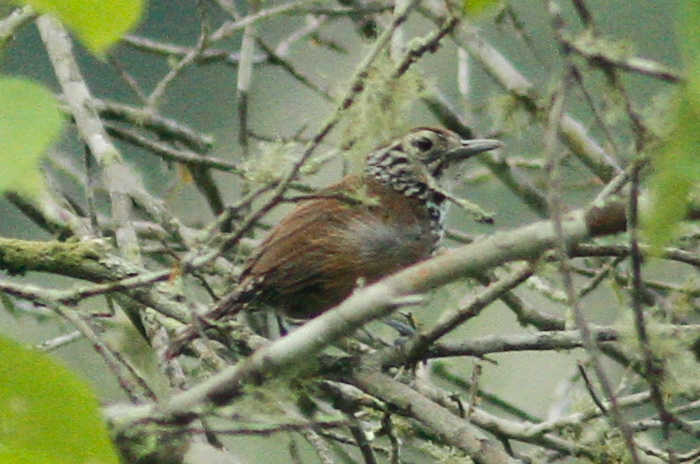
Adult nominate-subspecies birds have a reddish-brown crown, medium-brown back and rump, and a tail with alternating gray and dull-black bars. They have a narrow white supercilium, a dark eyestripe, and black-and-white mottling on the sides of the face and neck.[1][2][3][4]
The nominate subspecies has fine black-and-white barring across its underparts from the chin to the lower belly, with diffuse barring on the lower belly and flanks and a buff wash on the flanks. Juveniles resemble adults but have underside barring that extends less far down the belly.[5][6][7]
Adult Pheugopedius sclateri columbianus has uniformly brown upperparts with a rufous tinge on the crown and broad dark bars on the tail. Its narrow white supercilium contrasts with a face and most underparts marked with black bars and spots on white, while its flanks are dark buff.[8][9][10][11]
Adult Pheugopedius sclateri paucimaculatus has uniformly brown upperparts, black bars on the tail, a narrow white supercilium, and black-and-white speckled cheeks. Its underparts are mostly whitish, with a heavily black-speckled breast and rufescent flanks.[12][13][14]
Juvenile Pheugopedius sclateri paucimaculatus resembles the adult but has a less heavily speckled breast.[15]
Habitat
The species occurs from sea level to approximately 1,600 m elevation, locally at higher elevations.[16]
Pheugopedius sclateri sclateri inhabits the understory of dry forest up to approximately 1,600 m elevation. It occurs in the Marañon River drainage of extreme southern Ecuador and northern Peru.[17][18]
Pheugopedius sclateri columbianus inhabits dense understory along forest borders and in open woodland between 1,300 and 2,000 m elevation. It occurs in Colombia, on the western slopes of the Central and Eastern Andes.[19][20]
Pheugopedius sclateri paucimaculatus inhabits the interior and edges of deciduous semi-humid woodland, particularly where the understory is dense. In Ecuador it occurs from lowlands to approximately 1,600 m elevation, and in Peru up to approximately 2,000 m elevation.[21][22][23]
Diet
Pheugopedius sclateri paucimaculatus is known to feed on insects. The nominate subspecies and Pheugopedius sclateri columbianus are presumed to be mostly or entirely insectivorous.[24][25]
Behaviour
Pheugopedius sclateri paucimaculatus and the nominate subspecies forage in the understory, sometimes higher than the understory in the case of Pheugopedius sclateri paucimaculatus. They usually forage in pairs and often join mixed-species foraging flocks.[26][27][28][29]
Pheugopedius sclateri columbianus is presumed to use a foraging strategy similar to the other two subspecies.[30]
The songs of the three subspecies have no known differences. The species' song consists of a series of fast, repeated phrases, and its call is a musical rising trill.[31][32][33]
Reproduction and life cycle
The breeding season of Pheugopedius sclateri paucimaculatus apparently extends from April through September. These dates are based on observations of an active nest, adults carrying food, and recently fledged young.[34][35]
A described nest of Pheugopedius sclateri paucimaculatus was enclosed and constructed from sticks, vines, leaves, and lichen. It was situated on the ground.[36][37]
Conservation
All three subspecies have been separately assessed as Least Concern by the IUCN. All have relatively small geographic ranges.[38][39]
Pheugopedius sclateri sclateri and Pheugopedius sclateri paucimaculatus occur in several protected areas and are fairly common to common. Their preferred habitats appear to be sufficiently available.[40][41][42]
The population of Pheugopedius sclateri columbianus is believed to be declining because of habitat fragmentation and destruction.[43]
Similar species
The species forms a superspecies with the Rufous-breasted Wren (Pheugopedius rutilus) and Spot-breasted Wren (Pheugopedius maculipectus). It has historically been treated as conspecific with both species.[44][45]
Classification of the Speckle-breasted Wren
| Kingdom | Animalia |
|---|---|
| Phylum | Chordata |
| Subphylum | Vertebrata |
| Infraphylum | Gnathostomata |
| Parvphylum | Osteichthyes |
| Megaclass | Tetrapoda |
| Class | Aves (Bird) |
| Order | Passeriformes (Passerine) |
| Family | Troglodytidae (Wren) |
| Genus | Pheugopedius (Wren) |
| Species | Pheugopedius sclateri (Taczanowski, 1879) |
Where the Speckle-breasted Wren is found
Checklists and occurrence records place Pheugopedius sclateri in 3 countries. GBIF holds 12,470 georeferenced records of it.
Countries
Regions and cities with the most records
- Cundinamarca, Colombia 3,637
- Madrid, Colombia 1,840
- Mosquera, Colombia 1,807
- Sibaté, Colombia 1,764
- Soacha, Colombia 1,721
- Manabí, Ecuador 1,393
- Caldas Department, Colombia 1,181
- Chinchiná, Colombia 1,138
- Villamaría, Colombia 1,115
- Manizales, Colombia 1,113
- Neira, Colombia 1,079
- Guayas, Ecuador 1,041
- Villeta, Colombia 950
- Amazonas, Peru 933
- Guayaquil, Ecuador 882
- Loja, Ecuador 834
- Funza, Colombia 736
- Cajamarca Department, Peru 550
- Facatativá, Colombia 443
- Circasia, Colombia 422
- Santa Rosa de Cabal, Colombia 405
- Tumbes, Peru 395
- Valle del Cauca Department, Colombia 386
- Dosquebradas, Colombia 384
- Marsella, Colombia 381
- Pereira, Colombia 370
- Pacho, Colombia 367
- Risaralda Department, Colombia 367
- Chachapoyas, Peru 363
- Quimbaya, Colombia 354
- Guadalajara de Buga, Colombia 324
- Montenegro, Colombia 313
- Armenia, Colombia 306
- Calarcá, Colombia 302
- Darien, Colombia 301
- Quindío Department, Colombia 298
A number beside a place is its count of GBIF occurrence records. A place without a number comes from a checklist alone. Records show where a species has been observed or collected, which can include escapes and vagrants.
Common names
English
- Speckle-breasted Wren
- Maranon Wren
Names in 22 other languages
- Catalan
- cargolet jaspiat
- Chinese
- 斑胸鷦鷯, 鳞胸苇鹪鹩
- Croatian
- maranonski palčić
- Czech
- střízlík kropenatý
- Danish
- Stribet Smutte
- Dutch
- Marañónwinterkoning
- Esperanto
- punktobrusta troglodito
- Finnish
- kirjorintapeukaloinen
- French
- Troglodyte de Sclater
- German
- Bänderbrust-Zaunkönig, Pünktchenbrust-Zaunkönig, Pünktchenbrustzaunkönig
- Italian
- Scricciolo pettomarezzato
- Japanese
- ムナフマユミソサザイ
- Lithuanian
- Skleterio krūmyninė karietaitė
- Norwegian
- droplesmett
- Polish
- strzyżal plamisty
- Portuguese
- carriça-de-peito-pintalgado, garrinchão-de-peito-marmoreado
- Russian
- Веснушчатый крапивник, Веснушчатый кустарниковый крапивник
- Slovak
- oriešok škvrnitoprsý
- Spanish
- Cucarachero jaspeado
- Swedish
- marmorgärdsmyg
- Turkish
- Çilli Göğüslü Çıtkuşu
- Ukrainian
- поплітник плямистоволий
Synonyms
3 other scientific names have been used for this species and are now treated as synonyms of Pheugopedius sclateri.
- Thryothorus rutilus sclateri Taczanowski, W, 1879
- Thryothorus sclateri Taczanowski, 1879
- Thryothorus sclateri sclateri Taczanowski, W, 1879
Subspecies and varieties
- Pheugopedius sclateri columbianus (Colombian Wren) subspecies
- Pheugopedius sclateri paucimaculatus (Speckle-breasted Wren) subspecies
- Pheugopedius sclateri sclateri (Marañón Speckle-breasted Wren) subspecies
Related species
-
 Happy WrenPheugopedius felix
-
 Rufous-breasted WrenPheugopedius rutilus
-
 Coraya WrenPheugopedius coraya
-
 Spot-breasted WrenPheugopedius maculipectus
-
 Black-bellied WrenPheugopedius fasciatoventris
-
 Black-throated WrenPheugopedius atrogularis
-
 Whiskered WrenPheugopedius mystacalis
-
 Moustached WrenPheugopedius genibarbis
Compare
Questions and answers
What is the scientific name of the Speckle-breasted Wren?
The scientific name of the Speckle-breasted Wren is Pheugopedius sclateri. Written with its author, the full name is Pheugopedius sclateri (Taczanowski, 1879).
Which family does the Speckle-breasted Wren belong to?
Pheugopedius sclateri belongs to the family Troglodytidae, in the order Passeriformes and the class Aves.
Where is the Speckle-breasted Wren found?
Checklists and occurrence records place Pheugopedius sclateri in 3 countries: Colombia, Ecuador and Peru.
What is the conservation status of the Speckle-breasted Wren?
The IUCN Red List category recorded for Pheugopedius sclateri is Least Concern (LC).
What other names does the Speckle-breasted Wren have?
Pheugopedius sclateri is also known in English as Maranon Wren.
What bird looks like a wren but is bigger?
The Speckle-breasted Wren is described as a medium-sized wren.[46]
What are the different types of wrens?
Three subspecies of the Speckle-breasted Wren are recognized by the International Ornithological Committee and Clements taxonomy: Pheugopedius sclateri sclateri, Pheugopedius sclateri columbianus, and Pheugopedius sclateri paucimaculatus. BirdLife International treats these three subspecies as separate species.[47][48][49]
Sources
Passages the profile rests on
- Adult nominate-subspecies birds have a reddish-brown crown and medium-brown back and rump. Source passage: “Adults have a reddish brown crown and a medium brown back and rump.” — English Wikipedia
- The nominate subspecies has a tail with alternating gray and dull-black bars. Source passage: “Their tail has alternating gray and dull black bars.” — English Wikipedia
- The nominate subspecies has a narrow white supercilium and a dark eyestripe. Source passage: “They have a narrow white supercilium and a dark eyestripe” — English Wikipedia
- The nominate subspecies has black-and-white mottling on the sides of its face and neck. Source passage: “the sides of the face and neck are mottled black and white.” — English Wikipedia
- The nominate subspecies has fine black-and-white barring across its underparts from the chin to the lower belly. Source passage: “Their underparts from the chin down through the lower belly have fine black and white bars.” — English Wikipedia
- The nominate subspecies has diffuse barring on its lower belly and flanks, with a buff wash on the flanks. Source passage: “The lower belly and flanks have bars but they are more diffuse, and the flanks also have a buff wash.” — English Wikipedia
- Juvenile nominate-subspecies birds resemble adults but have underside barring that extends less far down the belly. Source passage: “Juveniles are similar to the adults but their underside's bars do not go as far down the belly.” — English Wikipedia
- Adult Pheugopedius sclateri columbianus has uniformly brown upperparts with a rufous tinge on the crown. Source passage: “Adults have uniform brown upperparts with a rufous tinge to the crown” — English Wikipedia
- Pheugopedius sclateri columbianus has broad dark bars on its tail. Source passage: “their tails have broad dark bars.” — English Wikipedia
- Pheugopedius sclateri columbianus has a narrow white supercilium and a face and most underparts marked with black bars and spots on white. Source passage: “They have a narrow white supercilium. Their face and most of their underparts are white with black bars and spots” — English Wikipedia
- The flanks of Pheugopedius sclateri columbianus are dark buff. Source passage: “the flanks are dark buff.” — English Wikipedia
- Adult Pheugopedius sclateri paucimaculatus has uniformly brown upperparts and black bars on its tail. Source passage: “Adults have uniform brown upperparts with black bars on the tail.” — English Wikipedia
- Pheugopedius sclateri paucimaculatus has a narrow white supercilium and black-and-white speckled cheeks. Source passage: “They have a narrow white supercilium and black and white speckled cheeks.” — English Wikipedia
- The underparts of adult Pheugopedius sclateri paucimaculatus are mostly whitish, with a heavily black-speckled breast and rufescent flanks. Source passage: “Most of the underparts are whitish, with a heavily black-speckled breast, and the flanks are rufescent.” — English Wikipedia
- Juvenile Pheugopedius sclateri paucimaculatus resembles the adult but has a less heavily speckled breast. Source passage: “The juvenile is similar but its breast is not as heavily speckled.” — English Wikipedia
- The species occurs from sea level to approximately 1,600 m elevation, locally at higher elevations. Source passage: “Occurs from sea level to around 1,600 m, locally higher.” — ebird.org
- Pheugopedius sclateri sclateri occurs in the Marañon River drainage of extreme southern Ecuador and northern Peru. Source passage: “the drainage of the Marañon River in extreme southern Ecuador and northern Peru” — English Wikipedia
- Pheugopedius sclateri sclateri inhabits the understory of dry forest up to approximately 1,600 m elevation. Source passage: “P. s. sclateri inhabits the undergrowth of dry forest up to approximately 1,600 m (5,200 ft) elevation.” — English Wikipedia
- Pheugopedius sclateri columbianus occurs in Colombia, on the western slopes of the Central and Eastern Andes. Source passage: “Colombia; separately the western slopes of the Central and Eastern Andes” — English Wikipedia
- Pheugopedius sclateri columbianus inhabits dense understory along forest borders and in open woodland between 1,300 and 2,000 m elevation. Source passage: “P. s. columbianus inhabits the thick understory of forest borders and open woodland at elevations between 1,300 and 2,000 m (4,300 and 6,600 ft).” — English Wikipedia
- Pheugopedius sclateri paucimaculatus inhabits the interior and edges of deciduous semi-humid woodland, particularly where the understory is dense. Source passage: “P. s. paucimaculatus inhabits the interior and edges of deciduous semi-humid woodland, especially those with a dense understory.” — English Wikipedia
- In Ecuador, Pheugopedius sclateri paucimaculatus occurs from lowlands to approximately 1,600 m elevation. Source passage: “It ranges from the lowlands to approximately 1,600 m (5,200 ft) in Ecuador” — English Wikipedia
- In Peru, Pheugopedius sclateri paucimaculatus occurs up to approximately 2,000 m elevation. Source passage: “and to 2,000 m (6,600 ft) in Peru.” — English Wikipedia
- Pheugopedius sclateri paucimaculatus is known to feed on insects. Source passage: “Pheugopedius sclateri paucimaculatus is known to eat insects” — English Wikipedia
- The nominate subspecies and Pheugopedius sclateri columbianus are presumed to be mostly or entirely insectivorous. Source passage: “the other two subspecies are assumed to also be mostly or completely insectivorous.” — English Wikipedia
- Pheugopedius sclateri paucimaculatus and the nominate subspecies are known to forage in the understory. Source passage: “It and P. s. sclateri are known to forage in the understory” — English Wikipedia
- Pheugopedius sclateri paucimaculatus sometimes forages higher than the understory. Source passage: “though the former also sometimes goes higher.” — English Wikipedia
- The nominate subspecies and Pheugopedius sclateri paucimaculatus usually forage in pairs. Source passage: “They are usually in pairs” — English Wikipedia
- The nominate subspecies and Pheugopedius sclateri paucimaculatus often join mixed-species foraging flocks. Source passage: “often join mixed-species foraging flocks.” — English Wikipedia
- Pheugopedius sclateri columbianus is presumed to use a foraging strategy similar to the other two subspecies. Source passage: “P. s. columbianus is assumed to have a similar strategy.” — English Wikipedia
- The songs of the three subspecies have no known differences. Source passage: “The songs of the three subspecies of speckle-breasted wren have no known differences.” — English Wikipedia
- The species' song consists of a series of fast, repeated phrases. Source passage: “a series of fast, repeated phrases” — English Wikipedia
- The species' call is described as a musical rising trill. Source passage: “a musical rising trill” — English Wikipedia
- The breeding season of Pheugopedius sclateri paucimaculatus apparently extends from April through September. Source passage: “Its breeding season apparently spans from April to September” — English Wikipedia
- The reported breeding-season dates for Pheugopedius sclateri paucimaculatus are based on observations of an active nest, adults carrying food, and recently fledged young. Source passage: “based on the dates of observation of an active nest, of adults carrying food, and of recent fledglings.” — English Wikipedia
- A described nest of Pheugopedius sclateri paucimaculatus was enclosed and constructed from sticks, vines, leaves, and lichen. Source passage: “The one described nest was enclosed, made from sticks, vines, leaves, and lichen” — English Wikipedia
- The described nest of Pheugopedius sclateri paucimaculatus was situated on the ground. Source passage: “and was on the ground” — English Wikipedia
- All three subspecies have been separately assessed as Least Concern by the IUCN. Source passage: “The IUCN has separately assessed all of the subspecies of speckle-breasted wren as being of Least Concern.” — English Wikipedia
- All three subspecies have relatively small geographic ranges. Source passage: “All three have relatively small ranges.” — English Wikipedia
- Pheugopedius sclateri sclateri and Pheugopedius sclateri paucimaculatus occur in several protected areas. Source passage: “P. s. sclateri and P. s. paucimaculatus occur in several protected areas” — English Wikipedia
- Pheugopedius sclateri sclateri and Pheugopedius sclateri paucimaculatus are fairly common to common. Source passage: “are fairly common to common” — English Wikipedia
- The preferred habitats of Pheugopedius sclateri sclateri and Pheugopedius sclateri paucimaculatus appear to be sufficiently available. Source passage: “appear to have enough of their preferred habitats.” — English Wikipedia
- The population of Pheugopedius sclateri columbianus is believed to be declining because of habitat fragmentation and destruction. Source passage: “the population of P. s. columbianus is believed to be decreasing due to habitat fragmentation and destruction.” — English Wikipedia
- The species has historically been treated as conspecific with the Rufous-breasted Wren (Pheugopedius rutilus) and Spot-breasted Wren (Pheugopedius maculipectus). Source passage: “The speckle-breasted wren has at times been treated as conspecific with rufous-breasted wren (P. rutilus) and spot-breasted wren (P. maculipectus).” — English Wikipedia
- The species forms a superspecies with the Rufous-breasted Wren and Spot-breasted Wren. Source passage: “They do form a superspecies.” — English Wikipedia
- The species is described as a distinctive, medium-sized wren. Source passage: “A distinctive medium-sized wren” — ebird.org
- The International Ornithological Committee and Clements taxonomy recognize three subspecies of this species. Source passage: “The International Ornithological Committee (IOC) and the Clements taxonomy recognize three subspecies.” — English Wikipedia
- The three recognized subspecies are Pheugopedius sclateri sclateri, Pheugopedius sclateri columbianus, and Pheugopedius sclateri paucimaculatus. Source passage: “Pheugopedius sclateri sclateri (Marañon) Taczanowski (1879) Pheugopedius sclateri columbianus (Colombian) Chapman (1924) Pheugopedius sclateri paucimaculatus (speckle-breasted) Sharpe (1882)” — English Wikipedia
- BirdLife International treats the three subspecies as separate species. Source passage: “BirdLife International (BLI) treats all three subspecies as separate species” — English Wikipedia
Data
- Catalogue of Life, 2026-10-16 XR cc by
- Global Biodiversity Information Facility CC BY 4.0
- Wikidata CC0
- GeoNames CC BY 4.0
- Wikimedia Commons per image; credit shown with each image
- Within the Catalogue of Life, this name comes from The Integrated Taxonomic Information System cc0
This species in other databases
Page built on 27 November 2026. See how the catalog is made and all sources and licences.
Cite this page
ScientificNames.org. (2026). Pheugopedius sclateri (Speckle-breasted Wren). Retrieved November 27, 2026, from https://scientificnames.org/species/pheugopedius-sclateri
“Pheugopedius sclateri (Speckle-breasted Wren).” ScientificNames.org, 2026, scientificnames.org/species/pheugopedius-sclateri. Accessed 27 Nov. 2026.
ScientificNames.org. “Pheugopedius sclateri (Speckle-breasted Wren).” Accessed November 27, 2026. https://scientificnames.org/species/pheugopedius-sclateri.
@misc{scientificnames_pheugopedius_sclateri_speckle_breasted_wren,
  author = {{ScientificNames.org}},
  title = {Pheugopedius sclateri (Speckle-breasted Wren)},
  year = {2026},
  url = {https://scientificnames.org/species/pheugopedius-sclateri},
  note = {Accessed 2026-11-27}
}