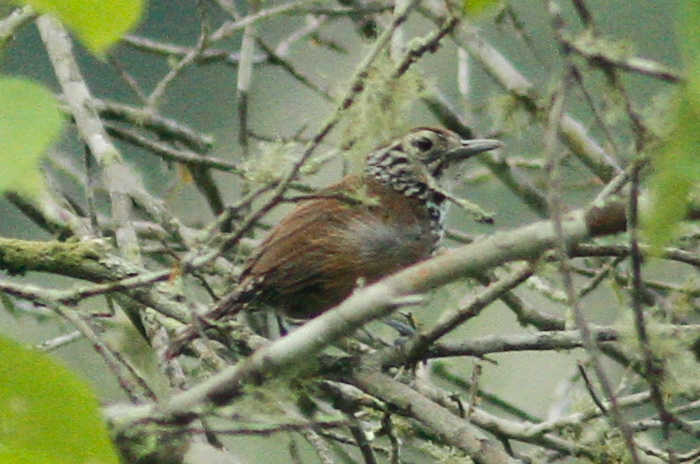
| Appearance | - Adult nominate-subspecies birds have a reddish-brown crown and medium-brown back and rump. English Wikipedia
- The nominate subspecies has a tail with alternating gray and dull-black bars. English Wikipedia
- The nominate subspecies has a narrow white supercilium and a dark eyestripe. English Wikipedia
- The nominate subspecies has black-and-white mottling on the sides of its face and neck. English Wikipedia
- The nominate subspecies has fine black-and-white barring across its underparts from the chin to the lower belly. English Wikipedia
- The nominate subspecies has diffuse barring on its lower belly and flanks, with a buff wash on the flanks. English Wikipedia
- Juvenile nominate-subspecies birds resemble adults but have underside barring that extends less far down the belly. English Wikipedia
- Adult Pheugopedius sclateri columbianus has uniformly brown upperparts with a rufous tinge on the crown. English Wikipedia
- Pheugopedius sclateri columbianus has broad dark bars on its tail. English Wikipedia
- Pheugopedius sclateri columbianus has a narrow white supercilium and a face and most underparts marked with black bars and spots on white. English Wikipedia
- The flanks of Pheugopedius sclateri columbianus are dark buff. English Wikipedia
- Adult Pheugopedius sclateri paucimaculatus has uniformly brown upperparts and black bars on its tail. English Wikipedia
- Pheugopedius sclateri paucimaculatus has a narrow white supercilium and black-and-white speckled cheeks. English Wikipedia
- The underparts of adult Pheugopedius sclateri paucimaculatus are mostly whitish, with a heavily black-speckled breast and rufescent flanks. English Wikipedia
- Juvenile Pheugopedius sclateri paucimaculatus resembles the adult but has a less heavily speckled breast. English Wikipedia
- The species is described as a distinctive, medium-sized wren. ebird.org
| - Adult nominate Rufous-breasted Wrens have warm brown crowns and upperparts, gray-brown tails with dark brown bars, and white supercilia edged in black. English Wikipedia
- The nominate subspecies has a black-and-white-speckled face and throat, a bright chestnut chest, and duller chestnut underparts with a grayish-white belly center. English Wikipedia
- Juvenile Rufous-breasted Wrens are duller than adults and have less distinct facial markings. English Wikipedia
- The species has a black face and throat densely spotted with white, contrasting sharply with its orangey-rufous breast. ebird.org
|
|---|
| Size | No checked fact yet | - Adult nominate Rufous-breasted Wrens measure approximately 14 cm in length. English Wikipedia
- Adult nominate Rufous-breasted Wrens weigh between 13.5 and 18.5 grams. English Wikipedia
|
|---|
| Habitat | - The species occurs from sea level to approximately 1,600 m elevation, locally at higher elevations. ebird.org
- Pheugopedius sclateri sclateri inhabits the understory of dry forest up to approximately 1,600 m elevation. English Wikipedia
- Pheugopedius sclateri columbianus inhabits dense understory along forest borders and in open woodland between 1,300 and 2,000 m elevation. English Wikipedia
- Pheugopedius sclateri paucimaculatus inhabits the interior and edges of deciduous semi-humid woodland, particularly where the understory is dense. English Wikipedia
- In Ecuador, Pheugopedius sclateri paucimaculatus occurs from lowlands to approximately 1,600 m elevation. English Wikipedia
- In Peru, Pheugopedius sclateri paucimaculatus occurs up to approximately 2,000 m elevation. English Wikipedia
| - The species inhabits rainforest and cloud forest. English Wikipedia
- The species prefers thickets, secondary growth, and forest edges rather than forest interiors. English Wikipedia
- The species occurs from sea level to approximately 1,900 metres elevation. English Wikipedia
|
|---|
| Diet | - Pheugopedius sclateri paucimaculatus is known to feed on insects. English Wikipedia
- The nominate subspecies and Pheugopedius sclateri columbianus are presumed to be mostly or entirely insectivorous. English Wikipedia
| - The species primarily feeds on insects, particularly beetles, bugs, and flies, as well as spiders. English Wikipedia
- The species has also been reported eating seeds, frogs, and lizards. English Wikipedia
|
|---|
| Behaviour | - Pheugopedius sclateri paucimaculatus and the nominate subspecies are known to forage in the understory. English Wikipedia
- Pheugopedius sclateri paucimaculatus sometimes forages higher than the understory. English Wikipedia
- The nominate subspecies and Pheugopedius sclateri paucimaculatus usually forage in pairs. English Wikipedia
- The nominate subspecies and Pheugopedius sclateri paucimaculatus often join mixed-species foraging flocks. English Wikipedia
- Pheugopedius sclateri columbianus is presumed to use a foraging strategy similar to the other two subspecies. English Wikipedia
- The songs of the three subspecies have no known differences. English Wikipedia
- The species' song consists of a series of fast, repeated phrases. English Wikipedia
- The species' call is described as a musical rising trill. English Wikipedia
| |
|---|
| Reproduction | - The breeding season of Pheugopedius sclateri paucimaculatus apparently extends from April through September. English Wikipedia
- The reported breeding-season dates for Pheugopedius sclateri paucimaculatus are based on observations of an active nest, adults carrying food, and recently fledged young. English Wikipedia
- A described nest of Pheugopedius sclateri paucimaculatus was enclosed and constructed from sticks, vines, leaves, and lichen. English Wikipedia
- The described nest of Pheugopedius sclateri paucimaculatus was situated on the ground. English Wikipedia
| - The species builds large spherical nests from leaves and grass, with an entrance on the side. English Wikipedia
- Rufous-breasted Wren nests are concealed in tangled vegetation at heights of up to 12 metres above ground. English Wikipedia
- The female incubates clutches containing two to four eggs. English Wikipedia
- Only the female incubates the eggs, but both parents feed the nestlings. English Wikipedia
|
|---|
| Distribution | - The species occurs in Colombia, Ecuador, and Peru. English Wikipedia
- The species' overall range extends from central Colombia to northwestern Peru. ebird.org
- Pheugopedius sclateri sclateri occurs in the Marañon River drainage of extreme southern Ecuador and northern Peru. English Wikipedia
- Pheugopedius sclateri columbianus occurs in Colombia, on the western slopes of the Central and Eastern Andes. English Wikipedia
| No checked fact yet |
|---|
| Conservation | - All three subspecies have been separately assessed as Least Concern by the IUCN. English Wikipedia
- All three subspecies have relatively small geographic ranges. English Wikipedia
- Pheugopedius sclateri sclateri and Pheugopedius sclateri paucimaculatus occur in several protected areas. English Wikipedia
- Pheugopedius sclateri sclateri and Pheugopedius sclateri paucimaculatus are fairly common to common. English Wikipedia
- The preferred habitats of Pheugopedius sclateri sclateri and Pheugopedius sclateri paucimaculatus appear to be sufficiently available. English Wikipedia
- The population of Pheugopedius sclateri columbianus is believed to be declining because of habitat fragmentation and destruction. English Wikipedia
| - The Rufous-breasted Wren was assessed as Least Concern by the IUCN. English Wikipedia
- The species is considered common across much of its range and occurs in several protected areas. English Wikipedia
- The species was most recently assessed for the IUCN Red List in 2020. iucnredlist.org
|
|---|
| Similar species | - The species has historically been treated as conspecific with the Rufous-breasted Wren (Pheugopedius rutilus) and Spot-breasted Wren (Pheugopedius maculipectus). English Wikipedia
| - The Rufous-breasted Wren has sometimes been treated as conspecific with the Speckle-breasted Wren and Spot-breasted Wren. English Wikipedia
- The Rufous-breasted Wren, Speckle-breasted Wren, and Spot-breasted Wren form a superspecies. English Wikipedia
- The facial pattern and rufous breast distinguish this species within its genus. English Wikipedia
|
|---|
| Other | - The species forms a superspecies with the Rufous-breasted Wren and Spot-breasted Wren. English Wikipedia
- The International Ornithological Committee and Clements taxonomy recognize three subspecies of this species. English Wikipedia
- The three recognized subspecies are Pheugopedius sclateri sclateri, Pheugopedius sclateri columbianus, and Pheugopedius sclateri paucimaculatus. English Wikipedia
- BirdLife International treats the three subspecies as separate species. English Wikipedia
| |
|---|