Comparison

Hume's Leaf Warbler vs Pallas's Leaf Warbler

Hume's Leaf Warbler (Phylloscopus humei) and Pallas's Leaf Warbler (Phylloscopus proregulus) both belong to the genus Phylloscopus (leaf warbler) and part ways below it. Both are recorded in 46 countries.
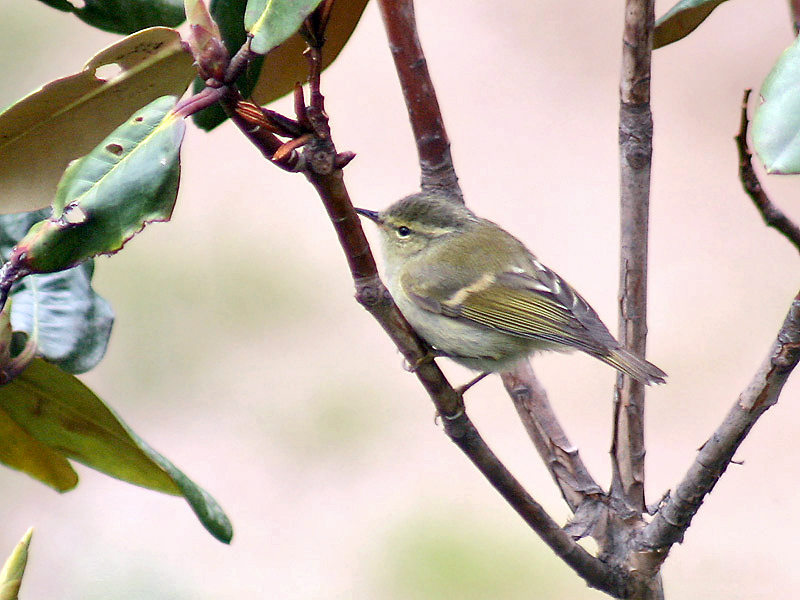
Hume's Leaf Warbler

Hume's Leaf Warbler

Phylloscopus humei

J.M.Garg, CC BY-SA 3.0, via Wikimedia Commons

Pallas's Leaf Warbler

Pallas's Leaf Warbler

Phylloscopus proregulus

christoph_moning, CC BY 4.0, via Wikimedia Commons

Side by side

Hume's Leaf WarblerPallas's Leaf Warbler
Scientific namePhylloscopus humei (W. E. Brooks, 1878)Phylloscopus proregulus (Pallas, 1811)
English nameHume's Leaf WarblerPallas's Leaf Warbler
GroupBirdsBirds
ClassAves BirdAves Bird
OrderPasseriformes PasserinePasseriformes Passerine
FamilyPhylloscopidae Leaf WarblerPhylloscopidae Leaf Warbler
GenusPhylloscopus Leaf WarblerPhylloscopus Leaf Warbler
Named in18781811
Red List categoryLeast ConcernLeast Concern
Countries on record60 countries53 countries
GBIF occurrence records120,870 records79,297 records

Rows where the two agree are shown in grey.

Where each is found

Both recorded in 46 countries

Only Hume's Leaf Warbler (14)

Only Pallas's Leaf Warbler (7)

From Catalogue of Life checklists and GBIF occurrence records. A country missing from a list means no record is held, which is not proof of absence.

Checked facts

Hume's Leaf WarblerPallas's Leaf Warbler
Appearance
  • The species has greenish upperparts and off-white underparts. English Wikipedia
  • The species has a long supercilium, a crown stripe, and yellow-margined tertial flight feathers. English Wikipedia
  • The species has one prominent light wing bar and a faint remnant of a second, shorter wing bar. English Wikipedia
  • The species has a dark lower mandible and dark legs. English Wikipedia
  • The species has greenish upperparts, white underparts, a lemon-yellow rump, yellow double wingbars, yellow supercilia and a yellow central crown stripe. English Wikipedia
  • The species has a relatively large head and a short tail. English Wikipedia
  • The species has a blackish-brown bill with yellowish areas along the cutting edges and at the base of the lower mandible. English Wikipedia
  • The species has a brown iris and brown legs with a greenish or greyish tinge. English Wikipedia
  • Non-breeding individuals are brighter green above and have broad, bright fringes on their flight feathers. English Wikipedia
  • Juveniles have brown-tinged upperparts, greyish-white underparts and a duller supercilium compared with adults. English Wikipedia
Size
Habitat
  • The species commonly inhabits mountain woodlands at elevations reaching 3,500 metres above sea level. English Wikipedia
  • The species breeds in coniferous taiga forests containing fir, spruce, pine and larch. English Wikipedia
  • The species also breeds in mixed forests containing willow and alder with a high proportion of conifers. English Wikipedia
  • During winter, the species occupies broadleaf forests, scrub and coniferous habitats. English Wikipedia
  • During winter, the species can occur in river valleys at sea level. English Wikipedia
Diet
  • The species feeds on adult insects, insect larvae, insect pupae and spiders. English Wikipedia
  • Its recorded insect prey includes flies, moths and aphids. English Wikipedia
Behaviour
  • The species forages in bushes and trees by picking prey from leaves or capturing it during short flights and hovering. English Wikipedia
  • The species frequently hovers briefly and may sometimes hang upside-down. English Wikipedia
  • Outside the breeding season, the species may forage in mixed-species flocks with tits, goldcrests and other warblers. English Wikipedia
  • The species sings from a concealed perch near the top of a tall tree. English Wikipedia
  • Its song lasts approximately 2–4 seconds. English Wikipedia
  • Its call is a short, soft dju-ee. English Wikipedia
Reproduction
  • The species generally nests from June to July, with egg laying beginning in mid-June. English Wikipedia
  • The female constructs the nest in a conifer, usually close to the trunk and 0.5–10 metres above the ground, although bushes are also used. English Wikipedia
  • The nest is a round or elliptical cup constructed from twigs, leaves and other vegetation and lined with feathers, hair or fine grasses. English Wikipedia
  • A typical clutch consists of four to six blue-grey eggs flecked with white. English Wikipedia
  • The female primarily feeds the chicks while they are in the nest, after which both parents feed them for approximately one week. English Wikipedia
  • Pairs in the southern part of the species' range may sometimes raise a second brood. English Wikipedia
  • The species can be a host of the oriental cuckoo, which parasitizes its nests. English Wikipedia
Distribution
  • The species breeds in the mountains of inner Asia. English Wikipedia
  • Both eastern and western populations migrate across the Himalayas to winter in India and adjacent regions. English Wikipedia
  • The breeding range extends across Siberia from the Altai Mountains east to the Sea of Okhotsk. English Wikipedia
  • The species also breeds in northern Mongolia and northeastern China, and possibly North Korea. English Wikipedia
  • The species winters mainly in subtropical southern China, northern Thailand and northeastern Indochina. English Wikipedia
Conservation
  • The species is classified as Least Concern on the IUCN Red List. iucnredlist.org
  • The species was most recently assessed for the IUCN Red List in 2025. iucnredlist.org
  • The global population is believed to be stable, although population trends have not been quantified. English Wikipedia
  • The species is widespread, common and locally abundant in Russia and northeastern China. English Wikipedia
  • Recorded breeding densities in southeastern Russia reach approximately 35–50 pairs per square kilometre. English Wikipedia
Similar species
  • The species closely resembles the yellow-browed warbler (Phylloscopus inornatus). English Wikipedia
  • The species was separated from the yellow-browed warbler based on morphological, bioacoustic, and molecular differences. English Wikipedia
  • The western population's range overlaps with that of the yellow-browed warbler in the western Sayan Mountains, but the two species apparently do not hybridize. English Wikipedia
  • The eastern subspecies is sometimes treated as a separate species called Mandell's leaf warbler or eastern Hume's warbler. English Wikipedia
  • The species resembles several other Asian leaf warblers, including some formerly classified as its subspecies. birdnet.cornell.edu
  • Buff-barred and Brooks's leaf warblers are larger and duller green above, with less prominent markings than Pallas's leaf warbler. English Wikipedia

In brief

Hume's Leaf Warbler

Hume's Leaf Warbler is one of the smallest Old World warblers. It breeds in the mountains of inner Asia, and both eastern and western populations migrate across the Himalayas to winter in India and adjacent regions. It has greenish upperparts, off-white underparts, a long supercilium, a crown stripe, and one prominent light wing bar. Full profile

Pallas's Leaf Warbler

Phylloscopus proregulus breeds across Siberia, northern Mongolia and northeastern China, and winters mainly in subtropical southern China, northern Thailand and northeastern Indochina. It is distinguished by its lemon-yellow rump, yellow double wingbars, yellow supercilia and yellow central crown stripe. Full profile

Compare something else

Page built on 26 November 2026 from the data on the two species pages, where every source is listed.

Cite this page

ScientificNames.org. (2026). Hume's Leaf Warbler vs Pallas's Leaf Warbler. Retrieved November 26, 2026, from https://scientificnames.org/compare/humes-leaf-warbler-vs-pallass-leaf-warbler