Species · Birds
Hume's Leaf Warbler Phylloscopus humei
The scientific name of the Hume's Leaf Warbler is Phylloscopus humei. It is a species of bird in the family Phylloscopidae (leaf warbler), order Passeriformes. The name dates from 1878.
- Scientific name
- Phylloscopus humei (W. E. Brooks, 1878)
- Common name
- Hume's Leaf Warbler
- Genus
- Phylloscopus
- Family
- Phylloscopidae (Leaf Warbler)
- Order
- Passeriformes
- Class
- Aves
- Red List category
- LC Least Concern
- Recorded in
- 60 countries
- Name status
- accepted in the Catalogue of Life
Overview
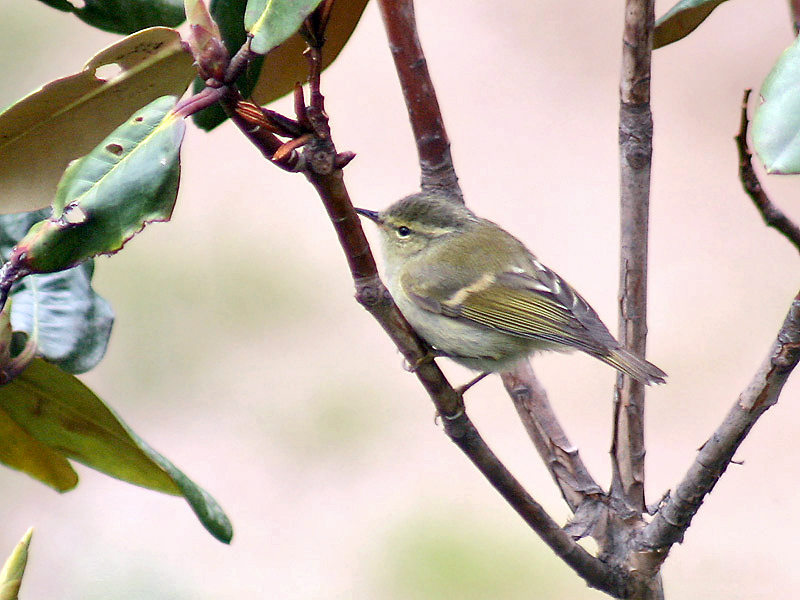
Hume's Leaf Warbler is one of the smallest Old World warblers. It breeds in the mountains of inner Asia, and both eastern and western populations migrate across the Himalayas to winter in India and adjacent regions. It has greenish upperparts, off-white underparts, a long supercilium, a crown stripe, and one prominent light wing bar.
Written 26 November 2026 from the sources listed below. Each statement was checked against the passage it cites; statements that could not be supported were removed.
Appearance
Hume's Leaf Warbler has greenish upperparts and off-white underparts. It has a long supercilium, a crown stripe, and yellow-margined tertial flight feathers.[1][2]
The species has one prominent light wing bar and a faint remnant of a second, shorter wing bar. Its lower mandible and legs are dark.[3][4]
Habitat
Hume's Leaf Warbler commonly inhabits mountain woodlands at elevations reaching 3,500 metres above sea level.[5]
Diet
Hume's Leaf Warbler is insectivorous.[6]
Behaviour
Hume's Leaf Warbler is migratory and winters mainly in India. Both eastern and western populations migrate across the Himalayas to winter in India and adjacent regions.[7][8]
The species is not shy but is difficult to observe because of its arboreal lifestyle and cryptic coloration. It is constantly in motion.[9][10][11]
The species produces a buzzing, high-pitched song. Its call is more disyllabic than that of the yellow-browed warbler.[12][13]
During autumn migration, Hume's Leaf Warbler can wander as far as western Europe.[14]
Reproduction and life cycle
Hume's Leaf Warbler builds its nest on the ground.[15]
Conservation
Hume's Leaf Warbler is common across most of its range and is not considered threatened by the IUCN.[16][17]
Similar species
Hume's Leaf Warbler closely resembles the yellow-browed warbler (Phylloscopus inornatus). The two species were separated based on morphological, bioacoustic, and molecular differences.[18][19]
The western population's range overlaps with that of the yellow-browed warbler in the western Sayan Mountains, but the two species apparently do not hybridize.[20]
The eastern subspecies is sometimes treated as a separate species called Mandell's leaf warbler or eastern Hume's warbler.[21]
Classification of the Hume's Leaf Warbler
| Kingdom | Animalia |
|---|---|
| Phylum | Chordata |
| Subphylum | Vertebrata |
| Infraphylum | Gnathostomata |
| Parvphylum | Osteichthyes |
| Megaclass | Tetrapoda |
| Class | Aves (Bird) |
| Order | Passeriformes (Passerine) |
| Family | Phylloscopidae (Leaf Warbler) |
| Genus | Phylloscopus (Leaf Warbler) |
| Species | Phylloscopus humei (W. E. Brooks, 1878) |
Where the Hume's Leaf Warbler is found
Checklists and occurrence records place Phylloscopus humei in 60 countries. GBIF holds 120,870 georeferenced records of it.
Countries
- Afghanistan 27
- Aland Islands 5
- Austria 44
- Azerbaijan 6
- Belarus 28
- Belgium 682
- Bhutan 403
- Bulgaria 21
- China 4,084
- Cyprus 20
- Denmark 1,264
- Estonia 58
- Faroe Islands 3
- Finland 173
- France 528
- Georgia 15
- Germany 378
- Greece 52
- Hong Kong 379
- Hungary 31
- Iceland 5
- India 68,553
- Iran 293
- Ireland 11
- Israel 688
- Italy 331
- Kazakhstan 2,410
- Kuwait 177
- Kyrgyzstan 1,431
- Laos 50
- Latvia 9
- Lithuania 4
- Macao 22
- Mongolia 1,226
- Myanmar 213
- Nepal 9,615
- Norway 621
- Oman 80
- Pakistan 2,168
- Palestinian Territory 21
- Poland 207
- Portugal 93
- Qatar 6
- Romania 17
- Russia 856
- Serbia 43
- South Korea 28
- Spain 736
- Sweden 5,165
- Switzerland 25
- Tajikistan 812
- Thailand 3,787
- The Netherlands 10,385
- Turkey 89
- Turkmenistan 3
- Ukraine 31
- United Arab Emirates 680
- United Kingdom 1,374
- Uzbekistan 350
- Vietnam 54
Regions and cities with the most records
- Uttarakhand, India 21,351
- Dehradun, India 9,916
- Rāipur, India 9,866
- Madhya Pradesh, India 9,798
- Clement Town, India 9,323
- Rijokri, India 6,656
- Sultan Pur, India 6,538
- Saiyad-ul-ajaib, India 6,453
- Neb Sarai, India 6,377
- Kusum Pur, India 6,344
- Malakpur Kohi Rangpur, India 6,343
- Tighri, India 6,215
- Delhi Cantonment, India 6,206
- Chhatarpur, India 6,196
- Deoli, India 6,174
- Aya Nagar, India 6,156
- Rajasthan, India 6,113
- Pul Pehlad, India 6,109
- New Delhi, India 6,083
- Taj Pul, India 5,878
- Bhati, India 5,825
- Dera Māndi, India 5,821
- Ali, India 5,820
- Chilla Soroda Bāngar, India 5,815
- Samālka, India 5,798
- Delhi, India 5,796
- Dalūpura, India 5,749
- Kāpas Herd, India 5,748
- Molārband, India 5,729
- Noida, India 5,670
- Kondli, India 5,664
- Gharonda Neemka Bangar, India 5,656
- Gharroli, India 5,601
- Jaitpur, India 5,526
- Mīthepur, India 5,497
- Mussoorie, India 5,261
1 more country has a few records outside this range
These countries hold a few records of Phylloscopus humei but lie outside the range the checklists give for it. Such records are often zoo or garden specimens, museum material or vagrants, so the species is not counted as occurring there.
A number beside a place is its count of GBIF occurrence records. A place without a number comes from a checklist alone. Records show where a species has been observed or collected, which can include escapes and vagrants.
Common names
English
- Hume's Leaf Warbler
- Hume's Leaf-warbler
- Hume's Warbler
- Hume’s Leaf Warbler
- Hume’s Leaf-warbler
Names in 43 other languages
- Arabic
- نقشارة هيوم, نقشارة هيوم صفراء الحاجب, هازجة الأوراق هيوم, هازجة هيوم
- Bulgarian
- Атласки певец
- Catalan
- mosquiter de Hume
- Chinese
- 中亞柳鶯, 淡眉柳莺, 淡眉柳鶯, 淡眉柳鶯〔休梅氏柳鶯〕
- Croatian
- srebrnastoprsi zviždak
- Czech
- budníček altajský, budníček středoasijský
- Danish
- Himalaya-sanger, Himalayaløvsanger/Humes Sanger, Himalayasanger
- Dutch
- Humes Bladkoning
- Esperanto
- altaja filoskopo
- Estonian
- tuhk-lehelind
- Finnish
- kashmirinuunilintu
- French
- Pouillot de Hume
- German
- Tienschan-Laubsänger
- Greek
- Γκριζοφυλλοσκόπος
- Hebrew
- עלווית לבנת-גבות
- Hungarian
- himalájai füzike
- Icelandic
- Hlídasöngvari, Hnökrasöngvari
- Irish
- Ceolaire Hume, Ceolaire hiúm
- Italian
- Luì, Luì di Hume
- Japanese
- バフマユムシクイ
- Kazakh
- Пеночка тусклая, Сұр сарықас
- Korean
- 연노랑눈썹솔새
- Latvian
- Hjūma ķauķītis
- Lithuanian
- sajaninė pečialinda
- Malayalam
- ചെറുകൊക്കൻ ഇലക്കുരുവി
- Nepali
- चञ्चले फिस्टो
- Northern Sami
- Kashmirajievžžan, Kashmirlastavizar, kashmirjievžžan
- Norwegian
- blekbrynsanger
- Norwegian Nynorsk
- bleikbrynsongar
- Persian
- سسک ابروزرد هیوم, سسک برگی هیوم
- Polish
- świstunka ałtajska
- Portuguese
- Felosa-listada de Hume, Felosa-listada-de-hume, felosa-de-hume, felosa-unilistada
- Romanian
- Pitulice asiatică
- Russian
- Тусклая зарничка, Тусклая пеночка
- Serbian
- Hjumov zviždak, Hjumov žviždak, Хјумов звиждак
- Slovak
- kolibiarik stužkatý
- Slovenian
- himalajska mušja listnica
- Spanish
- Mosquitero de Hume
- Swedish
- bergstaigasångare, bergstajgasångare, bergtajgasångare
- Thai
- นกกระจิ๊ดพันธุ์หิมาลัย
- Turkish
- Ak Kaşlı Çıvgın, Yaprak söğütbülbülü
- Ukrainian
- вівчарик алтайський
- Welsh
- Telor Hume
Synonyms
4 other scientific names have been used for this species and are now treated as synonyms of Phylloscopus humei.
- Abrornis humei (W.E. Brooks, 1878)
- Abrornis humei humei Brooks, WE, 1878
- Phylloscopus inornatus humei Brooks, WE, 1878
- Reguloides humei Brooks, WE, 1878
Subspecies and varieties
- Phylloscopus humei humei (Westerrn Hume’s Leaf Warbler) subspecies
- Phylloscopus humei mandellii subspecies
Related species
-
 Common ChiffchaffPhylloscopus collybita
-
 Willow WarblerPhylloscopus trochilus
-
 Yellow-browed WarblerPhylloscopus inornatus
-
 Arctic WarblerPhylloscopus borealis
-
 Pallas's Leaf WarblerPhylloscopus proregulus
-
 Greenish WarblerPhylloscopus trochiloides
-
 Dusky WarblerPhylloscopus fuscatus
-
 Radde's WarblerPhylloscopus schwarzi
Compare
Questions and answers
What is the scientific name of the Hume's Leaf Warbler?
The scientific name of the Hume's Leaf Warbler is Phylloscopus humei. Written with its author, the full name is Phylloscopus humei (W. E. Brooks, 1878).
Which family does the Hume's Leaf Warbler belong to?
Phylloscopus humei belongs to the family Phylloscopidae, in the order Passeriformes and the class Aves.
Where is the Hume's Leaf Warbler found?
Checklists and occurrence records place Phylloscopus humei in 60 countries, including India, The Netherlands, Nepal, Sweden, China and Thailand.
What is the conservation status of the Hume's Leaf Warbler?
The IUCN Red List category recorded for Phylloscopus humei is Least Concern (LC).
What other names does the Hume's Leaf Warbler have?
Phylloscopus humei is also known in English as Hume's Leaf-warbler, Hume's Warbler, Hume’s Leaf Warbler and Hume’s Leaf-warbler.
How can I identify a warbler?
Hume's Leaf Warbler has greenish upperparts, off-white underparts, a long supercilium, a crown stripe, and yellow-margined tertial flight feathers. It has one prominent light wing bar, a faint remnant of a second shorter wing bar, and dark legs and lower mandible.[1][2][3][4]
What does the warbler bird eat?
Hume's Leaf Warbler is insectivorous.[6]
Sources
Passages the profile rests on
- The species has greenish upperparts and off-white underparts. Source passage: “it has greenish upperparts and off-white underparts.” — English Wikipedia
- The species has a long supercilium, a crown stripe, and yellow-margined tertial flight feathers. Source passage: “With its long supercilium, crown stripe and yellow-margined tertial remiges” — English Wikipedia
- The species has one prominent light wing bar and a faint remnant of a second, shorter wing bar. Source passage: “it has only one prominent light wing bar, just a faint vestige of the second shorter wing bar” — English Wikipedia
- The species has a dark lower mandible and dark legs. Source passage: “It also has a dark lower mandible and legs.” — English Wikipedia
- The species commonly inhabits mountain woodlands at elevations reaching 3,500 metres above sea level. Source passage: “This is a common bird of mountain woodlands at altitudes of up to 3,500 m ASL.” — English Wikipedia
- The species is insectivorous. Source passage: “this small passerine is insectivorous.” — English Wikipedia
- The species is migratory and winters mainly in India. Source passage: “This warbler is migratory and winters mainly in India.” — English Wikipedia
- Both eastern and western populations migrate across the Himalayas to winter in India and adjacent regions. Source passage: “Both populations migrate over the Himalayas to winter in India and adjacent regions.” — English Wikipedia
- The species is not shy. Source passage: “This bird is not shy” — English Wikipedia
- The species is difficult to observe because of its arboreal lifestyle and cryptic coloration. Source passage: “although its arboreal lifestyle and cryptic colours make it difficult to observe.” — English Wikipedia
- The species is constantly in motion. Source passage: “It is constantly in motion.” — English Wikipedia
- The species produces a buzzing, high-pitched song. Source passage: “Its song is buzzing and high-pitched.” — English Wikipedia
- The species has a more disyllabic call than the yellow-browed warbler. Source passage: “The best distinction from the yellow-browed warbler is the more disyllabic call.” — English Wikipedia
- The species can wander as far as western Europe during autumn migration. Source passage: “Particularly on autumn migration, this tiny warbler is prone to vagrancy as far as western Europe” — English Wikipedia
- The species builds its nest on the ground. Source passage: “The nest is built on the ground.” — English Wikipedia
- The species is common across most of its range. Source passage: “A common species in most of its wide range” — English Wikipedia
- The species is not considered threatened by the IUCN. Source passage: “Hume's leaf-warbler is not considered threatened by the IUCN.” — English Wikipedia
- The species closely resembles the yellow-browed warbler (Phylloscopus inornatus). Source passage: “it is very similar to the yellow-browed warbler (P. inornatus).” — English Wikipedia
- The species was separated from the yellow-browed warbler based on morphological, bioacoustic, and molecular differences. Source passage: “It was recently split from the yellow-browed warbler (Phylloscopus inornatus), based on differences in morphology, bioacoustics, and molecular characters.” — English Wikipedia
- The western population's range overlaps with that of the yellow-browed warbler in the western Sayan Mountains, but the two species apparently do not hybridize. Source passage: “The western Hume's leaf warbler's range overlaps with that of the yellow-browed warbler in the western Sayan Mountains, but the species apparently do not hybridise.” — English Wikipedia
- The eastern subspecies is sometimes treated as a separate species called Mandell's leaf warbler or eastern Hume's warbler. Source passage: “The completely allopatric subspecies mandellii (Mandell's leaf warbler or eastern Hume's warbler) – sometimes separated as a full species” — English Wikipedia
Data
- Catalogue of Life, 2026-10-16 XR cc by
- Global Biodiversity Information Facility CC BY 4.0
- Wikidata CC0
- GeoNames CC BY 4.0
- Wikimedia Commons per image; credit shown with each image
- Within the Catalogue of Life, this name comes from The Integrated Taxonomic Information System cc0
References
- Str. Feath. 7 p. 131 where the name was published
This species in other databases
Page built on 26 November 2026. See how the catalog is made and all sources and licences.
Cite this page
ScientificNames.org. (2026). Phylloscopus humei (Hume's Leaf Warbler). Retrieved November 26, 2026, from https://scientificnames.org/species/phylloscopus-humei
“Phylloscopus humei (Hume's Leaf Warbler).” ScientificNames.org, 2026, scientificnames.org/species/phylloscopus-humei. Accessed 26 Nov. 2026.
ScientificNames.org. “Phylloscopus humei (Hume's Leaf Warbler).” Accessed November 26, 2026. https://scientificnames.org/species/phylloscopus-humei.
@misc{scientificnames_phylloscopus_humei_humes_leaf_warbler,
  author = {{ScientificNames.org}},
  title = {Phylloscopus humei (Hume's Leaf Warbler)},
  year = {2026},
  url = {https://scientificnames.org/species/phylloscopus-humei},
  note = {Accessed 2026-11-26}
}