Comparison
Acute Bladder Snail vs Snake River Physa Snail
Acute Bladder Snail (Physella acuta) and Snake River Physa Snail (Physella natricina) both belong to the genus Physella and part ways below it. Both are recorded in 1 country.
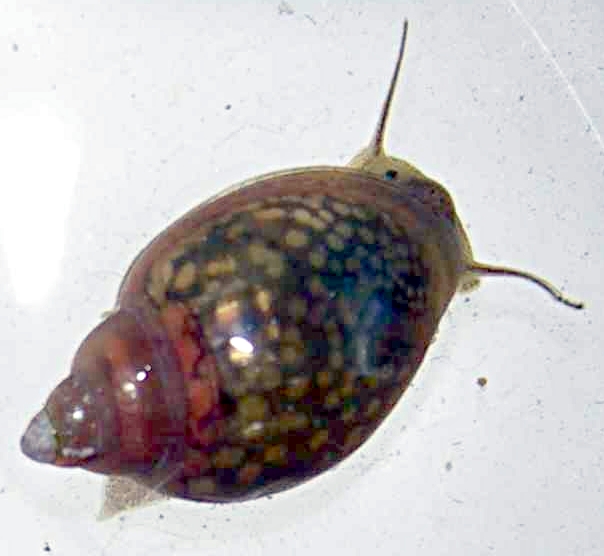

Snake River Physa Snail
Physella natricina
Side by side
| Acute Bladder Snail | Snake River Physa Snail | |
|---|---|---|
| Scientific name | Physella acuta (Draparnaud, 1805) | Physella natricina (D. W. Taylor, 1988) |
| English name | Acute Bladder Snail | Snake River Physa Snail |
| Group | Molluscs | Molluscs |
| Class | Gastropoda Gastropod | Gastropoda Gastropod |
| Family | Physidae Bladder Snails | Physidae Bladder Snails |
| Genus | Physella | Physella |
| Named in | 1805 | 1988 |
| Red List category | Least Concern | Data Deficient |
| Environment | freshwater | freshwater |
| Countries on record | 39 countries | 1 country |
| GBIF occurrence records | 47,154 records | 15 records |
Rows where the two agree are shown in grey.
Where each is found
Both recorded in 1 country
Only Acute Bladder Snail (38)
- Australia
- Austria
- Bahamas
- Barbados
- Belgium
- Bermuda
- Bonaire, Saint Eustatius and Saba
- Canada
- Costa Rica
- Cuba
- Dominican Republic
- France
- Germany
- Guadeloupe
- Guatemala
- Haiti
- Italy
- Jamaica
- Japan
- Martinique
- Mexico
- Montserrat
- New Zealand
- Nicaragua
- Panama
- Poland
- Portugal
- Puerto Rico
- Saint Barthelemy
- Saint Martin
- Sint Maarten
- South Korea
- Spain
- Switzerland
- The Netherlands
- Trinidad and Tobago
- U.S. Virgin Islands
- United Kingdom
From Catalogue of Life checklists and GBIF occurrence records. A country missing from a list means no record is held, which is not proof of absence.
Checked facts
| Acute Bladder Snail | Snake River Physa Snail | |
|---|---|---|
| Appearance |
| No checked fact yet |
| Size |
| No checked fact yet |
| Habitat |
| No checked fact yet |
| Diet |
| No checked fact yet |
| Behaviour |
| No checked fact yet |
| Reproduction |
| No checked fact yet |
| Distribution |
| No checked fact yet |
| Uses |
| No checked fact yet |
In brief
Acute Bladder Snail
Physella acuta inhabits lakes, ponds, streams, ditches and artificial freshwater environments. It is a simultaneous hermaphrodite that can reproduce through mating or self-fertilisation. Full profile
Compare something else
Page built on 24 November 2026 from the data on the two species pages, where every source is listed.
Cite this page
ScientificNames.org. (2026). Acute Bladder Snail vs Snake River Physa Snail. Retrieved November 24, 2026, from https://scientificnames.org/compare/acute-bladder-snail-vs-snake-river-physa-snail
“Acute Bladder Snail vs Snake River Physa Snail.” ScientificNames.org, 2026, scientificnames.org/compare/acute-bladder-snail-vs-snake-river-physa-snail. Accessed 24 Nov. 2026.
ScientificNames.org. “Acute Bladder Snail vs Snake River Physa Snail.” Accessed November 24, 2026. https://scientificnames.org/compare/acute-bladder-snail-vs-snake-river-physa-snail.
@misc{scientificnames_acute_bladder_snail_vs_snake_river_physa_snail,
  author = {{ScientificNames.org}},
  title = {Acute Bladder Snail vs Snake River Physa Snail},
  year = {2026},
  url = {https://scientificnames.org/compare/acute-bladder-snail-vs-snake-river-physa-snail},
  note = {Accessed 2026-11-24}
}