Species · Molluscs
Acute Bladder Snail Physella acuta
The scientific name of the Acute Bladder Snail is Physella acuta. It is a species of mollusc in the family Physidae (bladder snails). The name dates from 1805.
- Scientific name
- Physella acuta (Draparnaud, 1805)
- Common name
- Acute Bladder Snail
- Genus
- Physella
- Family
- Physidae (Bladder Snails)
- Class
- Gastropoda
- Red List category
- LC Least Concern
- Environment
- freshwater
- Recorded in
- 39 countries
- Name status
- accepted in the Catalogue of Life
Overview
Physella acuta inhabits lakes, ponds, streams, ditches and artificial freshwater environments. It is a simultaneous hermaphrodite that can reproduce through mating or self-fertilisation.
Written 24 November 2026 from the sources listed below. Each statement was checked against the passage it cites; statements that could not be supported were removed.
Appearance
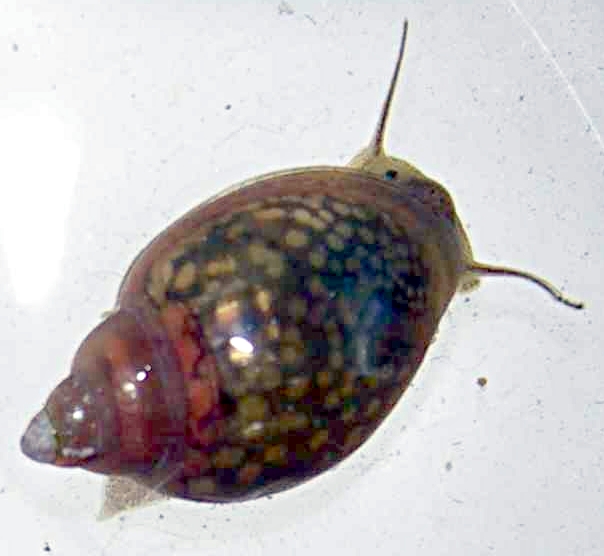
The shell has an ear-shaped aperture extending approximately three-quarters of its total height. It is thin, with thickness increasing in response to predator presence.[1][2]
The animal's body colour varies from blue to dark grey. The upper mantle has golden spots that are often visible through the shell.[3][4]
The mantle has seven to eleven finger-like lobes on the right side and four to six on the left. The tentacles are slender, cylindrical, grey and almost transparent, with small black eyes at their bases.[5][6]
The foot is narrow and terminates in a pointed tail.[7]
Habitat
The Acute Bladder Snail inhabits lakes, ponds, streams and ditches. It also occupies artificial freshwater environments, including reservoirs, sewage drains and irrigation systems.[8][9]
It tolerates polluted and oxygen-deprived waters and can occupy freshwater habitats with widely varying water availability.[10][11]
Diet
The Acute Bladder Snail feeds by scraping green algae, diatoms and aquatic plants from surfaces.[12]
Behaviour
The Acute Bladder Snail can rapidly twist its shell clockwise through rotations of up to 120 degrees. This movement helps defend it against slow-moving predators such as leeches and fly larvae, but is ineffective against fast-moving predators that actively pursue it.[13][14][15]
The mantle lobes can extract additional oxygen from the environment and help detect predators through touch-sensitive tissue. The eyes distinguish only between light and dark.[16][17]
Reproduction and life cycle
The Acute Bladder Snail is a simultaneous hermaphrodite with functioning male and female reproductive organs. Individuals can reproduce through mating with another individual or through self-fertilisation.[18][19]
Outcrossing accounts for most reproduction in natural populations, while self-fertilisation rates range from 10 to 30 percent. Self-fertilisation can become more frequent when potential mates are scarce.[20][21][22]
Individuals reach maturity for outcrossing after approximately five to seven weeks and for self-fertilisation at approximately 14 weeks.[23][24]
Sexually mature individuals reproduce throughout the year and lay 50–100 eggs weekly. The eggs are deposited in elongated gelatinous sacs attached to rocks, compacted mud or other individuals' shells.[25][26]
Eggs hatch approximately 15–20 days after deposition.[27]
Uses
The Acute Bladder Snail is used as a model organism in biological research. It is also used in studies assessing pesticide toxicity across different life stages.[28][29]
Controlled populations in aquariums can help remove organic leftovers and control algal growth.[30]
Classification of the Acute Bladder Snail
| Kingdom | Animalia |
|---|---|
| Phylum | Mollusca |
| Class | Gastropoda (Gastropod) |
| Subclass | Heterobranchia |
| Infraclass | Euthyneura |
| Subterclass | Tectipleura |
| Superorder | Hygrophila |
| Family | Physidae (Bladder Snails) |
| Subfamily | Physinae |
| Genus | Physella |
| Species | Physella acuta (Draparnaud, 1805) |
Where the Acute Bladder Snail is found
Checklists and occurrence records place Physella acuta in 39 countries across North America. GBIF holds 47,154 georeferenced records of it.
Countries
- Australia 1,935
- Austria 532
- Bahamas 49
- Barbados 3
- Belgium 3,463
- Bermuda 16
- Bonaire, Saint Eustatius and Saba 29
- Canada 715
- Costa Rica 20
- Cuba 153
- Dominican Republic 4
- France 4,258
- Germany 1,147
- Guadeloupe 8
- Guatemala 10
- Haiti 42
- Italy 445
- Jamaica 47
- Japan 1,386
- Martinique 5
- Mexico 487
- Montserrat 6
- New Zealand 3,032
- Nicaragua 5
- Panama 16
- Poland 466
- Portugal 692
- Puerto Rico 27
- Saint Barthelemy 3
- Saint Martin 5
- Sint Maarten 3
- South Korea 3,119
- Spain 1,627
- Switzerland 2,766
- The Netherlands 6,911
- Trinidad and Tobago 11
- U.S. Virgin Islands 40
- United Kingdom 3,315
- United States 10,356
Regions and cities with the most records
- England, United Kingdom 2,844
- Spijkenisse, The Netherlands 1,497
- Vlaardingen, The Netherlands 1,366
- Schiedam, The Netherlands 1,362
- Rotterdam, The Netherlands 1,139
- Delft, The Netherlands 1,078
- Hawke's Bay Region, New Zealand 979
- Capelle aan den IJssel, The Netherlands 868
- Ridderkerk, The Netherlands 852
- Centre-Val de Loire, France 822
- Rijswijk, The Netherlands 791
- South Australia, Australia 788
- Victoria, Australia 788
- Zoetermeer, The Netherlands 770
- Zwijndrecht, The Netherlands 669
- Mechelen, Belgium 665
- Illinois, United States 628
- Utrecht, The Netherlands 621
- Alphen aan den Rijn, The Netherlands 608
- The Hague, The Netherlands 606
- Woerden, The Netherlands 596
- Utrecht, The Netherlands 592
- Hilversum, The Netherlands 567
- Amstelveen, The Netherlands 566
- Dordrecht, The Netherlands 559
- Gelderland, The Netherlands 559
- Geneva, Switzerland 547
- Zürich, Switzerland 536
- Gyeongsangnam-do, South Korea 535
- Gouda, The Netherlands 525
- Nieuwegein, The Netherlands 523
- Zurich, Switzerland 520
- Zeeland, The Netherlands 514
- Beveren, Belgium 512
- Hoofddorp, The Netherlands 509
- Deurne, Belgium 507
70 more countries have a few records outside this range
These countries hold a few records of Physella acuta but lie outside the range the checklists give for it. Such records are often zoo or garden specimens, museum material or vagrants, so the species is not counted as occurring there.
- Albania 5
- Algeria 20
- Angola 5
- Argentina 58
- Armenia 3
- Bangladesh 3
- Brazil 46
- Bulgaria 18
- Chile 11
- China 79
- Colombia 42
- Croatia 10
- Czechia 36
- Denmark 43
- Egypt 73
- Finland 20
- French Guiana 3
- French Polynesia 8
- Greece 121
- Hong Kong 12
- Hungary 229
- India 48
- Indonesia 10
- Iran 35
- Iraq 9
- Ireland 6
- Isle of Man 3
- Israel 37
- Kenya 27
- Libya 4
- Liechtenstein 7
- Lithuania 17
- Luxembourg 28
- Macao 3
- Malaysia 4
- Malta 47
- Mauritius 21
- Montenegro 14
- Morocco 78
- Myanmar 10
- Namibia 3
- Nepal 9
- New Caledonia 4
- Nigeria 5
- North Macedonia 6
- Norway 42
- Oman 5
- Peru 7
- Philippines 5
- Reunion 42
- Romania 66
- Russia 34
- Rwanda 4
- Serbia 9
- Seychelles 8
- Singapore 3
- Slovakia 16
- South Africa 105
- Sweden 82
- Syria 4
- Taiwan 172
- Tanzania 7
- Thailand 186
- Turkey 15
- Ukraine 56
- Uruguay 11
- Uzbekistan 4
- Venezuela 5
- Vietnam 4
- Zimbabwe 27
Range as the checklists state it
North America
A number beside a place is its count of GBIF occurrence records. A place without a number comes from a checklist alone. Records show where a species has been observed or collected, which can include escapes and vagrants.
Common names
English
- Acute Bladder Snail
- Pewter Physa
- Ashy Physa
- Carib Physa
- European Physa
- Polished Physa
- Protean Physa
- Sharp-spired Bladder Snail
- Texas Physa
- Bladder Snail
- Pointed Bladder Snail
- Tadpole Snail
Names in 24 other languages
- Afrikaans
- Skerppuntblaasslak
- Albanian
- kërmilli mëshikëz me majë
- Catalan
- Caragol de Bufeta Punxegut
- Chinese
- 囊螺, 尖小膀胱螺
- Czech
- levatka ostrá
- Dutch
- Amerikaanse blaashoren, puntige blaashoren
- Finnish
- karkurikotilo
- French
- Physe aiguë, Physe américaine, Physe d'Amérique, Physe voyageuse
- German
- Amerikanische Blasenschnecke, Spitze Blasenschnecke
- Hebrew
- בועונית חדה
- Hungarian
- Tömzsi hólyagcsiga
- Italian
- Chiocciola sinistrorsa
- Japanese
- サカマキガイ
- Korean
- 왼돌이물달팽이
- Lithuanian
- Smailiakiautė pūsliasraigė
- Polish
- Rozdętka zaostrzona
- Portuguese
- Caracol-bexiga
- Russian
- Заостренная физа
- Slovak
- fyza končistá
- Spanish
- Caracol de vejiga afilada
- Swedish
- amerikansk blåssnäcka, sydeuropeisk blåssnäcka, sydeuropeisk båtsnäcka
- Thai
- หอยคันเวียนซ้าย
- Tswana
- Kgopa
- Ukrainian
- Пухирчик загострений
Synonyms
143 other scientific names have been used for this species and are now treated as synonyms of Physella acuta.
- Aplecta orbignyi Mazé, 1883
- Aplecta rivalis (Maton & Rackett, 1807)
- Aplexa (Stenophysa) orbignyi Mazé, 1883
- Aplexa rivalis (Maton & Rackett, 1807)
- Bulinus acutus (Draparnaud, 1805)
- Bulinus acutus normalis H. Beck, 1838
- Bulla rivalis Maton & Rackett, 1807
- Costatella acuta (Draparnaud, 1805)
- Haitia acuta (Draparnaud, 1805)
- Haitia cubensis (L. Pfeiffer, 1839)
- Haitia integra (Haldeman, 1841)
- Haitia mexicana (R. A. Philippi, 1841)
- Lymnaea heterostropha Say, 1817
- Lymnaea heterostropha Say, 1825
- Physa (Aplecta) rivalis (Maton & Rackett, 1807)
- Physa (Diastropha) integra Haldeman, 1841
- Physa (Physa) syriaca Germain, 1911
- Physa achaiae Westerlund, 1881
- Physa acroxa Fagot, 1883
- Physa acuta Draparnaud, 1805
- Physa acuta var. bulla Schlesch, 1907
- Physa acuta var. caerulescens Mabille, 1865
- Physa acuta var. castanea Schlesch, 1907
- Physa acuta var. fusca Kobelt, 1880
- Physa acuta var. gibbosa Moquin-Tandon, 1843
- Physa acuta var. major Locard, 1880
- Physa acuta var. minima T. D. A. Cockerell, 1889
- Physa acuta var. minor Bourguignat, 1864
- Physa acuta var. minor Moquin-Tandon, 1855
- Physa acuta var. septentrionalis Kobelt, 1880
- Physa acuta var. subacuta Moquin-Tandon, 1855
- Physa acuta var. thermalis C. R. Boettger, 1913
- Physa acuta var. ventricosa Moquin-Tandon, 1855
- Physa anatina I. Lea, 1864
- Physa ancillaria crassa B. Walker, 1901
- Physa ancillaria var. crassa B. Walker, 1901
- Physa balteata Preston, 1907
- Physa berendti Strebel, 1874
- Physa berendti var. intermedia P. Fischer & Crosse, 1886
- Physa billingsii Heron, 1880
Showing 40 of 143.
Questions and answers
What is the scientific name of the Acute Bladder Snail?
The scientific name of the Acute Bladder Snail is Physella acuta. Written with its author, the full name is Physella acuta (Draparnaud, 1805).
Which family does the Acute Bladder Snail belong to?
Physella acuta belongs to the family Physidae and the class Gastropoda.
Where is the Acute Bladder Snail found?
Checklists and occurrence records place Physella acuta in 39 countries, including United States, The Netherlands, France, Belgium, United Kingdom and South Korea.
What is the conservation status of the Acute Bladder Snail?
The IUCN Red List category recorded for Physella acuta is Least Concern (LC).
What other names does the Acute Bladder Snail have?
Physella acuta is also known in English as Pewter Physa, Ashy Physa, Carib Physa, European Physa, Polished Physa and Protean Physa.
Are bladder snails asexual?
The Acute Bladder Snail is a simultaneous hermaphrodite with functioning male and female reproductive organs. Individuals can reproduce by mating with another individual or through self-fertilisation, which accounts for 10 to 30 percent of reproduction in natural populations.[18][19][21]
How big will a bladder snail get?
The shell reaches a maximum length of 16 mm and width of 9 mm. Its thickness ranges from 0.15 to 0.35 mm, depending on environmental predator cues and self-fertilisation rates.[31][32]
What do bladder snails eat?
The Acute Bladder Snail feeds by scraping green algae, diatoms and aquatic plants from surfaces.[12]
Do bladder snails eat live plants?
The Acute Bladder Snail feeds on aquatic plants by scraping them from surfaces.[12]
Sources
Passages the profile rests on
- The shell has an ear-shaped aperture that extends approximately three-quarters of its total height. Source passage: “The aperture is ear-shaped and extends about three-quarters of the total shell height.” — English Wikipedia
- The shell is thin, with thickness increasing in response to predator presence. Source passage: “P. acuta's shell is thin, but shell thickness increases in the presence of predators, a response known as "adaptive plasticity".” — English Wikipedia
- The animal's body colour varies from blue to dark grey. Source passage: “The body of P. acuta is very variable in colour, which can range from blue to dark grey.” — English Wikipedia
- The upper mantle has golden spots that are often visible through the shell. Source passage: “The top mantle (tissue covering the visceral mass of the animal) has golden spots often visible under the thin shell.” — English Wikipedia
- The mantle has seven to eleven finger-like lobes on the right side and four to six on the left. Source passage: “Finger-like lobes extend from the mantle on both sides of the body (7–11 on the right side and 4–6 on the left)” — English Wikipedia
- Its tentacles are slender, cylindrical, grey and almost transparent, with small black eyes at their bases. Source passage: “The tentacles are grey and follow the build of other members within the family Physidae: cylindrical and slender, almost transparent, with small black eyes at the base.” — English Wikipedia
- The foot is narrow and terminates in a pointed tail. Source passage: “The foot is narrow and ends in a pointed tail, as is also typical of the family.” — English Wikipedia
- The species inhabits lakes, ponds, streams and ditches. Source passage: “P. acuta has been reported in lakes, ponds, streams, and ditches” — English Wikipedia
- The species also occupies artificial freshwater environments, including reservoirs, sewage drains and irrigation systems. Source passage: “as well as artificial sites such as reservoirs, sewage drains, and irrigation systems.” — English Wikipedia
- The species tolerates polluted and oxygen-deprived waters. Source passage: “As a pulmonate snail, it tolerates harsh environmental conditions such as polluted and eutrophic (oxygen-deprived) waters, since it is able to come to the surface to breathe air.” — English Wikipedia
- The species can occupy freshwater habitats with widely varying water availability. Source passage: “P. acuta can occupy a variety of freshwater habitats as well as habitats varying widely in water availability.” — English Wikipedia
- The species feeds by scraping green algae, diatoms and aquatic plants from surfaces. Source passage: “It is a scraper feeder and uses its radula (a tongue-like structure covered in small chitinous teeth) to scrape green algae, diatoms, and aquatic plants from the surface.” — English Wikipedia
- The species can rapidly twist its shell clockwise through rotations of up to 120 degrees. Source passage: “Based on dissections, Naranjo-García and Appleton (2009) proposed that these muscles allow the snail to rapidly twist its shell in clockwise rotations of up to 120°.” — English Wikipedia
- Shell twisting helps the snail defend itself against slow-moving predators such as leeches and fly larvae. Source passage: “This shell-shaking movement is an important defence against slow-moving predators like leeches and fly larvae, which cannot properly attach to the moving shell.” — English Wikipedia
- The shell-twisting defence is ineffective against fast-moving predators that actively pursue the snail. Source passage: “However, it is not effective when predators are fast-moving and actively pursue the snails, as is the case with water bugs.” — English Wikipedia
- The mantle lobes can extract additional oxygen from the environment and help detect predators through touch-sensitive tissue. Source passage: “They can act as an accessory gill by extracting additional oxygen from the environment and help detect predators through their touch-sensitive tissue.” — English Wikipedia
- The eyes distinguish only between light and dark. Source passage: “These pit eyes only distinguish between light and dark.” — English Wikipedia
- The species is a simultaneous hermaphrodite with functioning male and female reproductive organs. Source passage: “P. acuta is a simultaneous hermaphrodite, meaning it has both male and female reproductive organs functioning at the same time.” — English Wikipedia
- Individuals can reproduce through either mating with another individual or self-fertilisation. Source passage: “P. acuta is a simultaneous hermaphrodite which is self-compatible, meaning it is capable of both outcrossing (reproduction with another individual) and self-fertilisation.” — English Wikipedia
- Outcrossing accounts for most reproduction in natural populations. Source passage: “In natural populations, reproduction occurs mainly by outcrossing” — English Wikipedia
- Self-fertilisation rates in natural populations range from 10 to 30 percent. Source passage: “self-fertilisation rates still remain between 10 and 30 percent” — English Wikipedia
- Self-fertilisation can become more frequent when potential mates are scarce. Source passage: “and can increase as an adaptation strategy when mates are scarce.” — English Wikipedia
- Individuals reach maturity for outcrossing after approximately five to seven weeks. Source passage: “snails first reach outcrossing maturity after about 5–7 weeks” — English Wikipedia
- Individuals reach maturity for self-fertilisation at approximately 14 weeks. Source passage: “while self-fertilisation maturity comes at around 14 weeks.” — English Wikipedia
- Sexually mature individuals reproduce throughout the year and lay 50–100 eggs weekly. Source passage: “Sexually mature adults breed year-round and lay 50–100 eggs per week.” — English Wikipedia
- Eggs are deposited in elongated gelatinous sacs attached to rocks, compacted mud or other individuals' shells. Source passage: “Eggs are deposited in elongate gelatinous sacs, which they attach to rock, compacted mud, or the shells of other P. acuta.” — English Wikipedia
- Eggs hatch approximately 15–20 days after deposition. Source passage: “Eggs hatch after 15–20 days.” — English Wikipedia
- The species is used as a model organism in biological research. Source passage: “Due to its abundance, high reproductive rate, short generation time, and ease of laboratory cultivation, P. acuta is widely studied as a model organism” — English Wikipedia
- The species is used in studies assessing pesticide toxicity across different life stages. Source passage: “P. acuta has been used to assess pesticide toxicity across life stages” — English Wikipedia
- Controlled populations in aquariums can help remove organic leftovers and control algal growth. Source passage: “However, a controlled population in an aquarium can help clean up organic leftovers and control algal growth.” — English Wikipedia
- The shell reaches a maximum length of 16 mm and width of 9 mm. Source passage: “The shell is small, reaching up to 16 mm (0.63 in) length and 9 mm (0.35 in) in width.” — English Wikipedia
- Shell thickness ranges from 0.15 to 0.35 mm depending on environmental predator cues and self-fertilisation rates. Source passage: “In 2010 Auld and Relyea reported shell thickness in P. acuta ranging from 0.15 mm (0.0059 in) to 0.35 mm (0.014 in), depending on predator cues in the environment and self-fertilisation rates.” — English Wikipedia
- The species has a North American origin, with evidence supporting an origin in the United States. Source passage: “Comparative anatomy, fossil evidence, and phylogenetic data also support a North American origin, specifically within the United States.” — English Wikipedia
- The species occurs on every continent except Antarctica. Source passage: “It is an invasive species which can be found on all continents except Antarctica” — English Wikipedia
- The species' spread beyond North America has been largely facilitated by the aquarium trade. Source passage: “P. acuta is widely dispersed across the globe, largely due to the aquarium trade.” — English Wikipedia
Data
- Catalogue of Life, 2026-10-16 XR cc by
- Global Biodiversity Information Facility CC BY 4.0
- Wikidata CC0
- GeoNames CC BY 4.0
- Wikimedia Commons per image; credit shown with each image
- Within the Catalogue of Life, this name comes from World Register of Marine Species cc by
References
- Draparnaud, J. P. R. (1805) Histoire naturelle des mollusques terrestres et fluviatiles de la France. Louis Colas, Paris, 140 pp. where the name was published
This species in other databases
Page built on 24 November 2026. See how the catalog is made and all sources and licences.
Cite this page
ScientificNames.org. (2026). Physella acuta (Acute Bladder Snail). Retrieved November 24, 2026, from https://scientificnames.org/species/physella-acuta
“Physella acuta (Acute Bladder Snail).” ScientificNames.org, 2026, scientificnames.org/species/physella-acuta. Accessed 24 Nov. 2026.
ScientificNames.org. “Physella acuta (Acute Bladder Snail).” Accessed November 24, 2026. https://scientificnames.org/species/physella-acuta.
@misc{scientificnames_physella_acuta_acute_bladder_snail,
  author = {{ScientificNames.org}},
  title = {Physella acuta (Acute Bladder Snail)},
  year = {2026},
  url = {https://scientificnames.org/species/physella-acuta},
  note = {Accessed 2026-11-24}
}