Comparison

Hooded Pitohui vs Black-naped Oriole

Hooded Pitohui (Pitohui dichrous) and Black-naped Oriole (Oriolus chinensis) both belong to the family Oriolidae (old world oriole) and part ways below it. Both are recorded in 1 country.

Hooded Pitohui

Hooded Pitohui

Pitohui dichrous

Benjamin Freeman, CC BY 4.0, via Wikimedia Commons

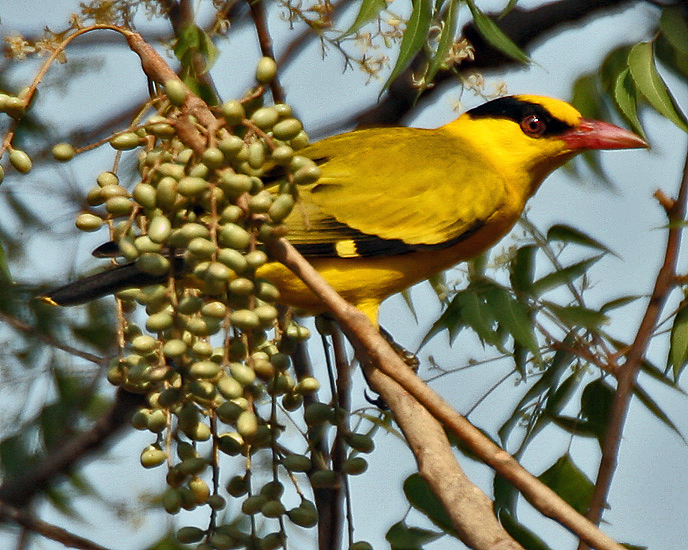
Black-naped Oriole

Black-naped Oriole

Oriolus chinensis

J.M.Garg, CC BY 3.0, via Wikimedia Commons

Side by side

Hooded PitohuiBlack-naped Oriole
Scientific namePitohui dichrous (Bonaparte, 1850)Oriolus chinensis Linnaeus, 1766
English nameHooded PitohuiBlack-naped Oriole
GroupBirdsBirds
ClassAves BirdAves Bird
OrderPasseriformes PasserinePasseriformes Passerine
FamilyOriolidae Old World OrioleOriolidae Old World Oriole
GenusPitohui Morning BirdsOriolus Oriole
Named in18501766
Red List categoryLeast ConcernLeast Concern
EnvironmentNot recordedterrestrial
Countries on record2 countries27 countries
GBIF occurrence records3,007 records209,513 records

Rows where the two agree are shown in grey.

Where each is found

Both recorded in 1 country

Only Hooded Pitohui (1)

Only Black-naped Oriole (26)

From Catalogue of Life checklists and GBIF occurrence records. A country missing from a list means no record is held, which is not proof of absence.

Checked facts

Hooded PitohuiBlack-naped Oriole
Appearance
  • Adults have reddish-brown and black plumage, with black covering the head, throat, upper breast, upperwings and tail. English Wikipedia
  • Both sexes have similar plumage. English Wikipedia
  • Juveniles resemble adults but have brown-tinged wing and tail flight feathers. English Wikipedia
  • Its bill and legs are black, while its irises range from reddish brown to dark brown or black. English Wikipedia
  • The adult male has predominantly golden-yellow plumage, black wings and tail, and a broad black band extending through the eyes. ebird.org
  • The species has a broad black mask and nape, golden plumage, and a strong pinkish bill. English Wikipedia
  • The female has a greener wing lining than the male. English Wikipedia
  • The female has a greener or more olive-coloured mantle than the male. English Wikipedia
  • Juvenile birds have streaked undersides. English Wikipedia
  • Nestlings have dull greenish plumage with brown streaks. English Wikipedia
  • Adult males have yellow tips on their central tail feathers, while their lateral tail feathers have broader yellow areas. English Wikipedia
  • The species has a pink bill that is stouter than the bill of the golden oriole. English Wikipedia
  • The Andaman subspecies has entirely black wings. English Wikipedia
  • The Nicobar subspecies has a very broad nape band that leaves only the top of the head yellow. English Wikipedia
  • Southern populations show reduced yellow on the forehead and less bright yellow plumage than northern populations. English Wikipedia
Size
Habitat
Diet
  • Fruit, particularly figs belonging to the genus Ficus, forms the main component of its diet. English Wikipedia
  • Grass seeds are among its food sources. English Wikipedia
  • Its invertebrate prey includes beetles, spiders, earwigs, bugs, flies, caterpillars and ants. English Wikipedia
  • The species may also consume small vertebrates. English Wikipedia
  • It forages at all forest levels, from the ground to the canopy. English Wikipedia
  • Beetles of the genus Choresine have been identified in the stomachs of hooded pitohuis as a possible dietary source of their toxins. English Wikipedia
Behaviour
  • The species is social and lives in family groups. English Wikipedia
  • It regularly joins mixed-species foraging flocks. English Wikipedia
  • On Yapen and at elevations of 1,100–1,300 m, it frequently leads mixed-species foraging flocks. English Wikipedia
  • Its song consists of three to seven whistles that may rise or fall in pitch with pauses between them. English Wikipedia
  • Its song usually starts with two similar notes followed by an ascending whistle. English Wikipedia
  • Young birds display a threat posture by rising and erecting their head feathers when approached in the nest. English Wikipedia
Reproduction
  • Nests containing eggs have been recorded between October and February. English Wikipedia
  • A described nest was located approximately 2 m above the ground. English Wikipedia
  • The nest is a cup constructed from vine tendrils, lined with finer vines and suspended from thin branches. English Wikipedia
  • A typical clutch contains one or two eggs. English Wikipedia
  • Eggs measure 27–32.8 mm by 20.5–22.2 mm. English Wikipedia
  • Eggs are creamy or pinkish and marked with brown to black spots and blotches and faint grey patches. English Wikipedia
  • Observed young birds were fed red acorn-shaped berries and insects. English Wikipedia
Distribution
  • The hooded pitohui is endemic to the islands of New Guinea. English Wikipedia
  • Its distribution includes the main island of New Guinea and the nearby island of Yapen. English Wikipedia
Conservation
  • The hooded pitohui is classified as Least Concern on the IUCN Red List. English Wikipedia
  • The species is common and widespread throughout New Guinea. English Wikipedia
  • Its populations are lower in disturbed lowland agricultural habitats than in undisturbed forest, but increase in disturbed mountain habitats. English Wikipedia
  • The species is trapped and sold in the bird trade in many parts of Southeast Asia. English Wikipedia
Similar species
  • The hooded pitohui is most closely related to variable pitohuis within its genus. English Wikipedia
  • The non-toxic juvenile greater melampitta has plumage resembling that of the hooded pitohui. English Wikipedia
No checked fact yet
Other
  • The hooded pitohui contains batrachotoxin compounds in its skin, feathers and other tissues. English Wikipedia
  • The skin and feathers are more toxic than the internal organs and skeletal muscles. English Wikipedia
  • The species is believed to acquire its toxins through its diet rather than producing them itself. English Wikipedia
  • Toxic feathers have been shown experimentally to deter chewing lice and reduce their survival. English Wikipedia
No checked fact yet

In brief

Hooded Pitohui

Pitohui dichrous is endemic to the islands of New Guinea, including the main island of New Guinea and the nearby island of Yapen. It contains batrachotoxin compounds in its skin, feathers and other tissues. Full profile

Black-naped Oriole

The Black-naped Oriole (Oriolus chinensis Linnaeus, 1766) is a medium-sized bird in the family Oriolidae, order Passeriformes and class Aves. The species occurs across many parts of Asia, inhabiting forests, gardens and plantations. It is distinguished by golden plumage, a broad black mask and nape, black wings and tail, and a strong pinkish bill. Full profile

Compare something else

Page built on 28 November 2026 from the data on the two species pages, where every source is listed.

Cite this page

ScientificNames.org. (2026). Hooded Pitohui vs Black-naped Oriole. Retrieved November 28, 2026, from https://scientificnames.org/compare/hooded-pitohui-vs-black-naped-oriole