Species · Birds
Black-naped Oriole Oriolus chinensis
The scientific name of the Black-naped Oriole is Oriolus chinensis. It is a species of bird in the family Oriolidae (old world oriole), order Passeriformes. The name dates from 1766.
- Scientific name
- Oriolus chinensis Linnaeus, 1766
- Common name
- Black-naped Oriole
- Genus
- Oriolus
- Family
- Oriolidae (Old World Oriole)
- Order
- Passeriformes
- Class
- Aves
- Red List category
- LC Least Concern
- Environment
- terrestrial
- Recorded in
- 27 countries
- Name status
- accepted in the Catalogue of Life
Overview
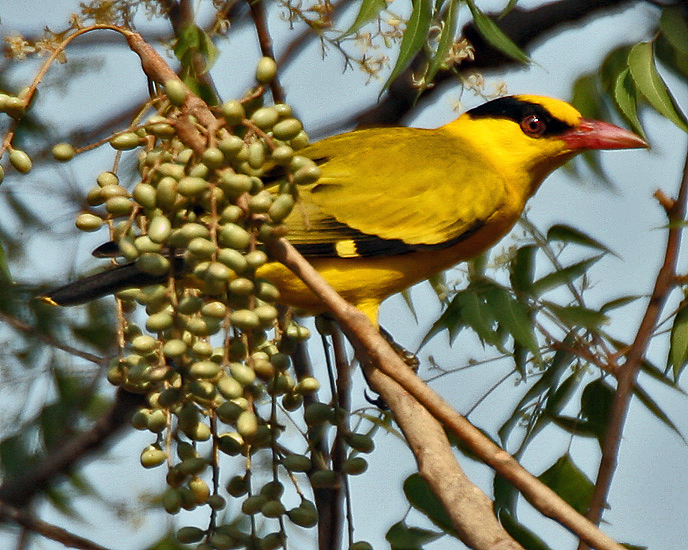
The Black-naped Oriole (Oriolus chinensis Linnaeus, 1766) is a medium-sized bird in the family Oriolidae, order Passeriformes and class Aves. The species occurs across many parts of Asia, inhabiting forests, gardens and plantations. It is distinguished by golden plumage, a broad black mask and nape, black wings and tail, and a strong pinkish bill.
Written 26 November 2026 from the sources listed below. Each statement was checked against the passage it cites; statements that could not be supported were removed.
Appearance
The adult male has predominantly golden-yellow plumage, black wings and tail, and a broad black band extending through the eyes. The species has a broad black mask and nape and a strong pinkish bill that is stouter than the bill of the golden oriole.[1][2][3]
The female has a greener wing lining and a greener or more olive-coloured mantle than the male. Juvenile birds have streaked undersides, while nestlings have dull greenish plumage with brown streaks.[4][5][6][7]
Adult males have yellow tips on their central tail feathers and broader yellow areas on their lateral tail feathers. The Andaman subspecies has entirely black wings, while the Nicobar subspecies has a very broad nape band that leaves only the top of the head yellow.[8][9][10]
Southern populations show reduced yellow on the forehead and less bright yellow plumage than northern populations.[11]
Habitat
The Black-naped Oriole occurs in forests, gardens and plantations. It feeds in the canopy.[12][13]
Diet
The species eats berries and insects. Recorded berry foods include Trema orientalis and Ficus.[14][15]
In India, the species takes nectar from large flowers, including those of Salmalia and Erythrina.[16]
Behaviour
The species has a dipping flight. Its usual call is a nasal niee or myaa sound.[17][18]
The species may have contributed to the dispersal of Ficus species on Krakatoa.[19]
Reproduction and life cycle
The usual breeding season is April to June, while the Nicobar population breeds from January to March. The nest is a deep cup constructed in a fork of a tree, often near nests of black drongos.[20][21][22]
A typical clutch contains two or three eggs. The eggs are salmon-pink with reddish spots and darker blotches.[23][24]
Females may construct two or three nests before selecting one for egg laying. The female alone incubates the eggs, which hatch after 14 to 16 days.[25][26][27]
The chicks fledge approximately two weeks after hatching. Females participate in nest sanitation, predator deterrence and feeding the young, while males take a more active role in feeding and guarding them.[28][29][30]
Eurasian tree sparrows and black bulbuls sometimes occupy abandoned nests of this species.[31]
Conservation
The species is trapped and sold in the bird trade in many parts of Southeast Asia.[32]
Classification of the Black-naped Oriole
| Kingdom | Animalia |
|---|---|
| Phylum | Chordata |
| Subphylum | Vertebrata |
| Infraphylum | Gnathostomata |
| Parvphylum | Osteichthyes |
| Megaclass | Tetrapoda |
| Class | Aves (Bird) |
| Order | Passeriformes (Passerine) |
| Family | Oriolidae (Old World Oriole) |
| Genus | Oriolus (Oriole) |
| Species | Oriolus chinensis Linnaeus, 1766 |
Where the Black-naped Oriole is found
Checklists and occurrence records place Oriolus chinensis in 27 countries. GBIF holds 209,513 georeferenced records of it.
Countries
- Bangladesh 415
- Bhutan 5
- Cambodia 5,083
- China 8,124
- Cocos Islands 3
- Hong Kong 1,188
- India 21,469
- Indonesia 9,464
- Iran 8
- Japan 66
- Laos 283
- Macao 67
- Malaysia 21,986
- Mongolia 25
- Myanmar 980
- Nepal 28
- North Korea 40
- Pakistan 5
- Philippines 20,405
- Russia 405
- Singapore 52,471
- South Korea 23,494
- Sri Lanka 53
- Taiwan 12,513
- Thailand 29,098
- United Arab Emirates 11
- Vietnam 1,824
Regions and cities with the most records
- Ang Mo Kio New Town, Singapore 52,127
- Yio Chu Kang, Singapore 52,118
- Novena, Singapore 52,021
- Yishun New Town, Singapore 51,524
- Sungai Simpang, Singapore 51,318
- Bukit Timah, Singapore 50,847
- Sengkang New Town, Singapore 50,728
- Queenstown Estate, Singapore 50,699
- Sembawang Estate, Singapore 50,307
- Woodlands, Singapore 47,647
- Anak Bukit, Singapore 47,249
- Matilda Estate, Singapore 47,097
- Singapore, Singapore 46,708
- Bukit Panjang New Town, Singapore 46,058
- Teck Whye, Singapore 45,546
- Choa Chu Kang New Town, Singapore 45,396
- Yew Tee, Singapore 45,211
- MacPherson, Singapore 44,797
- Eunos, Singapore 44,555
- Keat Hong Village, Singapore 44,064
- Jurong East, Singapore 43,871
- Jurong West, Singapore 43,215
- Marsiling, Singapore 43,149
- Jurong Town, Singapore 43,088
- Punggol, Singapore 42,482
- Marine Parade, Singapore 41,240
- Ulu Bedok, Singapore 40,897
- Kampong Pasir Ris, Singapore 40,544
- Bedok New Town, Singapore 39,759
- Boon Lay, Singapore 38,423
- Kampung Pasir Gudang Baru, Malaysia 36,408
- Johor Bahru, Malaysia 34,156
- Pasir Gudang, Malaysia 33,913
- Kampong Loyang, Singapore 31,696
- Masai, Malaysia 28,368
- Bandar Seri Alam, Malaysia 25,293
5 more countries have a few records outside this range
These countries hold a few records of Oriolus chinensis but lie outside the range the checklists give for it. Such records are often zoo or garden specimens, museum material or vagrants, so the species is not counted as occurring there.
A number beside a place is its count of GBIF occurrence records. A place without a number comes from a checklist alone. Records show where a species has been observed or collected, which can include escapes and vagrants.
Common names
English
- Black-naped Oriole
Names in 49 other languages
- Bengali
- কালাঘাড় বেনেবউ
- Breton
- Glazaour Sina
- Burmese
- ငှက်ဘုန်းကြီး
- Catalan
- oriol de la Xina
- Chinese
- 黃鸝, 黃鸝〔黑枕黃鸝〕, 黑枕黄鹂
- Croatian
- crnokapa vuga
- Czech
- žluva černošíjná
- Danish
- Sortnakket Pirol
- Dutch
- Chinese Wielewaal
- Esperanto
- nigranuka oriolo
- Estonian
- maskpeoleo
- Finnish
- naamiokuhankeittäjä
- French
- Loriot de Chine
- Georgian
- შავთავა მოლაღური
- German
- Schwarznackenpirol
- Hungarian
- amuri sárgarigó
- Indonesian
- Kepodang, Kepodang kuduk-hitam, Kepudang kapas, Kepudang kuduk-hitam
- Italian
- Oriolo nucanera
- Japanese
- コウライウグイス
- Korean
- 꾀꼬리
- Latvian
- melnkakla vālodze
- Lithuanian
- kininė volungė
- Malay
- Burung Kunyit Besar
- Malayalam
- ചീനമഞ്ഞക്കിളി
- Mongolian
- Дорнын шаргач
- Nepali
- कालोगर्दने सुनचरी
- Norwegian
- svartnakkepirol
- Persian
- پریشاهرخ چینی
- Polish
- wilga chińska, wilga maskowa
- Portuguese
- papa-figos-chinês, papa-figos-de-nuca-preta
- Russian
- Китайская иволга
- Serbian
- Kineska vuga
- Slovak
- vlha čiernotylová
- Spanish
- Oropéndola china, Oropéndola de nuca negra
- Swedish
- svartnackad gylling
- Tamil
- கரும்பிடரி மாங்குயில்
- Thai
- นกขมิ้นท้ายทอยดำ
- Turkish
- Kara Enseli Sarıasma
- Ukrainian
- вивільга чорноголова
- Vietnamese
- Vàng anh gáy đen
- Welsh
- euryn gwarddu
- arz
- الاوريول ذو القيلولة السوداء
- ban
- Clalongan
- chm
- Шим вуян царамак
- hak
- Vòng-ên
- jav
- Manuk kepodhang
- pnb
- کالے اگیوالا بسنتی پنچھی
- sun
- Bincarung
- zha
- Roeghenj
Synonyms
3 other scientific names have been used for this species and are now treated as synonyms of Oriolus chinensis.
- Oriolus chinensis macassariensis Hartert, EJO, 1925
- Oriolus indicus Jerdon
- Turdus cochinchinae Pennant, T, 1781
Subspecies and varieties
- Oriolus chinensis andamanensis subspecies
- Oriolus chinensis boneratensis subspecies
- Oriolus chinensis broderipi subspecies
- Oriolus chinensis celebensis subspecies
- Oriolus chinensis chinensis subspecies
- Oriolus chinensis diffusus subspecies
- Oriolus chinensis formosus subspecies
- Oriolus chinensis frontalis subspecies
- Oriolus chinensis fugaensis subspecies
- Oriolus chinensis insularis subspecies
- Oriolus chinensis lamprochryseus subspecies
- Oriolus chinensis macrourus subspecies
- Oriolus chinensis maculatus subspecies
- Oriolus chinensis melanisticus subspecies
- Oriolus chinensis mundus subspecies
- Oriolus chinensis richmondi subspecies
- Oriolus chinensis sangirensis subspecies
- Oriolus chinensis sipora subspecies
- Oriolus chinensis sorsogonensis subspecies
- Oriolus chinensis stresemanni subspecies
- Oriolus chinensis suluensis subspecies
- Oriolus chinensis yamamurae subspecies
Related species
-
 Eurasian Golden OrioleOriolus oriolus
-
 Black-hooded OrioleOriolus xanthornus
-
 Indian Golden OrioleOriolus kundoo
-
 Black-headed OrioleOriolus larvatus
-
 Maroon OrioleOriolus traillii
-
 Green OrioleOriolus flavocinctus
-
 African Golden OrioleOriolus auratus
-
 Isabela OrioleOriolus isabellae
Compare
Questions and answers
What is the scientific name of the Black-naped Oriole?
The scientific name of the Black-naped Oriole is Oriolus chinensis. Written with its author, the full name is Oriolus chinensis Linnaeus, 1766.
Which family does the Black-naped Oriole belong to?
Oriolus chinensis belongs to the family Oriolidae, in the order Passeriformes and the class Aves.
Where is the Black-naped Oriole found?
Checklists and occurrence records place Oriolus chinensis in 27 countries, including Singapore, Thailand, South Korea, Malaysia, India and Philippines.
What is the conservation status of the Black-naped Oriole?
The IUCN Red List category recorded for Oriolus chinensis is Least Concern (LC).
How rare is black naped oriole?
The Black-naped Oriole is common in Singapore, including within city gardens. It has a broad distribution across many parts of Asia.[33][34]
What do black naped orioles eat?
They eat berries and insects. Recorded foods include Trema orientalis and Ficus berries, and in India they also take nectar from large flowers, including those of Salmalia and Erythrina.[14][15][16]
Sources
Passages the profile rests on
- The adult male has predominantly golden-yellow plumage, black wings and tail, and a broad black band extending through the eyes. Source passage: “Male entirely golden-yellow apart from black wings and tail and a broad black band through the eyes.” — ebird.org
- The species has a broad black mask and nape, golden plumage, and a strong pinkish bill. Source passage: “The black-naped oriole is medium-sized and overall golden with a strong pinkish bill and a broad black mask and nape.” — English Wikipedia
- The species has a pink bill that is stouter than the bill of the golden oriole. Source passage: “The bill is pink and is stouter than in the golden oriole.” — English Wikipedia
- The female has a greener wing lining than the male. Source passage: “Males and females are very similar although the wing lining of the female is more greenish.” — English Wikipedia
- The female has a greener or more olive-coloured mantle than the male. Source passage: “The female has the mantle colour more greenish or olive.” — English Wikipedia
- Juvenile birds have streaked undersides. Source passage: “The juvenile has a streaked underside.” — English Wikipedia
- Nestlings have dull greenish plumage with brown streaks. Source passage: “The nestling has dull greenish with brown streaks.” — English Wikipedia
- Adult males have yellow tips on their central tail feathers, while their lateral tail feathers have broader yellow areas. Source passage: “The adult male has the central tail feathers tipped yellow and the lateral ones are more broadly yellow.” — English Wikipedia
- The Andaman subspecies has entirely black wings. Source passage: “The subspecies in the Andamans, O. c. andamanensis has all black wings” — English Wikipedia
- The Nicobar subspecies has a very broad nape band that leaves only the top of the head yellow. Source passage: “O. c. macrourus of the Nicobars has a very broad nape band so that only the top of the head is yellow.” — English Wikipedia
- Southern populations show reduced yellow on the forehead and less bright yellow plumage than northern populations. Source passage: “some geographic trends include a reduction of yellow on the forehead and a decreased brightness in the yellow plumage from north to south.” — English Wikipedia
- The species occurs in forests, gardens and plantations. Source passage: “The black-naped oriole is found in forests, gardens and plantations.” — English Wikipedia
- The species feeds in the canopy. Source passage: “It feeds on berries and insects in the canopy.” — English Wikipedia
- The species eats berries and insects. Source passage: “It feeds on berries and insects in the canopy.” — English Wikipedia
- Recorded berry foods include Trema orientalis and Ficus. Source passage: “Black-naped orioles have been recorded to feed on a range of berries including Trema orientalis, Ficus and others apart from insects.” — English Wikipedia
- In India, the species takes nectar from large flowers, including those of Salmalia and Erythrina. Source passage: “In India it has been noted to take nectar from large flowers such as those of Salmalia and Erythrina.” — English Wikipedia
- The species has a dipping flight. Source passage: “They have a dipping flight.” — English Wikipedia
- Its usual call is a nasal niee or myaa sound. Source passage: “The usual call is a nasal niee or myaa” — English Wikipedia
- The species may have contributed to the dispersal of Ficus species on Krakatoa. Source passage: “It has been suggested that they may have aided in the dispersal of Ficus species into the island of Krakatoa where they were also among the early pioneer species.” — English Wikipedia
- The usual breeding season is April to June, while the Nicobar population breeds from January to March. Source passage: “The breeding season is April to June (January–March in the Nicobars)” — English Wikipedia
- The nest is a deep cup constructed in a fork of a tree. Source passage: “the nest is a deep cup in a fork of a tree.” — English Wikipedia
- Nests are often constructed near nests of black drongos. Source passage: “The nests are often built in the vicinity of the nest of a black drongo.” — English Wikipedia
- A typical clutch contains two or three eggs. Source passage: “The eggs, two to three, are salmon pink with reddish spots and darker blotches” — English Wikipedia
- The eggs are salmon-pink with reddish spots and darker blotches. Source passage: “The eggs, two to three, are salmon pink with reddish spots and darker blotches” — English Wikipedia
- Females may construct two or three nests before selecting one for egg laying. Source passage: “Two or three nests may be built by the female and one is finally chosen for laying eggs.” — English Wikipedia
- The female alone incubates the eggs. Source passage: “Incubation is by the female alone” — English Wikipedia
- The eggs hatch after an incubation period of 14 to 16 days. Source passage: “the eggs hatch after 14 to 16 days” — English Wikipedia
- The chicks fledge approximately two weeks after hatching. Source passage: “the chicks fledge after another two weeks.” — English Wikipedia
- Females participate in nest sanitation, predator deterrence and feeding the young. Source passage: “Females stay closer to the nest, taking part in nest sanitation by removal of fecal sacs, driving away predators and feeding the young.” — English Wikipedia
- Males take a more active role in feeding and guarding the young. Source passage: “The males take a more active role in feeding and guarding.” — English Wikipedia
- Eurasian tree sparrows and black bulbuls sometimes occupy abandoned nests of this species. Source passage: “Eurasian tree sparrows and black bulbuls may sometimes use abandoned nests.” — English Wikipedia
- The species is trapped and sold in the bird trade in many parts of Southeast Asia. Source passage: “In many parts of Southeast Asia, they are trapped and sold in the bird trade.” — English Wikipedia
- The species has a broad distribution across many parts of Asia. Source passage: “The black-naped oriole (Oriolus chinensis) is a passerine bird in the oriole family that is found in many parts of Asia.” — English Wikipedia
- The species is common in Singapore, including within city gardens. Source passage: “In Singapore they are believed to have established as breeders only in the 1920s and are today common even within gardens in the city.” — English Wikipedia
- The black-naped oriole is a medium-sized bird. Source passage: “The black-naped oriole is medium-sized” — English Wikipedia
Data
- Catalogue of Life, 2026-10-16 XR cc by
- Global Biodiversity Information Facility CC BY 4.0
- Wikidata CC0
- GeoNames CC BY 4.0
- Wikimedia Commons per image; credit shown with each image
- Within the Catalogue of Life, this name comes from The Integrated Taxonomic Information System cc0
References
- Linnaeus, Carolus. 1766. Systema naturae sive regna tria naturae, secundum classes, ordines, genera, species, cum characteribus, differentiis, synonymis, locis. Laurentii Salvii, Holmiae [= Stockholm]. Vol. I, No. 1, Edito duodecima, reformata: 1-532. where the name was published
- Gill, Frank, & and Minturn Wright. (2006). Birds of the World: Recommended English Names.
This species in other databases
- Catalogue of Life 757GG
- Wikidata Q74092
- iNaturalist 7867
- WoRMS urn:lsid:marinespecies.org:taxname:1476309
- Avibase blnori1
Page built on 29 November 2026. See how the catalog is made and all sources and licences.
Cite this page
ScientificNames.org. (2026). Oriolus chinensis (Black-naped Oriole). Retrieved November 29, 2026, from https://scientificnames.org/species/oriolus-chinensis
“Oriolus chinensis (Black-naped Oriole).” ScientificNames.org, 2026, scientificnames.org/species/oriolus-chinensis. Accessed 29 Nov. 2026.
ScientificNames.org. “Oriolus chinensis (Black-naped Oriole).” Accessed November 29, 2026. https://scientificnames.org/species/oriolus-chinensis.
@misc{scientificnames_oriolus_chinensis_black_naped_oriole,
  author = {{ScientificNames.org}},
  title = {Oriolus chinensis (Black-naped Oriole)},
  year = {2026},
  url = {https://scientificnames.org/species/oriolus-chinensis},
  note = {Accessed 2026-11-29}
}