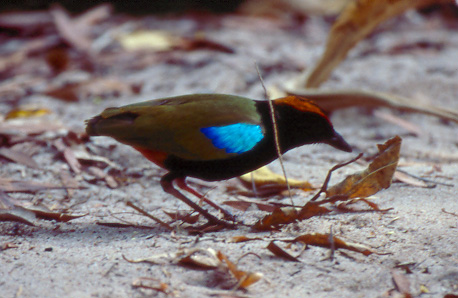
| Appearance | - The Rainbow Pitta has a velvet-black head with chestnut stripes above the eyes, olive-green upperparts, black underparts and a bright red belly. English Wikipedia
- The Rainbow Pitta has green wings with a golden sheen and a shining blue patch on the lesser wing coverts. English Wikipedia
- Male and female Rainbow Pittas have essentially identical plumage. English Wikipedia
| - The African pitta has a plump body and a somewhat thrush-like appearance. English Wikipedia
- The crown, face and ear coverts are solid black, while the throat is pale salmon pink. English Wikipedia
- The African pitta has a broad eyebrow that ranges from buff to brownish buff. English Wikipedia
- Its flanks, breast and sides of the neck are mustard yellow, with olive colouring on the upper breast. English Wikipedia
- Some western populations have a distinctly greenish breast. English Wikipedia
- The wing coverts are deep green with turquoise-blue tips or black with turquoise and royal-blue tips. English Wikipedia
- The mantle and back are green, while the rump and upper tail coverts are pale turquoise blue. English Wikipedia
- The wings are rounded, with black primary feathers bearing pale and white tips. English Wikipedia
- The bases of the central primary feathers form a conspicuous white square visible during flight or display. English Wikipedia
- The belly and undertail coverts are crimson red, and the legs are pink. English Wikipedia
- Immature birds have duller plumage, a buffy-pink vent and a fawn-coloured throat. English Wikipedia
|
|---|
| Size | | |
|---|
| Habitat | - The Rainbow Pitta occurs most commonly in monsoon forests, adjacent vine-scrub and gallery forests. English Wikipedia
- The species also inhabits eucalypt, bamboo and paperbark forests, scrub, Lophostemon forests and mangrove-forest edges. English Wikipedia
- The Rainbow Pitta occurs from sea level to elevations of 380 m. English Wikipedia
- The species has occasionally been recorded in introduced pine plantations, where it has also bred. English Wikipedia
| - The species forages beneath the canopy of riparian or coastal forests and thickets, as well as in climax miombo forest. English Wikipedia
- The breeding habitat in southeastern Africa consists of deciduous lowland riparian forest or thicket with intermittent dense understorey and small sub-canopy clearings. English Wikipedia
- During migration, African pittas may stop in any type of bush or woodland. English Wikipedia
- The African pitta is more numerous in undisturbed vegetation. English Wikipedia
|
|---|
| Diet | - The Rainbow Pitta feeds primarily on insects, insect larvae, other arthropods, snails and earthworms. English Wikipedia
- Near Darwin, earthworms account for approximately two-thirds of the Rainbow Pitta's diet. English Wikipedia
- The species consumes cockroaches, beetles, ants, caterpillars and grasshoppers, as well as centipedes, spiders and millipedes. English Wikipedia
- The Rainbow Pitta also eats fallen Carpentaria fruits, frogs and lizards. English Wikipedia
| - The African pitta forages alone in leaf litter and scratches to uncover insects and mollusks. English Wikipedia
|
|---|
| Behaviour | - The Rainbow Pitta is secretive and shy. English Wikipedia
- The Rainbow Pitta forages exclusively on the ground. English Wikipedia
- The species searches for food individually by hopping across the forest floor and pausing to scan its surroundings. English Wikipedia
- Rainbow Pittas use roots as anvils to extract snails from their shells. English Wikipedia
- The Rainbow Pitta is sedentary, with most pairs maintaining their territories throughout the year. English Wikipedia
- Young Rainbow Pittas disperse from their parents' territories to seek territories of their own. English Wikipedia
| - The African pitta is difficult to observe despite its brightly coloured plumage. English Wikipedia
- The species produces loud, explosive calls that are rarely heard. English Wikipedia
- The African pitta spends considerable time scratching through leaf litter or around termite mounds during mornings and at dusk. English Wikipedia
- The species sometimes remains motionless for extended periods. English Wikipedia
- Fallen dead trees and open branches are preferred perches for the species' bouncing display. English Wikipedia
- Exhausted and dead African pittas are regularly found during migration, particularly from November to December and April to June. English Wikipedia
- Some southward-migrating birds overshoot their destination by following moist tropical weather fronts at night. English Wikipedia
- The African pitta moves by making quick hops. English Wikipedia
- When alarmed, the African pitta may run or jump onto a low branch or fly to a high branch and hide by crouching. English Wikipedia
- The African pitta has a fast, direct flight. English Wikipedia
- The species produces several types of calls, including a scolding skeeow, a short deep trill followed by a wing-clap and a sproo note accompanied by a small jump. English Wikipedia
|
|---|
| Reproduction | - Rainbow Pittas are monogamous during the breeding season but do not maintain lifelong pair bonds. English Wikipedia
- The Rainbow Pitta's breeding season runs from December through April. English Wikipedia
- The first rains of the rainy season appear to trigger nest construction. English Wikipedia
- Rainbow Pitta breeding territories range from 1.6 to 3.1 hectares and are larger in drier forests. English Wikipedia
- Both parents construct the nest, which takes approximately one week to complete. English Wikipedia
- An average Rainbow Pitta clutch contains four eggs, although clutches of three or five also occur. English Wikipedia
- Rainbow Pitta eggs are rounded, white and marked with sepia spots, blotches and underlying grey markings. English Wikipedia
- Rainbow Pitta eggs average 26.2 by 21.2 mm. English Wikipedia
- Both parents incubate the eggs for approximately 14 days. English Wikipedia
- Rainbow Pitta chicks fledge after approximately 14 days. English Wikipedia
- Both parents feed the chicks for approximately 15–20 days after fledging. English Wikipedia
| - Breeding African pittas call and display from the forest mid-canopy following rainfall. English Wikipedia
- African pittas are considered probably monogamous and display for several weeks after arriving. English Wikipedia
- Displaying birds produce a loud, far-carrying quoip call while leaping from a lateral branch in the mid-canopy. English Wikipedia
- Displaying African pittas open their wings to expose the white bases of their primary feathers. English Wikipedia
- Breeding pairs may occupy territories spaced approximately 150 metres apart. English Wikipedia
- The nest is a bulky, untidy dome made from small sticks, grass and dry leaves. English Wikipedia
- The nest interior is lined with finer twigs, tendrils and some dry leaves. English Wikipedia
- The nest is placed 2 to 4 metres above ground in a sapling fork or among the thorny, leafy branches of Acacia, Ziziphus, Ximenia or Dichrostachys. English Wikipedia
- Egg-laying in southeastern Africa occurs from November to December. English Wikipedia
- African pittas become silent when incubation begins. English Wikipedia
- The species lays three to four eggs per clutch. English Wikipedia
- The eggs are white or cream with grey undermarkings and liver-red to blackish-brown markings near the broader end. English Wikipedia
- African pitta nestlings are altricial and nidicolous. English Wikipedia
|
|---|
| Distribution | - The Rainbow Pitta is endemic to Australia's Northern Territory and Western Australia. English Wikipedia
| No checked fact yet |
|---|
| Conservation | No checked fact yet | - Elephant-driven opening of riparian woodland may reduce the African pitta's habitat. English Wikipedia
- A decline in African pitta populations has been noted in Kenya's coastal forests since 1983. English Wikipedia
- Lighted buildings in coastal Tanzania have been identified as a potential collision hazard for nocturnally migrating African pittas. English Wikipedia
- Elephants and agricultural expansion have affected African pitta breeding habitat in the Zambezi Valley. English Wikipedia
- Habitat loss and fragmentation affecting the African pitta are ongoing. English Wikipedia
|
|---|
| Similar species | - The superb pitta of Manus Island is the closest relative of the Rainbow Pitta. English Wikipedia
| - The green-breasted pitta replaces the African pitta in the interior of Africa's tropical rainforests. English Wikipedia
- The African pitta and green-breasted pitta belong to a wide-ranging Old World superspecies. English Wikipedia
|
|---|
| Other | | - The African pitta was described by Louis Pierre Vieillot in 1816 under the scientific name Pitta angolensis. English Wikipedia
|
|---|