Species · Birds
African Pitta Pitta angolensis
The scientific name of the African Pitta is Pitta angolensis. It is a species of bird in the family Pittidae (pittas), order Passeriformes. The name dates from 1816.
- Scientific name
- Pitta angolensis Vieillot, 1816
- Common name
- African Pitta
- Genus
- Pitta
- Family
- Pittidae (Pittas)
- Order
- Passeriformes
- Class
- Aves
- Red List category
- LC Least Concern
- Recorded in
- 21 countries
- Name status
- accepted in the Catalogue of Life

Overview
The African Pitta is a bird in the family Pittidae, order Passeriformes and class Aves, described by Louis Pierre Vieillot in 1816 under the scientific name Pitta angolensis. It has brightly coloured plumage, a plump body and loud, explosive calls that are rarely heard.
Written 26 November 2026 from the sources listed below. Each statement was checked against the passage it cites; statements that could not be supported were removed.
Appearance
The African Pitta has a plump body and a somewhat thrush-like appearance. Its crown, face and ear coverts are solid black, its throat is pale salmon pink, and its broad eyebrow ranges from buff to brownish buff.[1][2][3]
Its flanks, breast and sides of the neck are mustard yellow, with olive colouring on the upper breast. Some western populations have a distinctly greenish breast.[4][5]
The wing coverts are deep green with turquoise-blue tips or black with turquoise and royal-blue tips. The mantle and back are green, while the rump and upper tail coverts are pale turquoise blue.[6][7]
The wings are rounded, with black primary feathers bearing pale and white tips. The bases of the central primary feathers form a conspicuous white square visible during flight or display.[8][9]
The belly and undertail coverts are crimson red, and the legs are pink. Immature birds have duller plumage, a buffy-pink vent and a fawn-coloured throat.[10][11]
Habitat
The African Pitta forages beneath the canopy of riparian or coastal forests and thickets, as well as in climax miombo forest. It is more numerous in undisturbed vegetation.[12][13]
Its breeding habitat in southeastern Africa consists of deciduous lowland riparian forest or thicket with intermittent dense understorey and small sub-canopy clearings.[14]
During migration, African pittas may stop in any type of bush or woodland.[15]
Diet
The African Pitta forages alone in leaf litter and scratches to uncover insects and mollusks.[16]
Behaviour
The African Pitta is difficult to observe despite its brightly coloured plumage. It sometimes remains motionless for extended periods.[17][18]
It spends considerable time scratching through leaf litter or around termite mounds during mornings and at dusk. It moves by making quick hops.[19][20]
When alarmed, the African Pitta may run or jump onto a low branch, or fly to a high branch and hide by crouching. Its flight is fast and direct.[21][22]
The species produces several types of calls, including a scolding skeeow, a short deep trill followed by a wing-clap and a sproo note accompanied by a small jump. Its loud, explosive calls are rarely heard.[23][24]
Fallen dead trees and open branches are preferred perches for its bouncing display.[25]
Exhausted and dead African pittas are regularly found during migration, particularly from November to December and April to June. Some southward-migrating birds overshoot their destination by following moist tropical weather fronts at night.[26][27]
Reproduction and life cycle
African pittas are considered probably monogamous and display for several weeks after arriving. Breeding birds call and display from the forest mid-canopy following rainfall.[28][29]
Displaying birds produce a loud, far-carrying quoip call while leaping from a lateral branch in the mid-canopy. They open their wings to expose the white bases of their primary feathers.[30][31]
Breeding pairs may occupy territories spaced approximately 150 metres apart.[32]
The nest is a bulky, untidy dome made from small sticks, grass and dry leaves. Its interior is lined with finer twigs, tendrils and some dry leaves.[33][34]
The nest is placed 2 to 4 metres above ground in a sapling fork or among the thorny, leafy branches of Acacia, Ziziphus, Ximenia or Dichrostachys.[35]
Egg-laying in southeastern Africa occurs from November to December. African pittas become silent when incubation begins.[36][37]
The species lays three to four eggs per clutch. The eggs are white or cream with grey undermarkings and liver-red to blackish-brown markings near the broader end.[38][39]
African pitta eggs measure approximately 28 by 23.5 millimetres. The nestlings are altricial and nidicolous.[40][41]
Similar species
The green-breasted pitta replaces the African Pitta in the interior of Africa's tropical rainforests. The two species belong to a wide-ranging Old World superspecies.[42][43]
Conservation
A decline in African Pitta populations has been noted in Kenya's coastal forests since 1983. Habitat loss and fragmentation affecting the species are ongoing.[44][45]
Elephant-driven opening of riparian woodland may reduce the African Pitta's habitat. Elephants and agricultural expansion have affected its breeding habitat in the Zambezi Valley.[46][47]
Lighted buildings in coastal Tanzania have been identified as a potential collision hazard for nocturnally migrating African pittas.[48]
Classification of the African Pitta
| Kingdom | Animalia |
|---|---|
| Phylum | Chordata |
| Subphylum | Vertebrata |
| Infraphylum | Gnathostomata |
| Parvphylum | Osteichthyes |
| Megaclass | Tetrapoda |
| Class | Aves (Bird) |
| Order | Passeriformes (Passerine) |
| Family | Pittidae (Pittas) |
| Genus | Pitta (Typical Pittas) |
| Species | Pitta angolensis Vieillot, 1816 |
Where the African Pitta is found
Checklists and occurrence records place Pitta angolensis in 21 countries across Africa. GBIF holds 1,080 georeferenced records of it.
Countries
- Angola 29
- Benin 22
- Cameroon 34
- Central African Republic 6
- Democratic Republic of the Congo 91
- Gabon 4
- Ghana 12
- Ivory Coast 11
- Kenya 83
- Liberia 15
- Malawi 55
- Mozambique 87
- Nigeria 4
- Republic of the Congo 3
- Rwanda 22
- Sierra Leone 35
- South Africa 3
- Tanzania 75
- Uganda 52
- Zambia 149
- Zimbabwe 288
Regions and cities with the most records
- Mashonaland Central, Zimbabwe 163
- Lusaka Province, Zambia 115
- Mashonaland West, Zimbabwe 101
- Sofala, Mozambique 82
- Gisenyi, Rwanda 59
- Goma, Democratic Republic of the Congo 59
- Sake, Democratic Republic of the Congo 59
- Kilifi County, Kenya 54
- Watamu, Kenya 53
- Chirundu, Zambia 46
- Malindi, Kenya 41
- Mtwara, Tanzania 41
- Mtwara, Tanzania 30
- Atakora, Benin 22
- Southern Province, Sierra Leone 21
- Masindi, Uganda 19
- Bengo, Angola 12
- Southern Province, Zambia 12
- Busogo, Rwanda 10
- Muchinga, Zambia 10
- Mukingo, Rwanda 10
- Musanze, Rwanda 10
- Northern Province, Rwanda 10
- Elubo, Ghana 9
- Mukamira, Rwanda 9
- Salima, Malawi 9
- Arusha, Tanzania 8
- Central Province, Zambia 8
- Eastern Province, Sierra Leone 8
- Kikuyu, Kenya 8
- Western, Ghana 8
- Eastern Province, Zambia 7
- Karuri, Kenya 7
- Nairobi, Kenya 7
- Ngong, Kenya 7
- Ongata Rongai, Kenya 7
Range as the checklists state it
Africa
A number beside a place is its count of GBIF occurrence records. A place without a number comes from a checklist alone. Records show where a species has been observed or collected, which can include escapes and vagrants.
Common names
English
- African Pitta
Names in 32 other languages
- Afrikaans
- Angolapitta
- Arabic
- بيتا أفريقي
- Catalan
- pita d'Angola
- Chinese
- 非洲八色鳥, 非洲八色鶇, 非洲八色鸫
- Croatian
- crvenotrba pita
- Czech
- pita africká
- Danish
- Afrikansk Pitta
- Esperanto
- afrika pito
- Estonian
- aafrika pita
- Finnish
- afrikanpitta
- French
- Brève d'Angola, Brève d’Angola
- German
- Angola-Pitta
- Hungarian
- afrikai pitta
- Italian
- Pitta africana
- Japanese
- アフリカヤイロチョウ
- Lithuanian
- angolinė pita
- Norwegian
- praktpitta
- Persian
- پیتای آنگولایی
- Polish
- kurtaczek angolski
- Portuguese
- Pita-d'Angola, pita-angolana, pita-de-angola
- Russian
- Ангольская питта
- Serbian
- Afrička pita
- Slovak
- pita plavoprsá
- Spanish
- Pita angoleña
- Swedish
- afrikansk juveltrast
- Turkish
- Afrika Pittası
- Ukrainian
- піта ангольська
- Vietnamese
- Đuôi cụt châu Phi
- Welsh
- pita Affrica
- kcg
- A̱gwam-a̱ga̱shoot
- mrj
- Африка питта
- pnb
- افریقی نورنگا
Subspecies and varieties
- Pitta angolensis angolensis subspecies
- Pitta angolensis longipennis subspecies
- Pitta angolensis pulih subspecies
Related species
-
 Indian PittaPitta brachyura
-
 Fairy PittaPitta nympha
-
 Blue-winged PittaPitta moluccensis
-
 Noisy PittaPitta versicolor
-
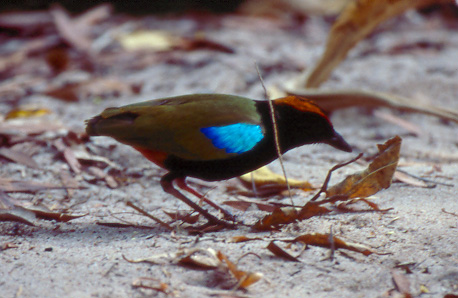 Rainbow PittaPitta iris
-
 Western Hooded PittaPitta sordida
-
 Mangrove PittaPitta megarhyncha
-
 Azure-breasted PittaPitta steerii
Compare
Questions and answers
What is the scientific name of the African Pitta?
The scientific name of the African Pitta is Pitta angolensis. Written with its author, the full name is Pitta angolensis Vieillot, 1816.
Which family does the African Pitta belong to?
Pitta angolensis belongs to the family Pittidae, in the order Passeriformes and the class Aves.
Where is the African Pitta found?
Checklists and occurrence records place Pitta angolensis in 21 countries, including Zimbabwe, Zambia, Democratic Republic of the Congo, Mozambique, Kenya and Tanzania.
What is the conservation status of the African Pitta?
The IUCN Red List category recorded for Pitta angolensis is Least Concern (LC).
What does a pitta bird eat?
The African Pitta forages alone in leaf litter and scratches to uncover insects and mollusks.[16]
What is a pitta animal?
The African Pitta is a bird belonging to the family Pittidae, order Passeriformes and class Aves.[49]
Sources
Passages the profile rests on
- The African pitta has a plump body and a somewhat thrush-like appearance. Source passage: “The plump, somewhat thrush-like birds” — English Wikipedia
- The crown, face and ear coverts are solid black, while the throat is pale salmon pink. Source passage: “The crown, face, and ear coverts are solid black, and the throat is pale salmon pink.” — English Wikipedia
- The African pitta has a broad eyebrow that ranges from buff to brownish buff. Source passage: “The broad eyebrow is buff to brownish buff.” — English Wikipedia
- Its flanks, breast and sides of the neck are mustard yellow, with olive colouring on the upper breast. Source passage: “The flanks, breast, and side of the neck are a mustard yellow, washed olive on the upper breast.” — English Wikipedia
- Some western populations have a distinctly greenish breast. Source passage: “Some western birds have the breast very greenish.” — English Wikipedia
- The wing coverts are deep green with turquoise-blue tips or black with turquoise and royal-blue tips. Source passage: “The wing coverts are deep green and tipped turquoise blue, or black and tipped turquoise and royal blue.” — English Wikipedia
- The mantle and back are green, while the rump and upper tail coverts are pale turquoise blue. Source passage: “The mantle and back are green, and the rump and upper tail coverts pale turquoise blue.” — English Wikipedia
- The wings are rounded, with black primary feathers bearing pale and white tips. Source passage: “The wings are rounded, and the primaries are black with pale and white tips.” — English Wikipedia
- The bases of the central primary feathers form a conspicuous white square visible during flight or display. Source passage: “The bases of the central primaries form a white square, conspicuous in flight or display.” — English Wikipedia
- The belly and undertail coverts are crimson red, and the legs are pink. Source passage: “The belly and undertail coverts are crimson red, and the legs are pink.” — English Wikipedia
- Immature birds have duller plumage, a buffy-pink vent and a fawn-coloured throat. Source passage: “Immature birds have a duller plumage with a buffy-pink vent and fawn-coloured throat.” — English Wikipedia
- The species forages beneath the canopy of riparian or coastal forests and thickets, as well as in climax miombo forest. Source passage: “under the canopy of riparian or coastal forest and thickets, or in climax miombo forest.” — English Wikipedia
- The African pitta is more numerous in undisturbed vegetation. Source passage: “They are more numerous in undisturbed vegetation” — English Wikipedia
- The breeding habitat in southeastern Africa consists of deciduous lowland riparian forest or thicket with intermittent dense understorey and small sub-canopy clearings. Source passage: “Its breeding habitat in southeastern Africa is deciduous, lowland riparian forest or thicket with intermittent dense understorey and small sub-canopy glades.” — English Wikipedia
- During migration, African pittas may stop in any type of bush or woodland. Source passage: “On migration however, they may sojourn at any areas of bush or woodland.” — English Wikipedia
- The African pitta forages alone in leaf litter and scratches to uncover insects and mollusks. Source passage: “It forages singly on leaf litter, where it scratches to uncover insects and mollusks.” — English Wikipedia
- The African pitta is difficult to observe despite its brightly coloured plumage. Source passage: “They are elusive and hard to observe despite their brightly coloured plumage” — English Wikipedia
- The species sometimes remains motionless for extended periods. Source passage: “or may stand motionless for long periods.” — English Wikipedia
- The African pitta spends considerable time scratching through leaf litter or around termite mounds during mornings and at dusk. Source passage: “They spend much time during mornings and at dusk scratching in leaf litter or around termitaria” — English Wikipedia
- The African pitta moves by making quick hops. Source passage: “The African pitta moves about by quick hops.” — English Wikipedia
- When alarmed, the African pitta may run or jump onto a low branch or fly to a high branch and hide by crouching. Source passage: “run or jump to a low branch when alarmed, or fly to a high branch where it hides by crouching.” — English Wikipedia
- The African pitta has a fast, direct flight. Source passage: “It has a fast and direct flight.” — English Wikipedia
- The species produces loud, explosive calls that are rarely heard. Source passage: “their loud, explosive calls are infrequently heard.” — English Wikipedia
- The species produces several types of calls, including a scolding skeeow, a short deep trill followed by a wing-clap and a sproo note accompanied by a small jump. Source passage: “It has various call notes, including a querulous scolding skeeow, noted by Moreau, a short, deep trill followed by a wing-clap, and a sproo note, accompanied by a small jump.” — English Wikipedia
- Fallen dead trees and open branches are preferred perches for the species' bouncing display. Source passage: “Fallen dead trees and open branches are favoured perches when performing their peculiar bouncing display.” — English Wikipedia
- Exhausted and dead African pittas are regularly found during migration, particularly from November to December and April to June. Source passage: “Exhausted and perished birds are regularly found during migration, especially November to December and April to June.” — English Wikipedia
- Some southward-migrating birds overshoot their destination by following moist tropical weather fronts at night. Source passage: “Southward migrating birds sometimes overshoot when they follow moist tropical fronts (at night)” — English Wikipedia
- Breeding African pittas call and display from the forest mid-canopy following rainfall. Source passage: “Following rains breeding birds call and display from the mid-canopy.” — English Wikipedia
- African pittas are considered probably monogamous and display for several weeks after arriving. Source passage: “They are probably monogamous, and display for a few weeks after arrival.” — English Wikipedia
- Displaying birds produce a loud, far-carrying quoip call while leaping from a lateral branch in the mid-canopy. Source passage: “Displaying birds utter a far-carrying and explosive quoip as they leap from a lateral branch in mid-canopy.” — English Wikipedia
- Displaying African pittas open their wings to expose the white bases of their primary feathers. Source passage: “At the same time the wings are opened to reveal the white bases to the primary feathers.” — English Wikipedia
- Breeding pairs may occupy territories spaced approximately 150 metres apart. Source passage: “Pairs may be spaced 150 meters from one another.” — English Wikipedia
- The nest is a bulky, untidy dome made from small sticks, grass and dry leaves. Source passage: “The bulky, untidy nest is a dome-shape structure composed of small sticks, grass and dry leaves.” — English Wikipedia
- The nest interior is lined with finer twigs, tendrils and some dry leaves. Source passage: “The inside is lined with finer twigs, tendrils and some dry leaves.” — English Wikipedia
- The nest is placed 2 to 4 metres above ground in a sapling fork or among the thorny, leafy branches of Acacia, Ziziphus, Ximenia or Dichrostachys. Source passage: “It is placed 2 to 4 metres (6.6 to 13.1 ft) above ground in the fork of a sapling, or in the thorny and leafy branches of Acacia, Ziziphus, Ximenia or Dichrostachys.” — English Wikipedia
- Egg-laying in southeastern Africa occurs from November to December. Source passage: “Egg-laying takes place from November to December in southeastern Africa” — English Wikipedia
- African pittas become silent when incubation begins. Source passage: “the birds fall silent once incubation starts.” — English Wikipedia
- The species lays three to four eggs per clutch. Source passage: “Three to four eggs are laid.” — English Wikipedia
- The eggs are white or cream with grey undermarkings and liver-red to blackish-brown markings near the broader end. Source passage: “They are white or cream in colour, and flecked with grey undermarkings and liver-red to blackish-brown markings near the thicker end.” — English Wikipedia
- African pitta eggs measure approximately 28 by 23.5 millimetres. Source passage: “They measure 28 by 23.5 mm (1.10 by 0.93 in).” — English Wikipedia
- African pitta nestlings are altricial and nidicolous. Source passage: “The nestlings are altricial and nidicolous.” — English Wikipedia
- The green-breasted pitta replaces the African pitta in the interior of Africa's tropical rainforests. Source passage: “The closely related green-breasted pitta (Pitta reichenowi) replaces the African pitta in the interior of Africa's tropical rainforests.” — English Wikipedia
- The African pitta and green-breasted pitta belong to a wide-ranging Old World superspecies. Source passage: “Together the two species form part of a wide-ranging Old World superspecies” — English Wikipedia
- A decline in African pitta populations has been noted in Kenya's coastal forests since 1983. Source passage: “A decline has been noted in the coastal forests of Kenya after 1983.” — English Wikipedia
- Habitat loss and fragmentation affecting the African pitta are ongoing. Source passage: “Habitat loss and fragmentation is ongoing.” — English Wikipedia
- Elephant-driven opening of riparian woodland may reduce the African pitta's habitat. Source passage: “the opening up of the riparian woodland by elephants may reduce their habitat.” — English Wikipedia
- Elephants and agricultural expansion have affected African pitta breeding habitat in the Zambezi Valley. Source passage: “Breeding habitat in the Zambezi valley has been impacted by elephants and agricultural expansion.” — English Wikipedia
- Lighted buildings in coastal Tanzania have been identified as a potential collision hazard for nocturnally migrating African pittas. Source passage: “Concern has been expressed about lighted buildings in coastal Tanzania, which might pose a collision risk, as the birds are nocturnal migrants.” — English Wikipedia
- The African pitta was described by Louis Pierre Vieillot in 1816 under the scientific name Pitta angolensis. Source passage: “The African pitta was described by the French ornithologist Louis Pierre Vieillot in 1816 and given the binomial name Pitta angolensis.” — English Wikipedia
Data
- Catalogue of Life, 2026-10-16 XR cc by
- Global Biodiversity Information Facility CC BY 4.0
- Wikidata CC0
- GeoNames CC BY 4.0
- Wikimedia Commons per image; credit shown with each image
- Within the Catalogue of Life, this name comes from The Integrated Taxonomic Information System cc0
References
- Vieillot, & Louis Pierre. (1816). Brève. Nouveau Dictionnaire d’Histoire Naturelle, Appliquée Aux Arts, À l’Agriculture, À l’Économie Rurale et Domestique, À La Médecine, Etc. Par Une Société de Naturalisted et d’Agriculteurs Nouvelle Édition, Vol. 4. where the name was published
- Gill, Frank, & and Minturn Wright. (2006). Birds of the World: Recommended English Names.
This species in other databases
Page built on 28 November 2026. See how the catalog is made and all sources and licences.
Cite this page
ScientificNames.org. (2026). Pitta angolensis (African Pitta). Retrieved November 28, 2026, from https://scientificnames.org/species/pitta-angolensis
“Pitta angolensis (African Pitta).” ScientificNames.org, 2026, scientificnames.org/species/pitta-angolensis. Accessed 28 Nov. 2026.
ScientificNames.org. “Pitta angolensis (African Pitta).” Accessed November 28, 2026. https://scientificnames.org/species/pitta-angolensis.
@misc{scientificnames_pitta_angolensis_african_pitta,
  author = {{ScientificNames.org}},
  title = {Pitta angolensis (African Pitta)},
  year = {2026},
  url = {https://scientificnames.org/species/pitta-angolensis},
  note = {Accessed 2026-11-28}
}