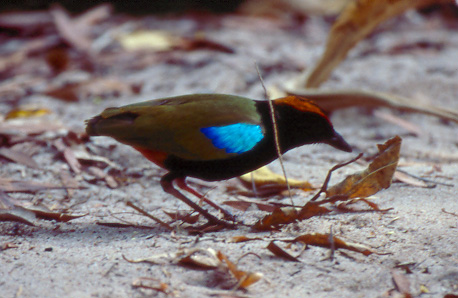
| Appearance | - The Rainbow Pitta has a velvet-black head with chestnut stripes above the eyes, olive-green upperparts, black underparts and a bright red belly. English Wikipedia
- The Rainbow Pitta has green wings with a golden sheen and a shining blue patch on the lesser wing coverts. English Wikipedia
- Male and female Rainbow Pittas have essentially identical plumage. English Wikipedia
| - The adult has a black head and nape with a chestnut crown, green wings with turquoise front edges, a green back, lemon-yellow throat, breast and belly, and a black tail with orange-red undertail coverts. English Wikipedia
- Juveniles are duller than adults, with olive-green wings and buffy breast, throat and chin washed with grey. English Wikipedia
- The juvenile's chestnut crown feathers have black tips, and its lesser wing coverts lack blue. English Wikipedia
|
|---|
| Size | | No checked fact yet |
|---|
| Habitat | - The Rainbow Pitta occurs most commonly in monsoon forests, adjacent vine-scrub and gallery forests. English Wikipedia
- The species also inhabits eucalypt, bamboo and paperbark forests, scrub, Lophostemon forests and mangrove-forest edges. English Wikipedia
- The Rainbow Pitta occurs from sea level to elevations of 380 m. English Wikipedia
- The species has occasionally been recorded in introduced pine plantations, where it has also bred. English Wikipedia
| - The species inhabits temperate forests, subtropical or tropical moist lowland forests, and subtropical or tropical moist montane forests. English Wikipedia
- The species occurs mainly in rainforest but also inhabits drier woodland and scrub. English Wikipedia
|
|---|
| Diet | - The Rainbow Pitta feeds primarily on insects, insect larvae, other arthropods, snails and earthworms. English Wikipedia
- Near Darwin, earthworms account for approximately two-thirds of the Rainbow Pitta's diet. English Wikipedia
- The species consumes cockroaches, beetles, ants, caterpillars and grasshoppers, as well as centipedes, spiders and millipedes. English Wikipedia
- The Rainbow Pitta also eats fallen Carpentaria fruits, frogs and lizards. English Wikipedia
| - The species feeds on earthworms, insects and snails. English Wikipedia
- Its forest-floor diet includes insects, woodlice, snails and other invertebrates collected from leaf litter. English Wikipedia
- Fruit forms part of its diet. English Wikipedia
- The species opens mollusc shells by striking them against an anvil, stone or another hard surface. English Wikipedia
- The species also catches small lizards and strikes them against hard surfaces before swallowing them. English Wikipedia
|
|---|
| Behaviour | - The Rainbow Pitta is secretive and shy. English Wikipedia
- The Rainbow Pitta forages exclusively on the ground. English Wikipedia
- The species searches for food individually by hopping across the forest floor and pausing to scan its surroundings. English Wikipedia
- Rainbow Pittas use roots as anvils to extract snails from their shells. English Wikipedia
- The Rainbow Pitta is sedentary, with most pairs maintaining their territories throughout the year. English Wikipedia
- Young Rainbow Pittas disperse from their parents' territories to seek territories of their own. English Wikipedia
| - The species is shy, and its distinctive call is heard more frequently than the bird is seen. English Wikipedia
- Its calling is most frequent in the morning, with additional peaks around midday and dusk. English Wikipedia
- The species also calls at night. English Wikipedia
- Calling is most frequent during the breeding season and almost absent between March and August. English Wikipedia
- Its call is usually repeated twice and consists of three ascending notes. English Wikipedia
- While foraging, the species bobs its head up and down and flicks its tail from side to side. English Wikipedia
|
|---|
| Reproduction | - Rainbow Pittas are monogamous during the breeding season but do not maintain lifelong pair bonds. English Wikipedia
- The Rainbow Pitta's breeding season runs from December through April. English Wikipedia
- The first rains of the rainy season appear to trigger nest construction. English Wikipedia
- Rainbow Pitta breeding territories range from 1.6 to 3.1 hectares and are larger in drier forests. English Wikipedia
- Both parents construct the nest, which takes approximately one week to complete. English Wikipedia
- An average Rainbow Pitta clutch contains four eggs, although clutches of three or five also occur. English Wikipedia
- Rainbow Pitta eggs are rounded, white and marked with sepia spots, blotches and underlying grey markings. English Wikipedia
- Rainbow Pitta eggs average 26.2 by 21.2 mm. English Wikipedia
- Both parents incubate the eggs for approximately 14 days. English Wikipedia
- Rainbow Pitta chicks fledge after approximately 14 days. English Wikipedia
- Both parents feed the chicks for approximately 15–20 days after fledging. English Wikipedia
| - The species nests in concealed locations on the ground. English Wikipedia
- Breeding generally peaks in late spring and early summer, with timing varying geographically. English Wikipedia
- The nest is domed and measures approximately 30 by 30 by 20 cm. English Wikipedia
- Nests are generally placed on the ground near large rocks, stumps or roots, although some have been recorded up to 2.7 m above ground in trees. English Wikipedia
- Nest construction materials include branches, twigs, roots, plant fibres, mosses, bark strips and feathers. English Wikipedia
- Clutches typically contain two to five eggs. English Wikipedia
- Average egg dimensions are approximately 32 by 25 mm. English Wikipedia
- The eggs are white or blue-white with purple-brown spots and grey-blue underlying blotches. English Wikipedia
- Both parents incubate the eggs. English Wikipedia
- Wild incubation lasts 17 days from the laying of the final egg. English Wikipedia
- Both parents feed the chicks, although males provide most of the food as fledging approaches. English Wikipedia
|
|---|
| Distribution | - The Rainbow Pitta is endemic to Australia's Northern Territory and Western Australia. English Wikipedia
| - The species occurs in eastern Australia and southern New Guinea. English Wikipedia
- Members of the subspecies Pitta versicolor simillima migrate to southern Papua New Guinea. English Wikipedia
|
|---|
| Conservation | No checked fact yet | |
|---|
| Similar species | - The superb pitta of Manus Island is the closest relative of the Rainbow Pitta. English Wikipedia
| - Some authorities consider the noisy pitta potentially conspecific with the elegant pitta. English Wikipedia
- Some authorities consider the noisy pitta potentially conspecific with the rainbow pitta. English Wikipedia
|
|---|
| Other | | No checked fact yet |
|---|