Species · Birds
Noisy Pitta Pitta versicolor
The scientific name of the Noisy Pitta is Pitta versicolor. It is a species of bird in the family Pittidae (pittas), order Passeriformes. The name dates from 1825.
- Scientific name
- Pitta versicolor Swainson, 1825
- Common name
- Noisy Pitta
- Genus
- Pitta
- Family
- Pittidae (Pittas)
- Order
- Passeriformes
- Class
- Aves
- Red List category
- LC Least Concern
- Recorded in
- 2 countries
- Name status
- accepted in the Catalogue of Life

Overview
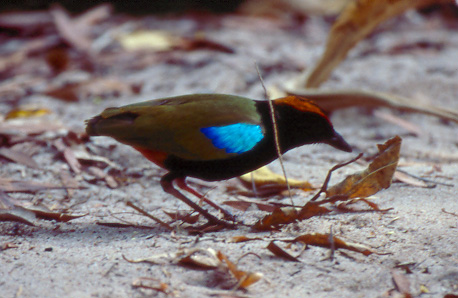
The species occurs in eastern Australia and southern New Guinea. It has a chestnut crown, green wings with turquoise front edges, yellow underparts and a black tail with orange-red undertail coverts.
Written 26 November 2026 from the sources listed below. Each statement was checked against the passage it cites; statements that could not be supported were removed.
Appearance
Adults have a black head and nape with a chestnut crown, green wings with turquoise front edges and a green back. The throat, breast and belly are lemon-yellow, while the black tail has orange-red undertail coverts.[1]
Juveniles are duller than adults, with olive-green wings and buffy breast, throat and chin washed with grey. Their chestnut crown feathers have black tips, and their lesser wing coverts lack blue.[2][3]
Habitat
The species inhabits temperate forests, subtropical or tropical moist lowland forests, and subtropical or tropical moist montane forests. It occurs mainly in rainforest but also inhabits drier woodland and scrub.[4][5]
Diet
The Noisy Pitta feeds on earthworms, insects, woodlice, snails and other invertebrates collected from leaf litter. Fruit also forms part of its diet.[6][7][8]
The species opens mollusc shells by striking them against an anvil, stone or another hard surface. It also catches small lizards and strikes them against hard surfaces before swallowing them.[9][10]
Behaviour
The species is shy, and its distinctive call is heard more frequently than the bird is seen. Its call usually consists of three ascending notes repeated twice.[11][12]
Calling is most frequent in the morning, with additional peaks around midday and dusk, and the species also calls at night. Calling is most frequent during the breeding season and almost absent between March and August.[13][14][15]
While foraging, the species bobs its head up and down and flicks its tail from side to side.[16]
Reproduction and life cycle
The Noisy Pitta nests in concealed locations on the ground. Breeding generally peaks in late spring and early summer, with timing varying geographically.[17][18]
The nest is domed and measures approximately 30 by 30 by 20 cm. Nests are generally placed on the ground near large rocks, stumps or roots, although some have been recorded up to 2.7 m above ground in trees.[19][20]
Nest construction materials include branches, twigs, roots, plant fibres, mosses, bark strips and feathers.[21]
Clutches typically contain two to five eggs, with average dimensions of approximately 32 by 25 mm. The eggs are white or blue-white with purple-brown spots and grey-blue underlying blotches.[22][23][24]
Both parents incubate the eggs, and wild incubation lasts 17 days from the laying of the final egg. Both parents feed the chicks, although males provide most of the food as fledging approaches.[25][26][27]
Conservation
The species is listed as Least Concern by BirdLife International. It is believed to be fairly common in suitable habitats in Queensland.[28][29]
Its population may be declining slightly because of habitat destruction. BirdLife DataZone classifies the species as a full migrant.[30][31]
Similar species
Some authorities consider the Noisy Pitta potentially conspecific with the elegant pitta or the rainbow pitta.[32][33]
Classification of the Noisy Pitta
| Kingdom | Animalia |
|---|---|
| Phylum | Chordata |
| Subphylum | Vertebrata |
| Infraphylum | Gnathostomata |
| Parvphylum | Osteichthyes |
| Megaclass | Tetrapoda |
| Class | Aves (Bird) |
| Order | Passeriformes (Passerine) |
| Family | Pittidae (Pittas) |
| Genus | Pitta (Typical Pittas) |
| Species | Pitta versicolor Swainson, 1825 |
Where the Noisy Pitta is found
Checklists and occurrence records place Pitta versicolor in 2 countries across Oceania. GBIF holds 40,168 georeferenced records of it.
Countries
Regions and cities with the most records
- Queensland, Australia 26,707
- New South Wales, Australia 12,171
- Brisbane, Australia 1,487
- Cairns, Australia 1,027
- Narangba, Australia 721
- Port Macquarie, Australia 535
- Capalaba, Australia 483
- Logan City, Australia 384
- Coffs Harbour, Australia 380
- Central Coast, Australia 353
- Sunshine Coast, Australia 248
- Hornsby, Australia 228
- Wollongong, Australia 214
- Gold Coast, Australia 147
- Sydney, Australia 143
- Caloundra, Australia 133
- Newcastle, Australia 111
- Parramatta, Australia 74
- Townsville, Australia 67
- Gympie, Australia 56
- Hervey Bay, Australia 47
- Toowoomba, Australia 47
- Cessnock, Australia 45
- Grafton, Australia 45
- Taree, Australia 36
- Liverpool, Australia 27
- Mackay, Australia 25
- Maitland, Australia 24
- Bundaberg, Australia 19
- Gladstone, Australia 14
- South Australia, Australia 14
- Northern Territory, Australia 10
- Maryborough, Australia 8
- Rockhampton, Australia 8
- Western Province, Papua New Guinea 4
2 more countries have a few records outside this range
These countries hold a few records of Pitta versicolor but lie outside the range the checklists give for it. Such records are often zoo or garden specimens, museum material or vagrants, so the species is not counted as occurring there.
Range as the checklists state it
Australia
A number beside a place is its count of GBIF occurrence records. A place without a number comes from a checklist alone. Records show where a species has been observed or collected, which can include escapes and vagrants.
Common names
English
- Noisy Pitta
Names in 32 other languages
- Arabic
- بيتا صاخب
- Bulgarian
- Шумна пита
- Catalan
- pita sorollós
- Chinese
- 噪八色鳥, 噪八色鸫
- Croatian
- kestenjastokapa pita
- Czech
- pita hřmotivá, pita zvučnohlasá
- Danish
- Larmpitta
- Dutch
- Australische Pitta
- Esperanto
- bruema pito
- Estonian
- austraalia pita
- Finnish
- sinappipitta
- French
- Brève versicolore
- German
- Lärmpitta
- Hungarian
- lármás pitta
- Indonesian
- Paok lantang
- Italian
- Pitta chiassosa, Pitta versicolore
- Japanese
- ノドグロヤイロチョウ
- Lithuanian
- triukšmingoji pita
- Norwegian
- palettpitta
- Persian
- پیتای پرسروصدا
- Polish
- kurtaczek hałaśliwy
- Portuguese
- pita-ruidosa, pita-versicolor
- Russian
- Крикливая питта
- Serbian
- Australijska pita
- Slovak
- pita krikľavá
- Spanish
- Pita bulliciosa, Pìta bulliciosa
- Swedish
- larmjuveltrast
- Turkish
- Geveze Pitta
- Ukrainian
- піта-крикун
- Vietnamese
- Đuôi cụt ồn ào
- Welsh
- pita swnllyd
- pnb
- رولا نورنگا
Synonyms
One other scientific name has been used for this species and is now treated as a synonym of Pitta versicolor.
- Pitta strepitans Temminck, CJ, 1825
Subspecies and varieties
- Pitta versicolor intermedia (Central Queensland Noisy Pitta) subspecies
- Pitta versicolor simillima (Cape York Noisy Pitta) subspecies
- Pitta versicolor versicolor (Southern Noisy Pitta) subspecies
Related species
-
 Indian PittaPitta brachyura
-
 Fairy PittaPitta nympha
-
 Blue-winged PittaPitta moluccensis
-
 African PittaPitta angolensis
-
 Rainbow PittaPitta iris
-
 Western Hooded PittaPitta sordida
-
 Mangrove PittaPitta megarhyncha
-
 Azure-breasted PittaPitta steerii
Compare
Questions and answers
What is the scientific name of the Noisy Pitta?
The scientific name of the Noisy Pitta is Pitta versicolor. Written with its author, the full name is Pitta versicolor Swainson, 1825.
Which family does the Noisy Pitta belong to?
Pitta versicolor belongs to the family Pittidae, in the order Passeriformes and the class Aves.
Where is the Noisy Pitta found?
Checklists and occurrence records place Pitta versicolor in 2 countries: Australia and Papua New Guinea.
What is the conservation status of the Noisy Pitta?
The IUCN Red List category recorded for Pitta versicolor is Least Concern (LC).
Are noisy pittas rare?
The species is believed to be fairly common in suitable habitats in Queensland. Its population may be declining slightly because of habitat destruction, and it is listed as Least Concern by BirdLife International.[28][29][30]
Sources
Passages the profile rests on
- The adult has a black head and nape with a chestnut crown, green wings with turquoise front edges, a green back, lemon-yellow throat, breast and belly, and a black tail with orange-red undertail coverts. Source passage: “It has a black head and nape of neck with a chestnut crown. The wings are green with a turquoise front edge and the back is also green. The throat, breast and belly are lemon yellow. The tail is black and the under-tail coverts are orange-red.” — English Wikipedia
- Juveniles are duller than adults, with olive-green wings and buffy breast, throat and chin washed with grey. Source passage: “Juvenile birds resembled adults but are duller, with olive green on the wings and the buffy breast washed with grey, as is the throat and chin.” — English Wikipedia
- The juvenile's chestnut crown feathers have black tips, and its lesser wing coverts lack blue. Source passage: “The chestnut feathers of the crown are tipped with black and the lesser wing coverts lack any blue.” — English Wikipedia
- The species inhabits temperate forests, subtropical or tropical moist lowland forests, and subtropical or tropical moist montane forests. Source passage: “Its natural habitats are temperate forests, subtropical or tropical moist lowland forest, and subtropical or tropical moist montane forest.” — English Wikipedia
- The species occurs mainly in rainforest but also inhabits drier woodland and scrub. Source passage: “It occurs mainly in rainforest but is also sometimes found in drier woodland and scrub.” — English Wikipedia
- The species feeds on earthworms, insects and snails. Source passage: “It eats earthworms, insects and snails.” — English Wikipedia
- Its forest-floor diet includes insects, woodlice, snails and other invertebrates collected from leaf litter. Source passage: “it rummages through the leaf litter for the insects, woodlice, snails and other invertebrates on which it feeds.” — English Wikipedia
- Fruit forms part of its diet. Source passage: “Its diet includes some fruit” — English Wikipedia
- The species opens mollusc shells by striking them against an anvil, stone or another hard surface. Source passage: “it cracks open the shells of molluscs such as the giant panda snail (Hedleyella falconeri) on an anvil, a stone or other hard surface habitually used for this purpose.” — English Wikipedia
- The species also catches small lizards and strikes them against hard surfaces before swallowing them. Source passage: “Small lizards are also caught and bashed against hard surfaces before swallowing.” — English Wikipedia
- The species is shy, and its distinctive call is heard more frequently than the bird is seen. Source passage: “The noisy pitta is a shy bird and its distinctive call is heard more often than the bird is seen.” — English Wikipedia
- Its call is usually repeated twice and consists of three ascending notes. Source passage: “The call is usually repeated twice and consists of a sequence of three ascending notes” — English Wikipedia
- Its calling is most frequent in the morning, with additional peaks around midday and dusk. Source passage: “Noisy pittas call most frequently in the morning with a secondary peak in calling around midday. Calling declines in the afternoon before spiking again at dusk.” — English Wikipedia
- The species also calls at night. Source passage: “They also call at night.” — English Wikipedia
- Calling is most frequent during the breeding season and almost absent between March and August. Source passage: “Seasonally, they call most frequently in the breeding season, with almost no calling between March and August.” — English Wikipedia
- While foraging, the species bobs its head up and down and flicks its tail from side to side. Source passage: “It bobs its head up and down and flicks its tail from side to side while it forages.” — English Wikipedia
- The species nests in concealed locations on the ground. Source passage: “Like other pittas this species nests in a concealed location on the ground.” — English Wikipedia
- Breeding generally peaks in late spring and early summer, with timing varying geographically. Source passage: “The breeding season peaks in late spring and early summer, although the timing varies by location.” — English Wikipedia
- The nest is domed and measures approximately 30 by 30 by 20 cm. Source passage: “The nest is domed and measures 30 by 30 by 20 cm (11.8 by 11.8 by 7.9 in).” — English Wikipedia
- Nests are generally placed on the ground near large rocks, stumps or roots, although some have been recorded up to 2.7 m above ground in trees. Source passage: “The nest is usually placed on the ground at the bottom of a large rock, stump of roots, but has also been reported being placed in a tree up to 2.7 m (8.9 ft) off the ground.” — English Wikipedia
- Nest construction materials include branches, twigs, roots, plant fibres, mosses, bark strips and feathers. Source passage: “The nest is made from branches and twigs, roots, plant fibres, mosses, strips of bark and feathers.” — English Wikipedia
- Clutches typically contain two to five eggs. Source passage: “Clutch sizes can is typically between two and five eggs” — English Wikipedia
- Average egg dimensions are approximately 32 by 25 mm. Source passage: “The eggs measure 32 mm × 25 mm (1.26 in × 0.98 in) on average” — English Wikipedia
- The eggs are white or blue-white with purple-brown spots and grey-blue underlying blotches. Source passage: “The eggs are white or blue-white and have purple-brown spots and underlying blotches of grey-blue.” — English Wikipedia
- Both parents incubate the eggs. Source passage: “Both parents incubate the eggs.” — English Wikipedia
- Wild incubation lasts 17 days from the laying of the final egg. Source passage: “In the wild the incubation period lasts 17 days from the laying of the last egg.” — English Wikipedia
- Both parents feed the chicks, although males provide most of the food as fledging approaches. Source passage: “Both parents feed the chicks, although as the chicks get closer to fledging the male provided the most food.” — English Wikipedia
- The species is listed as Least Concern by BirdLife International. Source passage: “It is listed as being of "Least Concern" by BirdLife International in the Red List of Threatened Species.” — English Wikipedia
- The species is believed to be fairly common in suitable habitats in Queensland. Source passage: “The noisy pitta has a wide range and is believed to be fairly common in suitable habitats in Queensland.” — English Wikipedia
- Its population may be declining slightly because of habitat destruction. Source passage: “It may be diminishing slightly in number because of habitat destruction” — English Wikipedia
- BirdLife DataZone classifies the species as a full migrant. Source passage: “Migratory status Full Migrant” — datazone.birdlife.org
- Some authorities consider the noisy pitta potentially conspecific with the elegant pitta. Source passage: “Some authorities believe that the noisy pitta is conspecific with the elegant pitta (Pitta elegans) of Indonesia” — English Wikipedia
- Some authorities consider the noisy pitta potentially conspecific with the rainbow pitta. Source passage: “and/or with the rainbow pitta (Pitta iris) from the Northern Territory” — English Wikipedia
- Members of the subspecies Pitta versicolor simillima migrate to southern Papua New Guinea. Source passage: “The members of this subspecies migrate to the southern part of Papua New Guinea.” — English Wikipedia
Data
- Catalogue of Life, 2026-10-16 XR cc by
- Global Biodiversity Information Facility CC BY 4.0
- Wikidata CC0
- GeoNames CC BY 4.0
- Wikimedia Commons per image; credit shown with each image
- Within the Catalogue of Life, this name comes from The Integrated Taxonomic Information System cc0
References
- Swainson, & William John. (1825). On the Characters and Natural Affinities of several New Birds from Australasia; including some Observations on the Columbide. The Zoological Journal, Vol. 1, No. 4. where the name was published
- Gill, Frank, & and Minturn Wright. (2006). Birds of the World: Recommended English Names.
This species in other databases
Page built on 27 November 2026. See how the catalog is made and all sources and licences.
Cite this page
ScientificNames.org. (2026). Pitta versicolor (Noisy Pitta). Retrieved November 27, 2026, from https://scientificnames.org/species/pitta-versicolor
“Pitta versicolor (Noisy Pitta).” ScientificNames.org, 2026, scientificnames.org/species/pitta-versicolor. Accessed 27 Nov. 2026.
ScientificNames.org. “Pitta versicolor (Noisy Pitta).” Accessed November 27, 2026. https://scientificnames.org/species/pitta-versicolor.
@misc{scientificnames_pitta_versicolor_noisy_pitta,
  author = {{ScientificNames.org}},
  title = {Pitta versicolor (Noisy Pitta)},
  year = {2026},
  url = {https://scientificnames.org/species/pitta-versicolor},
  note = {Accessed 2026-11-27}
}