Comparison
Eastern Flat-whorl vs Lovely Vallonia
Eastern Flat-whorl (Planogyra asteriscus) and Lovely Vallonia (Vallonia pulchella) both belong to the family Valloniidae (grass snails) and part ways below it. Both are recorded in 2 countries.
Eastern Flat-whorl
Planogyra asteriscus
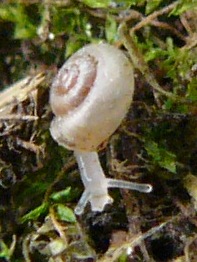

Side by side
| Eastern Flat-whorl | Lovely Vallonia | |
|---|---|---|
| Scientific name | Planogyra asteriscus (E. S. Morse, 1857) | Vallonia pulchella (O. F. Müller, 1774) |
| English name | Eastern Flat-whorl | Lovely Vallonia |
| Group | Molluscs | Molluscs |
| Class | Gastropoda Gastropod | Gastropoda Gastropod |
| Family | Valloniidae Grass Snails | Valloniidae Grass Snails |
| Genus | Planogyra | Vallonia Grass-snails |
| Named in | 1857 | 1774 |
| Environment | terrestrial | terrestrial |
| Countries on record | 2 countries | 41 countries |
| GBIF occurrence records | 256 records | 41,957 records |
Rows where the two agree are shown in grey.
Where each is found
Both recorded in 2 countries
Only Lovely Vallonia (39)
- Aland Islands
- Austria
- Belarus
- Belgium
- Bermuda
- Bulgaria
- Croatia
- Czechia
- Denmark
- Estonia
- Finland
- France
- Germany
- Greece
- Guernsey
- Hungary
- Ireland
- Isle of Man
- Italy
- Jersey
- Latvia
- Liechtenstein
- Lithuania
- Luxembourg
- Mexico
- Norway
- Poland
- Portugal
- Romania
- Russia
- Serbia
- Slovakia
- Slovenia
- Spain
- Sweden
- Switzerland
- The Netherlands
- Ukraine
- United Kingdom
From Catalogue of Life checklists and GBIF occurrence records. A country missing from a list means no record is held, which is not proof of absence.
Checked facts
| Eastern Flat-whorl | Lovely Vallonia | |
|---|---|---|
| Appearance |
|
|
| Habitat |
|
|
| Diet |
| No checked fact yet |
| Behaviour |
|
|
| Reproduction |
|
|
| Distribution |
|
|
| Conservation |
| No checked fact yet |
| Uses |
| No checked fact yet |
| Other | No checked fact yet |
|
In brief
Eastern Flat-whorl
Planogyra asteriscus occurs in ten northeastern and Midwestern United States states and in Canada. Full profile
Lovely Vallonia
The lovely vallonia is a very small, air-breathing terrestrial pulmonate gastropod mollusc belonging to the family Valloniidae. It has been recorded in British Columbia, Canada, and Illinois, United States of America, and is described as having a wide distribution. It has an ivory-white shell with a circular outline, 3.2–3.3 whorls and a very wide umbilicus. Full profile
Compare something else
Page built on 28 November 2026 from the data on the two species pages, where every source is listed.
Cite this page
ScientificNames.org. (2026). Eastern Flat-whorl vs Lovely Vallonia. Retrieved November 28, 2026, from https://scientificnames.org/compare/eastern-flat-whorl-vs-lovely-vallonia
“Eastern Flat-whorl vs Lovely Vallonia.” ScientificNames.org, 2026, scientificnames.org/compare/eastern-flat-whorl-vs-lovely-vallonia. Accessed 28 Nov. 2026.
ScientificNames.org. “Eastern Flat-whorl vs Lovely Vallonia.” Accessed November 28, 2026. https://scientificnames.org/compare/eastern-flat-whorl-vs-lovely-vallonia.
@misc{scientificnames_eastern_flat_whorl_vs_lovely_vallonia,
  author = {{ScientificNames.org}},
  title = {Eastern Flat-whorl vs Lovely Vallonia},
  year = {2026},
  url = {https://scientificnames.org/compare/eastern-flat-whorl-vs-lovely-vallonia},
  note = {Accessed 2026-11-28}
}