Comparison

McKay's Bunting vs Snow Bunting

McKay's Bunting (Plectrophenax hyperboreus) and Snow Bunting (Plectrophenax nivalis) both belong to the genus Plectrophenax (snow buntings) and part ways below it. Both are recorded in 2 countries.

McKay's Bunting

McKay's Bunting

Plectrophenax hyperboreus

Bering Land Bridge National Preserve, CC BY 2.0, via Wikimedia Commons

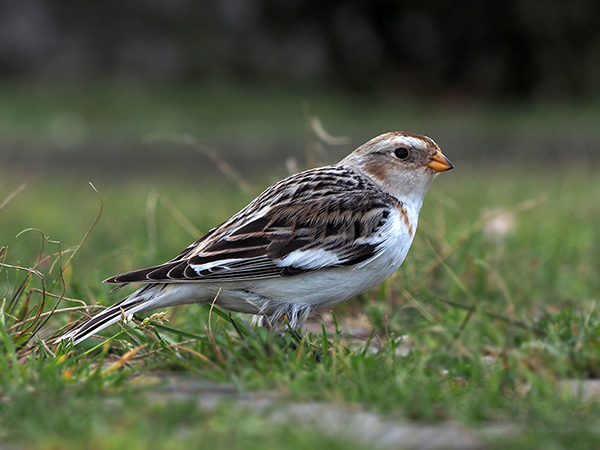
Snow Bunting

Snow Bunting

Plectrophenax nivalis

Amasuela - Luis Lafuente Agudín, CC BY-SA 4.0, via Wikimedia Commons

Side by side

McKay's BuntingSnow Bunting
Scientific namePlectrophenax hyperboreus Ridgway, 1884Plectrophenax nivalis (Linnaeus, 1758)
English nameMcKay's BuntingSnow Bunting
GroupBirdsBirds
ClassAves BirdAves Bird
OrderPasseriformes PasserinePasseriformes Passerine
FamilyCalcariidae LongspursCalcariidae Longspurs
GenusPlectrophenax Snow BuntingsPlectrophenax Snow Buntings
Named in18841758
Red List categoryLeast ConcernLeast Concern
EnvironmentNot recordedterrestrial
Countries on record2 countries51 countries
GBIF occurrence records1,776 records889,197 records

Rows where the two agree are shown in grey.

Where each is found

Both recorded in 2 countries

Only Snow Bunting (49)

From Catalogue of Life checklists and GBIF occurrence records. A country missing from a list means no record is held, which is not proof of absence.

Checked facts

McKay's BuntingSnow Bunting
Appearance
  • The species is whiter overall than the Snow Bunting in all plumages. English Wikipedia
  • Breeding males are almost entirely white, with small black areas on their wingtips and tails. English Wikipedia
  • Breeding females have streaked backs. English Wikipedia
  • Non-breeding individuals have warm brown patches on their cheeks, crowns, and sides of the neck. English Wikipedia
  • The Snow Bunting is a sexually dimorphic, medium-sized passerine with a white underside and black-and-white wings and back. English Wikipedia
  • During breeding, males have white plumage with black wingtips and a black back. English Wikipedia
  • During breeding, females have black wingtips and brown-fringed black back feathers. English Wikipedia
  • Both sexes develop broad orangey-brown fringes on their back feathers during winter. English Wikipedia
  • The species develops its breeding plumage through abrasion of the brown feather fringes rather than a spring moult. English Wikipedia
  • The Snow Bunting has feathered tarsi. English Wikipedia
Size
Habitat
  • The species nests on shingle beaches, using hollow drift logs and rock crevices as nesting sites. English Wikipedia
  • Its winter habitats include coastal marshes, shingle beaches, and agricultural fields. English Wikipedia
  • The Snow Bunting inhabits high-latitude Arctic tundra. English Wikipedia
  • During breeding, Snow Buntings select rocky habitats in the Arctic. English Wikipedia
  • Breeding habitats include wet sedge meadows and areas containing Dryas and lichens. English Wikipedia
  • During winter, Snow Buntings use open habitats including farms, barren fields, and lakeshores. English Wikipedia
  • The Snow Bunting uses coasts and shorelines, fields, meadows, and grasslands as habitat. audubon.org
Diet
  • The species' detailed diet has not been established. audubon.org
  • Its feeding habits are considered similar to those of the Snow Bunting. English Wikipedia
  • The Snow Bunting's winter diet includes seeds from weeds and grasses. English Wikipedia
  • The Snow Bunting's summer diet includes seeds, buds, and insects. English Wikipedia
  • From autumn through spring, the Snow Bunting eats knotweed, ragweed, amaranth, goosefoot, aster, and goldenrod. English Wikipedia
  • The species also consumes various grass seeds during autumn, winter, and spring. English Wikipedia
  • During autumn through spring, Snow Buntings forage for seeds from lower plant stems in snow. English Wikipedia
  • During summer, the species eats seeds of crowberry, bilberry, bistort, dock, poppy, and purple saxifrage. English Wikipedia
  • The summer diet also includes butterflies, true bugs, flies, wasps, and spiders. English Wikipedia
  • Snow Bunting nestlings are fed exclusively on invertebrates. English Wikipedia
  • Snow Buntings prey on basking spiders by throwing rocks around. English Wikipedia
  • Seeds, spiders, and insects constitute the majority of the Snow Bunting's diet. fws.gov
BehaviourNo checked fact yet
  • The Snow Bunting is ground-dwelling and moves by walking, running, or hopping. English Wikipedia
  • The species gives a distinctive rippling whistle as its call. English Wikipedia
  • Male Snow Buntings sing to attract females. English Wikipedia
  • Communication calls are produced by both sexes during flight or while on the ground. English Wikipedia
  • Male Snow Buntings commonly sing from perches or during flight displays. English Wikipedia
  • Males begin singing upon reaching breeding grounds and stop after finding a mate. English Wikipedia
  • Individual male Snow Buntings have distinctive songs, although some syllables are shared between individuals. English Wikipedia
  • Individual male songs last approximately two seconds and have frequencies between 2 and 6 kHz. English Wikipedia
  • Snow Buntings nest in cavities to protect their offspring from predators. English Wikipedia
  • Snow Buntings are among the first migrant birds to arrive in Arctic breeding territories. English Wikipedia
  • Male Snow Buntings arrive at Arctic breeding grounds at the beginning of April. English Wikipedia
  • Females arrive at breeding grounds four to six weeks after males. English Wikipedia
  • During migration, Snow Buntings generally travel in small flocks with an undulating flight at moderate height. English Wikipedia
  • Wintering Snow Buntings form flocks that can number in the hundreds. English Wikipedia
  • Snow Buntings generally leave their Arctic breeding grounds between mid-September and the end of September, although some depart in early November. English Wikipedia
  • Females migrate south before males and tend to winter farther south. English Wikipedia
  • Snow Bunting migration takes place at night. English Wikipedia
ReproductionNo checked fact yet
Distribution
  • The species breeds on St. Matthew Island and Hall Island in the Bering Sea. English Wikipedia
  • The species winters along the western coast of Alaska. English Wikipedia
  • The species is endemic to the Bering Sea region. usgs.gov
  • The species breeds almost exclusively on St. Matthew Island. ebird.org
  • The Snow Bunting breeds throughout the circumpolar Arctic in the Northern Hemisphere. English Wikipedia
  • Small isolated breeding populations occur in the Cairngorms of central Scotland, the Saint Elias Mountains, and the Cape Breton Highlands. English Wikipedia
  • During winter, the species migrates to southern Canada, the northern United States, northern European coasts and plains, and central Asia. English Wikipedia
Conservation
  • The estimated population is 19,481 individuals. English Wikipedia
  • The species is considered to have no immediate conservation threat according to the cited account. English Wikipedia
  • Introduced rats, weasels, or foxes could devastate the species. English Wikipedia
  • The species is designated as being of high conservation concern because of its small population size. usgs.gov
  • Surveys indicate that the species' population has continued to decline since survey efforts began in 2003. usgs.gov
No checked fact yet
Similar species
  • The Snow Bunting is the species' closest relative. English Wikipedia
  • The species closely resembles the Snow Bunting but is paler. ebird.org
  • Hybrids between McKay's Bunting and Snow Bunting have been observed. English Wikipedia
  • The Snow Bunting is closely related to McKay's Bunting. English Wikipedia
  • McKay's Bunting differs from the Snow Bunting by having more white in its plumage. English Wikipedia
  • Hybrids between Snow Buntings and McKay's Buntings have been recorded in Alaska. English Wikipedia
  • A hybrid between a Snow Bunting and a Lapland Longspur was photographed in Newfoundland and Labrador in April 2011. English Wikipedia

In brief

McKay's Bunting

Plectrophenax hyperboreus breeds on St. Matthew Island and Hall Island in the Bering Sea and winters along the western coast of Alaska. It is whiter overall than the Snow Bunting in all plumages, and breeding males are almost entirely white. Full profile

Snow Bunting

The Snow Bunting is a sexually dimorphic, medium-sized passerine bird. It breeds throughout the circumpolar Arctic in the Northern Hemisphere. Full profile

Compare something else

Page built on 28 November 2026 from the data on the two species pages, where every source is listed.

Cite this page

ScientificNames.org. (2026). McKay's Bunting vs Snow Bunting. Retrieved November 28, 2026, from https://scientificnames.org/compare/mckays-bunting-vs-snow-bunting