Species · Birds
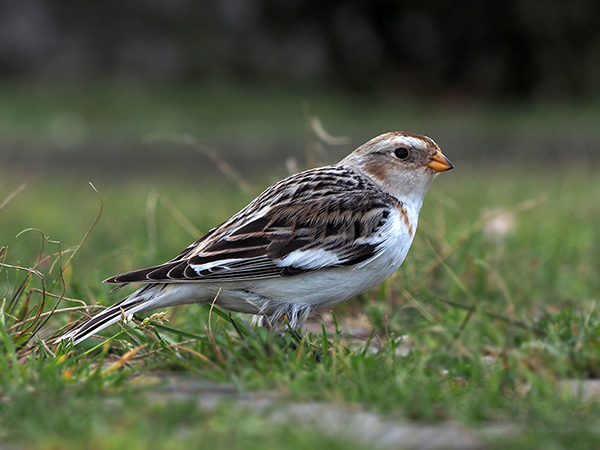
Snow Bunting Plectrophenax nivalis
The scientific name of the Snow Bunting is Plectrophenax nivalis. It is a species of bird in the family Calcariidae (longspurs), order Passeriformes. The name dates from 1758.
- Scientific name
- Plectrophenax nivalis (Linnaeus, 1758)
- Common name
- Snow Bunting
- Genus
- Plectrophenax
- Family
- Calcariidae (Longspurs)
- Order
- Passeriformes
- Class
- Aves
- Red List category
- LC Least Concern
- Environment
- terrestrial
- Recorded in
- 51 countries
- Name status
- accepted in the Catalogue of Life
Overview
The Snow Bunting is a sexually dimorphic, medium-sized passerine bird. It breeds throughout the circumpolar Arctic in the Northern Hemisphere.
Written 26 November 2026 from the sources listed below. Each statement was checked against the passage it cites; statements that could not be supported were removed.
Appearance
During breeding, males have white plumage with black wingtips and a black back. Females have black wingtips and brown-fringed black back feathers.[1][2]
Both sexes develop broad orangey-brown fringes on their back feathers during winter. Breeding plumage develops through abrasion of these brown feather fringes rather than a spring moult.[3][4]
The Snow Bunting has feathered tarsi. It measures approximately 15 cm in length, has a wingspan of 32 to 38 cm, and weighs between 30 and 40 grams.[5][6][7][8]
Habitat
The Snow Bunting inhabits high-latitude Arctic tundra. During breeding, it selects rocky habitats, including wet sedge meadows and areas containing Dryas and lichens.[9][10][11]
During winter, it uses open habitats including farms, barren fields, and lakeshores. It also uses coasts and shorelines, fields, meadows, and grasslands as habitat.[12][13]
Behaviour
The Snow Bunting is ground-dwelling and moves by walking, running, or hopping. It gives a distinctive rippling whistle as its call, and both sexes produce communication calls during flight or while on the ground.[14][15][16]
Males sing to attract females, commonly singing from perches or during flight displays. They begin singing upon reaching breeding grounds and stop after finding a mate.[17][18][19]
Individual male Snow Buntings have distinctive songs, although some syllables are shared between individuals. Individual songs last approximately two seconds and have frequencies between 2 and 6 kHz.[20][21]
Snow Buntings are among the first migrant birds to arrive in Arctic breeding territories. Males arrive at the beginning of April, while females arrive four to six weeks later.[22][23][24]
During migration, Snow Buntings generally travel in small flocks with an undulating flight at moderate height. Wintering flocks can number in the hundreds.[25][26]
Snow Buntings generally leave their Arctic breeding grounds between mid-September and the end of September, although some depart in early November. Migration takes place at night, and females migrate south before males and tend to winter farther south.[27][28][29]
Snow Buntings nest in cavities to protect their offspring from predators.[30]
Diet
From autumn through spring, the Snow Bunting eats knotweed, ragweed, amaranth, goosefoot, aster, and goldenrod. It also consumes various grass seeds during autumn, winter, and spring, foraging for seeds from lower plant stems in snow.[31][32][33]
During summer, its diet includes seeds of crowberry, bilberry, bistort, dock, poppy, and purple saxifrage. It also eats butterflies, true bugs, flies, wasps, and spiders.[34][35]
Snow Bunting nestlings are fed exclusively on invertebrates. Seeds, spiders, and insects constitute the majority of the species' diet.[36][37]
Snow Buntings prey on basking spiders by throwing rocks around.[38]
Reproduction and life cycle
Snow Buntings exhibit monogamous breeding behaviour. Males follow their mates during the fertile period to prevent mating with other males.[39][40]
Snow Buntings begin laying eggs when ambient temperatures rise above 0 °C. Their eggs are blue-green and spotted brown, and hatch after 12–13 days of incubation.[41][42][43]
Similar species
The Snow Bunting is closely related to McKay's Bunting. McKay's Bunting differs by having more white in its plumage.[44][45]
Hybrids between Snow Buntings and McKay's Buntings have been recorded in Alaska. A hybrid between a Snow Bunting and a Lapland Longspur was photographed in Newfoundland and Labrador in April 2011.[46][47]
Classification of the Snow Bunting
| Kingdom | Animalia |
|---|---|
| Phylum | Chordata |
| Subphylum | Vertebrata |
| Infraphylum | Gnathostomata |
| Parvphylum | Osteichthyes |
| Megaclass | Tetrapoda |
| Class | Aves (Bird) |
| Order | Passeriformes (Passerine) |
| Family | Calcariidae (Longspurs) |
| Genus | Plectrophenax (Snow Buntings) |
| Species | Plectrophenax nivalis (Linnaeus, 1758) |
Where the Snow Bunting is found
Checklists and occurrence records place Plectrophenax nivalis in 51 countries across Asia, North America and Oceania. GBIF holds 889,197 georeferenced records of it.
Countries
- Aland Islands 352
- Austria 138
- Belarus 130
- Belgium 3,105
- Bermuda 341
- Bulgaria 42
- Canada 257,062
- China 137
- Croatia 3
- Czechia 514
- Denmark 45,860
- Estonia 4,935
- Faroe Islands 90
- Finland 14,009
- France 5,635
- Germany 4,633
- Greece 39
- Greenland 4,356
- Guernsey 6
- Hungary 83
- Iceland 16,688
- Ireland 635
- Isle of Man 146
- Israel 37
- Italy 342
- Japan 228
- Jersey 32
- Kazakhstan 27
- Latvia 188
- Lithuania 205
- Luxembourg 4
- Mongolia 13
- Norway 45,209
- Poland 1,606
- Portugal 814
- Romania 35
- Russia 7,042
- Saint Pierre and Miquelon 228
- Serbia 7
- Slovakia 58
- Slovenia 12
- South Korea 58
- Spain 1,697
- Svalbard and Jan Mayen 11,631
- Sweden 135,063
- Switzerland 116
- The Netherlands 39,644
- Turkey 68
- Ukraine 326
- United Kingdom 23,916
- United States 261,652
Regions and cities with the most records
- Quebec, Canada 120,528
- Ontario, Canada 66,019
- New York, United States 34,985
- Alaska, United States 29,447
- Michigan, United States 28,148
- Massachusetts, United States 23,545
- Wisconsin, United States 16,742
- Minnesota, United States 16,569
- Kalmar, Sweden 14,811
- England, United Kingdom 13,643
- Skåne, Sweden 11,842
- Ohio, United States 11,632
- Manitoba, Canada 11,588
- Halland, Sweden 11,034
- Västerbotten, Sweden 10,879
- Newburyport, United States 10,521
- Norrbotten, Sweden 10,282
- Rimouski, Canada 10,184
- Alberta, Canada 10,154
- Amesbury, United States 9,948
- Illinois, United States 9,748
- Västra Götaland, Sweden 9,744
- Vermont, United States 9,562
- Falkenberg, Sweden 8,496
- New Jersey, United States 8,095
- Maine, United States 7,706
- New Hampshire, United States 7,651
- L'Ancienne-Lorette, Canada 7,559
- Connecticut, United States 7,390
- Stockholm, Sweden 7,323
- Svalbard, Svalbard and Jan Mayen 7,313
- Nunavut, Canada 7,244
- Québec, Canada 6,925
- Neufchâtel-Est–Lebourgneuf, Canada 6,885
- Umeå, Sweden 6,865
- Capital Region, Denmark 6,856
Range as the checklists state it
Europe & Northern Asia (excluding China)
North America
Southern Asia
Oceania
A number beside a place is its count of GBIF occurrence records. A place without a number comes from a checklist alone. Records show where a species has been observed or collected, which can include escapes and vagrants.
Common names
English
- Snow Bunting
- Snowflake
Names in 67 other languages
- Arabic
- درسة الثلوج, درسة ثلجية
- Armenian
- Դրախտապան ձյան
- Asturian
- escribana la ñeve
- Azerbaijani
- Şimal sərçəsi
- Basque
- Elur-berdantza
- Belarusian
- Сняжурка, Сняжурка (або пуначка)
- Bengali
- তুষার চটক
- Breton
- Brean erc’h, Brean-erc'h
- Bulgarian
- Снежна овесарка
- Catalan
- sit blanc
- Chinese
- 雪鵐, 雪鹀
- Croatian
- bijela strnadica
- Czech
- sněhule severní
- Danish
- snespurv
- Dutch
- sneeuwgors
- Esperanto
- Neĝemberizo, neĝa kalkario
- Estonian
- hangelind
- Faroese
- Snjófuglur
- Finnish
- pulmunen
- French
- Plectrophane des neiges, bruant des neiges
- Galician
- Escribenta das neves
- German
- Schneeammer
- Greek
- Χιονοτσίχλον, Χιονοτσίχλονο
- Hebrew
- גיבתון השלג, גיבתון שלג
- Hungarian
- hósármány
- Icelandic
- Snjótittlingur
- Irish
- Gealóg shneachta, Gealóg sneachta
- Italian
- zigolo delle nevi
- Japanese
- ユキホオジロ
- Kazakh
- Ақторғай
- Korean
- 흰멧새
- Latvian
- sniedze
- Lithuanian
- paprastoji sniegstartė, sniegstartė
- Luxembourgish
- Schnéimësch
- Mongolian
- Туйлын цасчхөмрөг
- Northern Sami
- duottarállat, Állat
- Norwegian Bokmål
- snøspurv
- Norwegian Nynorsk
- snøsporv
- Persian
- زردپره برفی
- Polish
- Śnieguła zwyczajna, śnieguła, śnieguła (zwyczajna)
- Portuguese
- escrevedeira-das-neves
- Romanian
- Pasărea omătului
- Russian
- Снежный подорожник, или снегурочка, или снежный подорожник
- Scottish Gaelic
- eun an t-sneachda, eòin an t-sneachda, gealag an t-sneachda, gealagan an t-sneachda
- Serbian
- Snežna strnadica, Снежна стрнадица - Snežna strnadica
- Slovak
- snehuľka severská
- Slovenian
- snežni strnad
- Spanish
- escribano niva, escribano nival
- Swedish
- snösparv
- Turkish
- Alaca Çinte, Kar kiraz kuşu, alaca kiraz kusu, alaca kiraz kuşu
- Ukrainian
- Пуночка, пуночка снігова
- Welsh
- Breision yr Eira, bras yr eira
- bak
- Аҡбаш турғай
- chm
- Поран кек
- chv
- Юр шӗпшӗлӗ
- cor
- Pluven ergh
- csb
- Zwëczajnô sniegùlka
- frr
- Snäsparag
- fry
- Sniefink
- glv
- Pompee niaghtee
- kal
- Qupaloraarsuk, amaaligaq, qupannaaq
- kbd
- КӀырыкъпӀащэ
- kur
- Çirçiroka berfê
- oji
- Waapanakwakoshiihsh (waapanakkoshiihsh)
- olo
- Punaine
- sah
- Туллук
- tat
- Акбаш чыпчык
Synonyms
7 other scientific names have been used for this species and are now treated as synonyms of Plectrophenax nivalis.
- Calcarius nivalis Linnaeus, C, 1758
- Emberiza nivalis Linnaeus, C, 1758
- Passerina nivalis Linnaeus, C, 1758
- Plectophenax nivalis Linnaeus, C, 1758
- Plectophenax nivalis nivalis Linnaeus, C, 1758
- Plectrophenax nivalis pallidior Salomonsen,1947
- Plectrophenax nivalis subnivalis (Brehm, 1826)
Subspecies and varieties
- Plectrophenax nivalis insulae (Icelandic Snow Bunting) subspecies
- Plectrophenax nivalis nivalis (Common Snow Bunting) subspecies
- Plectrophenax nivalis townsendi (Bering Snow Bunting) subspecies
- Plectrophenax nivalis vlasowae (Siberian Snow Bunting) subspecies
Related species
-
 McKay's BuntingPlectrophenax hyperboreus
-
 Lapland LongspurCalcarius lapponicus
-
 Chestnut-collared LongspurCalcarius ornatus
-
 Thick-billed LongspurRhynchophanes mccownii
-
 Smith's LongspurCalcarius pictus
Compare
Questions and answers
What is the scientific name of the Snow Bunting?
The scientific name of the Snow Bunting is Plectrophenax nivalis. Written with its author, the full name is Plectrophenax nivalis (Linnaeus, 1758).
Which family does the Snow Bunting belong to?
Plectrophenax nivalis belongs to the family Calcariidae, in the order Passeriformes and the class Aves.
Where is the Snow Bunting found?
Checklists and occurrence records place Plectrophenax nivalis in 51 countries, including United States, Canada, Sweden, Denmark, Norway and The Netherlands.
What is the conservation status of the Snow Bunting?
The IUCN Red List category recorded for Plectrophenax nivalis is Least Concern (LC).
What other names does the Snow Bunting have?
Plectrophenax nivalis is also known in English as Snowflake.
Where are snow buntings found?
Snow Buntings breed throughout the circumpolar Arctic in the Northern Hemisphere. They also occur in small isolated breeding populations in the Cairngorms of central Scotland, the Saint Elias Mountains, and the Cape Breton Highlands. Their winter range includes southern Canada, the northern United States, northern European coasts and plains, and central Asia.[48][49][50]
Do snow buntings change color?
Yes. Both sexes develop broad orangey-brown fringes on their back feathers during winter. Their breeding plumage develops through abrasion of these brown feather fringes rather than a spring moult.[3][4]
What do snow buntings eat?
Snow Buntings eat seeds, spiders, and insects. Their diet varies seasonally, including grass seeds and other plant seeds from autumn through spring, and seeds, butterflies, true bugs, flies, wasps, and spiders during summer. Nestlings are fed exclusively on invertebrates.[31][32][34][35][36][37]
Sources
Passages the profile rests on
- During breeding, males have white plumage with black wingtips and a black back. Source passage: “during the breeding season, the male is white with black wingtips and a black back” — English Wikipedia
- During breeding, females have black wingtips and brown-fringed black back feathers. Source passage: “while the female has black wingtips and the black feathers on the back fringed with brown.” — English Wikipedia
- Both sexes develop broad orangey-brown fringes on their back feathers during winter. Source passage: “During the winter, they both have broad orangey-brown fringes on the back feathers.” — English Wikipedia
- The species develops its breeding plumage through abrasion of the brown feather fringes rather than a spring moult. Source passage: “in the spring, the buntings do not moult as many other passerines do; instead the breeding colours come with the wearing and abrasion of the brown fringes” — English Wikipedia
- The Snow Bunting measures approximately 15 cm in length. Source passage: “It measures 15 cm with a wingspan of 32–38 cm (13–15 in)” — English Wikipedia
- Its wingspan ranges from 32 to 38 cm. Source passage: “with a wingspan of 32–38 cm (13–15 in)” — English Wikipedia
- The species weighs between 30 and 40 grams. Source passage: “and weights 30 to 40 grams.” — English Wikipedia
- The Snow Bunting has feathered tarsi. Source passage: “Unlike most passerines, it has feathered tarsi” — English Wikipedia
- The Snow Bunting inhabits high-latitude Arctic tundra. Source passage: “The snow bunting lives in very high latitudes in the Arctic tundra.” — English Wikipedia
- During breeding, Snow Buntings select rocky habitats in the Arctic. Source passage: “During the breeding period, the snow bunting looks for rocky habitats in the Arctic.” — English Wikipedia
- Breeding habitats include wet sedge meadows and areas containing Dryas and lichens. Source passage: “During this period, buntings also look for a habitat rich in vegetation such as wet sedge meadows and areas rich in dryas and lichens.” — English Wikipedia
- During winter, Snow Buntings use open habitats including farms, barren fields, and lakeshores. Source passage: “In the winter, they seek open habitats such as farms, barren fields, and lakeshores” — English Wikipedia
- The Snow Bunting uses coasts and shorelines, fields, meadows, and grasslands as habitat. Source passage: “Habitat. Coasts and Shorelines, Fields, Meadows, and Grasslands, Saltwater” — audubon.org
- The Snow Bunting is ground-dwelling and moves by walking, running, or hopping. Source passage: “It is ground-dwelling, and walks, runs and can hop if needed.” — English Wikipedia
- The species gives a distinctive rippling whistle as its call. Source passage: “The call is a distinctive rippling whistle, per,r,r,rit” — English Wikipedia
- Communication calls are produced by both sexes during flight or while on the ground. Source passage: “The communication calls are done by both the male and the female and they tend to be emitted in flight or in the ground” — English Wikipedia
- Male Snow Buntings sing to attract females. Source passage: “males will have a song to attract the female.” — English Wikipedia
- Male Snow Buntings commonly sing from perches or during flight displays. Source passage: “while the males will often emit the song from a perching position or in a flight display.” — English Wikipedia
- Males begin singing upon reaching breeding grounds and stop after finding a mate. Source passage: “The males will start singing as soon as they will reach the breeding grounds, and will stop once they find a mate.” — English Wikipedia
- Individual male Snow Buntings have distinctive songs, although some syllables are shared between individuals. Source passage: “Within snow buntings, vocalizations in males are unique to each individual, although there is certain syllable sharing between one another.” — English Wikipedia
- Individual male songs last approximately two seconds and have frequencies between 2 and 6 kHz. Source passage: “The songs have duration of 2 seconds and have a frequency of 2 to 6 kHz.” — English Wikipedia
- Snow Buntings are among the first migrant birds to arrive in Arctic breeding territories. Source passage: “The snow buntings migrate to the Arctic to breed and they are the first migrant species that arrives in these territories.” — English Wikipedia
- Male Snow Buntings arrive at Arctic breeding grounds at the beginning of April. Source passage: “The males will arrive first at the beginning of April” — English Wikipedia
- Females arrive at breeding grounds four to six weeks after males. Source passage: “Females will arrive four to six weeks later, when the snow starts to melt.” — English Wikipedia
- During migration, Snow Buntings generally travel in small flocks with an undulating flight at moderate height. Source passage: “They tend to migrate in small flocks and have an undulating flight at a moderate height.” — English Wikipedia
- Wintering Snow Buntings form flocks that can number in the hundreds. Source passage: “The birds overwinter in northern temperate zones in open fields and forms moving flocks that can number into the hundreds.” — English Wikipedia
- Snow Buntings generally leave their Arctic breeding grounds between mid-September and the end of September, although some depart in early November. Source passage: “They will leave the Arctic at the middle and end of September, although some will start the migration at the beginning of November.” — English Wikipedia
- Females migrate south before males and tend to winter farther south. Source passage: “The female leaves first and tends to winter in more southern territories than the male” — English Wikipedia
- Snow Bunting migration takes place at night. Source passage: “The migration is nocturnal” — English Wikipedia
- Snow Buntings nest in cavities to protect their offspring from predators. Source passage: “the snow bunting nests in cavities in order to protect the nestlings from any threat.” — English Wikipedia
- From autumn through spring, the Snow Bunting eats knotweed, ragweed, amaranth, goosefoot, aster, and goldenrod. Source passage: “From the fall to the spring the snow bunting eats a variety of weeds such as knotweed, ragweed, amaranth, goosefoot, aster, and goldenrod” — English Wikipedia
- The species also consumes various grass seeds during autumn, winter, and spring. Source passage: “and also eats various types of grass seeds.” — English Wikipedia
- During autumn through spring, Snow Buntings forage for seeds from lower plant stems in snow. Source passage: “During this season it will forage in the snow collecting seeds from lower stems.” — English Wikipedia
- During summer, the species eats seeds of crowberry, bilberry, bistort, dock, poppy, and purple saxifrage. Source passage: “During the summer their diet includes seeds of crowberry, bilberry, bistort, dock, poppy, purple saxifrage” — English Wikipedia
- The summer diet also includes butterflies, true bugs, flies, wasps, and spiders. Source passage: “and invertebrates such as butterflies, true bugs, flies, wasps and spiders.” — English Wikipedia
- Snow Bunting nestlings are fed exclusively on invertebrates. Source passage: “The nestlings are fed exclusively on invertebrates.” — English Wikipedia
- Seeds, spiders, and insects constitute the majority of the Snow Bunting's diet. Source passage: “Seeds, spiders and insects make up the majority of the snow bunting's diet.” — fws.gov
- Snow Buntings prey on basking spiders by throwing rocks around. Source passage: “Snow buntings also prey on basking spiders by throwing rocks around” — English Wikipedia
- Snow Buntings exhibit monogamous breeding behaviour. Source passage: “Snow buntings have a monogamous behaviour” — English Wikipedia
- Male Snow Buntings follow their mates during the fertile period to prevent mating with other males. Source passage: “The male will follow the female during her fertile period to make sure that she will not mate with any other male.” — English Wikipedia
- Snow Buntings begin laying eggs when ambient temperatures rise above 0 °C. Source passage: “It lays its eggs as soon as the ambient temperature is above 0 °C (32 °F).” — English Wikipedia
- Snow Bunting eggs are blue-green and spotted brown. Source passage: “The eggs are blue-green, spotted brown” — English Wikipedia
- Snow Bunting eggs hatch after 12–13 days of incubation. Source passage: “and hatch in 12–13 days” — English Wikipedia
- The Snow Bunting is closely related to McKay's Bunting. Source passage: “It is very closely related to the Beringian McKay's bunting (Plectrophenax hyperboreus)” — English Wikipedia
- McKay's Bunting differs from the Snow Bunting by having more white in its plumage. Source passage: “which differs in having even more white in the plumage.” — English Wikipedia
- Hybrids between Snow Buntings and McKay's Buntings have been recorded in Alaska. Source passage: “Hybrids between the two occur in Alaska” — English Wikipedia
- A hybrid between a Snow Bunting and a Lapland Longspur was photographed in Newfoundland and Labrador in April 2011. Source passage: “A hybrid with a Lapland longspur was photographed at St. Lewis Inlet, Newfoundland and Labrador, Canada, during spring migration in April 2011.” — English Wikipedia
- The Snow Bunting breeds throughout the circumpolar Arctic in the Northern Hemisphere. Source passage: “It is an Arctic specialist, with a circumpolar Arctic breeding range throughout the northern hemisphere.” — English Wikipedia
- Small isolated breeding populations occur in the Cairngorms of central Scotland, the Saint Elias Mountains, and the Cape Breton Highlands. Source passage: “There are small isolated populations on a few high mountain tops south of the Arctic region, including the Cairngorms in central Scotland and the Saint Elias Mountains on the southern Alaska-Yukon border, as well as the Cape Breton Highlands.” — English Wikipedia
- During winter, the species migrates to southern Canada, the northern United States, northern European coasts and plains, and central Asia. Source passage: “During the winter, this bird migrates to the circumglobal northern temperate zone including the south of Canada, the northern United States, the coasts and plains of northern Europe in Great Britain, the Netherlands, Germany, Poland, Ukraine, and east to central Asia.” — English Wikipedia
Data
- Catalogue of Life, 2026-10-16 XR cc by
- Global Biodiversity Information Facility CC BY 4.0
- Wikidata CC0
- GeoNames CC BY 4.0
- Wikimedia Commons per image; credit shown with each image
- Within the Catalogue of Life, this name comes from The Integrated Taxonomic Information System cc0
References
- Syst. Nat. ed. 10 p. 176 where the name was published
- Banks, R. C., R. W. McDiarmid, and A. L. Gardner. (1987). Checklist of Vertebrates of the United States, the U.S. Territories, and Canada. Resource Publication, No. 166.
- Gill, Frank, & and Minturn Wright. (2006). Birds of the World: Recommended English Names.
This species in other databases
- Catalogue of Life 77QJ8
- Wikidata Q26416
- iNaturalist 117059
- WoRMS urn:lsid:marinespecies.org:taxname:383228
- Avibase snobun
Page built on 29 November 2026. See how the catalog is made and all sources and licences.
Cite this page
ScientificNames.org. (2026). Plectrophenax nivalis (Snow Bunting). Retrieved November 29, 2026, from https://scientificnames.org/species/plectrophenax-nivalis
“Plectrophenax nivalis (Snow Bunting).” ScientificNames.org, 2026, scientificnames.org/species/plectrophenax-nivalis. Accessed 29 Nov. 2026.
ScientificNames.org. “Plectrophenax nivalis (Snow Bunting).” Accessed November 29, 2026. https://scientificnames.org/species/plectrophenax-nivalis.
@misc{scientificnames_plectrophenax_nivalis_snow_bunting,
  author = {{ScientificNames.org}},
  title = {Plectrophenax nivalis (Snow Bunting)},
  year = {2026},
  url = {https://scientificnames.org/species/plectrophenax-nivalis},
  note = {Accessed 2026-11-29}
}