Comparison

Holub's Golden Weaver vs Black-headed Weaver

Holub's Golden Weaver (Ploceus xanthops) and Black-headed Weaver (Ploceus melanocephalus) both belong to the genus Ploceus (typical weavers) and part ways below it. Both are recorded in 10 countries.

Holub's Golden Weaver

Holub's Golden Weaver

Ploceus xanthops

Lip Kee from Singapore, Republic of Singapore, CC BY-SA 2.0, via Wikimedia Commons
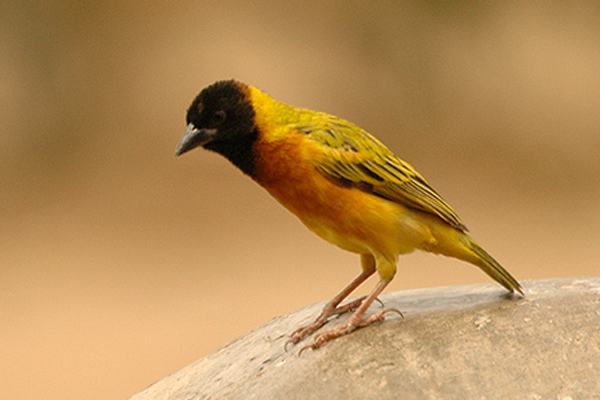
Black-headed Weaver

Black-headed Weaver

Ploceus melanocephalus

Tom Tarrant, CC BY-SA 3.0, via Wikimedia Commons

Side by side

Holub's Golden WeaverBlack-headed Weaver
Scientific namePloceus xanthops (Hartlaub, 1862)Ploceus melanocephalus (Linnaeus, 1758)
English nameHolub's Golden WeaverBlack-headed Weaver
GroupBirdsBirds
ClassAves BirdAves Bird
OrderPasseriformes PasserinePasseriformes Passerine
FamilyPloceidae BishopsPloceidae Bishops
GenusPloceus Typical WeaversPloceus Typical Weavers
Named in18621758
Red List categoryLeast ConcernLeast Concern
Countries on record17 countries34 countries
GBIF occurrence records40,834 records41,313 records

Rows where the two agree are shown in grey.

Where each is found

Both recorded in 10 countries

Only Holub's Golden Weaver (7)

Only Black-headed Weaver (24)

From Catalogue of Life checklists and GBIF occurrence records. A country missing from a list means no record is held, which is not proof of absence.

Checked facts

Holub's Golden WeaverBlack-headed Weaver
Appearance
  • Adult males have entirely yellow heads, bright greenish-yellow bodies and orange coloring beneath the chin extending to the upper breast. English Wikipedia
  • Females have duller plumage than males and yellow coloring restricted to the forehead. English Wikipedia
  • Both sexes have dull brown upper wings, yellow lower wings, light yellow eyes, black bills and pink legs. English Wikipedia
  • Juveniles are dull olive-colored, with yellow restricted to the tail, chin and throat. English Wikipedia
  • Juveniles have dark brown eyes and pale brown bills. English Wikipedia
  • Breeding males have a black head and a yellow collar at the nape. English Wikipedia
  • The yellow nuchal collar is absent in Juba and golden-backed weavers. English Wikipedia
  • The species has plain greenish mantle plumage that distinguishes it from golden-backed and village weavers. English Wikipedia
  • Its underparts are pale yellow with a variable amount of chestnut coloration. English Wikipedia
  • Females and non-breeding males lack the black head. English Wikipedia
  • Females and non-breeding males have dark eyes and a darker bill compared with female masked weavers. English Wikipedia
  • Females and non-breeding males have buffy breast plumage. English Wikipedia
Habitat
  • The species inhabits inland areas near freshwater, including forests, savannas, shrublands, grasslands and wetlands. English Wikipedia
  • Its habitat includes bushy areas with tall grass. English Wikipedia
  • The species occurs along forest margins and beside streams. English Wikipedia
  • The species occurs along coastal areas between eastern South Africa and western Angola. English Wikipedia
Diet
  • The species is omnivorous and consumes invertebrates, fruits, seeds and nectar. English Wikipedia
  • Recorded insect prey includes beetle larvae, termites, grasshoppers, praying mantises, tabanid flies and spiders. English Wikipedia
  • Recorded fruit foods include guavas, figs and Rhus pyroides. English Wikipedia
  • The species consumes grass seeds and seeds described as exocite pins. English Wikipedia
  • The species feeds on nectar from Ruttya and Erythrina. English Wikipedia
  • The species sometimes eats flower petals. English Wikipedia
No checked fact yet
Behaviour
  • The species is presumed to be sedentary because research on its movements is limited. English Wikipedia
  • The species does not undertake seasonal migration. English Wikipedia
  • The longest recorded movement distance for the species is ten kilometres. English Wikipedia
  • The species' usual vocalization is described as a repeated chichi-chichi-chi-squirr ski-wee sound, although contact calls can be short chirps. English Wikipedia
  • The species often lives in an Acacia tree approximately three metres from land. English Wikipedia
  • Living in Acacia trees away from land is described as a means of preventing predation. English Wikipedia
Reproduction
  • The species forms monogamous breeding pairs. English Wikipedia
  • Breeding generally occurs between January and April, with breeding beginning as early as September in South Africa, Zambia and Malawi. English Wikipedia
  • Breeding takes place in colonies containing two to three territorial males. English Wikipedia
  • During courtship, males perch beside females, perform specific movements and sing. English Wikipedia
  • Males construct nests approximately two to two and a half metres above the ground in tall bushes or reeds. English Wikipedia
  • Nests are usually built above water, and females provide the nest lining. English Wikipedia
  • The species has been recorded using old nests of Brown Firefinches, White-collared Olivebacks and Zebra Waxbills. English Wikipedia
  • Clutches contain between one and three eggs. English Wikipedia
  • Egg colors range from solid pink, blue or white to eggs marked with red and lilac freckles. English Wikipedia
  • Egg incubation lasts approximately fourteen to fifteen days. English Wikipedia
  • Nestlings remain in the nest for approximately nineteen to twenty-two days after hatching. English Wikipedia
  • Both parents feed the nestlings. English Wikipedia
No checked fact yet
Distribution
  • The species occurs in Angola, Botswana, Burundi, Republic of the Congo, Democratic Republic of the Congo, Eswatini, Gabon, Kenya, Malawi, Mozambique, Namibia, Rwanda, South Africa, Tanzania, Uganda, Zambia and Zimbabwe. English Wikipedia
  • The species' geographic range extends from Gabon to Uganda and Kenya, and southward to northern Namibia, northern Botswana and eastern South Africa. English Wikipedia
  • The species occurs in West, Central, and East Africa. English Wikipedia
  • The species has been introduced to the Iberian Peninsula. English Wikipedia
  • The nominate subspecies P. m. melanocephalus occurs in Mauritania, Senegal, Gambia, Mali, and Niger. English Wikipedia
  • The subspecies P. m. capitalis occurs from Guinea-Bissau to Nigeria and extends into northern Cameroon, southwestern Chad, and northern Central African Republic. English Wikipedia
  • The subspecies P. m. duboisi occurs in eastern Congo, southern Central African Republic, southwestern Sudan, and northern Zambia. English Wikipedia
  • The subspecies P. m. fischeri occurs in eastern Democratic Republic of the Congo, Uganda, western Kenya, northwestern Tanzania, and northern Zambia. English Wikipedia
Conservation
  • The species was reported as not globally threatened in 2024. English Wikipedia
  • The population trend is reported as stable. English Wikipedia
  • The species occurs across a large geographic range and is not considered vulnerable to extinction. English Wikipedia
  • The species occurs in protected areas throughout its geographic range. English Wikipedia
  • The number of mature individuals in the wild has not been researched. English Wikipedia
No checked fact yet
Similar speciesNo checked fact yet
  • The taxon P. victoriae is considered a hybrid between the black-headed weaver and P. castanops. English Wikipedia

In brief

Holub's Golden Weaver

Ploceus xanthops inhabits inland areas near freshwater, including forests, savannas, shrublands, grasslands and wetlands. Adult males have entirely yellow heads, bright greenish-yellow bodies and orange coloring beneath the chin extending to the upper breast. Full profile

Black-headed Weaver

Ploceus melanocephalus occurs in West, Central, and East Africa, breeding in damp areas of tropical Africa. Breeding males have a black head, a yellow collar at the nape, and plain greenish mantle plumage. Full profile

Compare something else

Page built on 27 November 2026 from the data on the two species pages, where every source is listed.

Cite this page

ScientificNames.org. (2026). Holub's Golden Weaver vs Black-headed Weaver. Retrieved November 27, 2026, from https://scientificnames.org/compare/holubs-golden-weaver-vs-black-headed-weaver