Comparison
Arctic Haircap Moss vs Common Haircap Moss
Arctic Haircap Moss (Polytrichum hyperboreum) and Common Haircap Moss (Polytrichum commune) both belong to the genus Polytrichum (hair moss) and part ways below it. Both are recorded in 9 countries.
Arctic Haircap Moss
Polytrichum hyperboreum
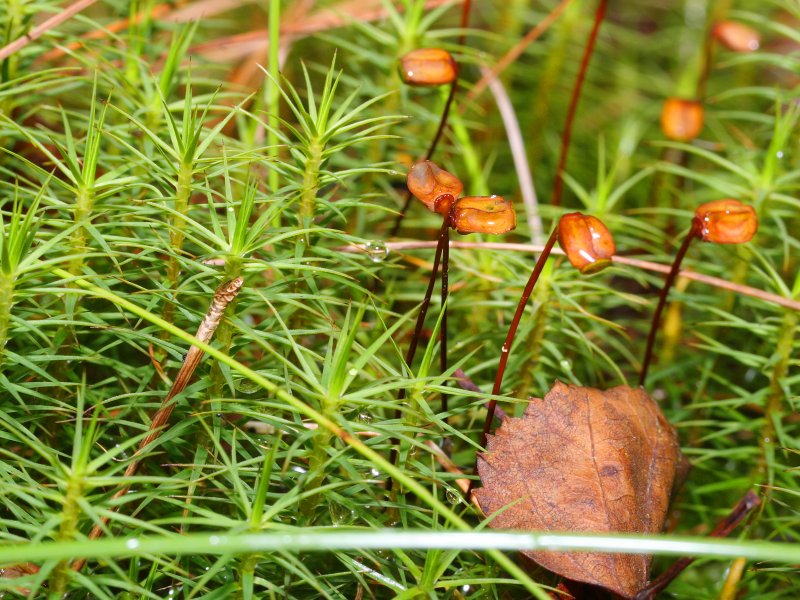
Common Haircap Moss
Polytrichum commune
Kristian Peters -- Fabelfroh 14:35, 21 October 2007 (UTC), CC BY-SA 3.0, via Wikimedia Commons

Side by side
| Arctic Haircap Moss | Common Haircap Moss | |
|---|---|---|
| Scientific name | Polytrichum hyperboreum R. Br. | Polytrichum commune Hedw. |
| English name | Arctic Haircap Moss | Common Haircap Moss |
| Group | Mosses and liverworts | Mosses and liverworts |
| Class | Polytrichopsida | Polytrichopsida |
| Order | Polytrichales | Polytrichales |
| Family | Polytrichaceae Aloe-mosses | Polytrichaceae Aloe-mosses |
| Genus | Polytrichum Hair Moss | Polytrichum Hair Moss |
| Countries on record | 9 countries | 44 countries |
| GBIF occurrence records | 1,929 records | 122,086 records |
Rows where the two agree are shown in grey.
Where each is found
Both recorded in 9 countries
Only Common Haircap Moss (35)
- Aland Islands
- Andorra
- Australia
- Austria
- Belarus
- Belgium
- Brazil
- Denmark
- Estonia
- Faroe Islands
- France
- Germany
- Hungary
- Iceland
- Ireland
- Isle of Man
- Italy
- Japan
- Latvia
- Lithuania
- Luxembourg
- Mexico
- New Zealand
- Poland
- Portugal
- Romania
- Saint Pierre and Miquelon
- Slovakia
- Slovenia
- South Africa
- Spain
- Switzerland
- The Netherlands
- Ukraine
- United Kingdom
From Catalogue of Life checklists and GBIF occurrence records. A country missing from a list means no record is held, which is not proof of absence.
Checked facts
| Arctic Haircap Moss | Common Haircap Moss | |
|---|---|---|
| Appearance |
|
|
| Size |
|
|
| Habitat |
|
|
| Diet |
| No checked fact yet |
| Behaviour | No checked fact yet |
|
| Reproduction |
|
|
| Distribution |
|
|
| Similar species |
| No checked fact yet |
| Other |
| No checked fact yet |
In brief
Arctic Haircap Moss
Polytrichum hyperboreum, known as Arctic Haircap Moss, is a moss species in the family Polytrichaceae. It occurs throughout Arctic regions of the world, growing in dry tundra, rocky areas, acidic soil or sand, and alongside bodies of water. Its identifying characteristics include its branching pattern, awn, lamellae cells, overlapping marginal laminae, and relatively short, reddish setae. Full profile
Compare something else
Page built on 29 November 2026 from the data on the two species pages, where every source is listed.
Cite this page
ScientificNames.org. (2026). Arctic Haircap Moss vs Common Haircap Moss. Retrieved November 29, 2026, from https://scientificnames.org/compare/arctic-haircap-moss-vs-common-haircap-moss
“Arctic Haircap Moss vs Common Haircap Moss.” ScientificNames.org, 2026, scientificnames.org/compare/arctic-haircap-moss-vs-common-haircap-moss. Accessed 29 Nov. 2026.
ScientificNames.org. “Arctic Haircap Moss vs Common Haircap Moss.” Accessed November 29, 2026. https://scientificnames.org/compare/arctic-haircap-moss-vs-common-haircap-moss.
@misc{scientificnames_arctic_haircap_moss_vs_common_haircap_moss,
  author = {{ScientificNames.org}},
  title = {Arctic Haircap Moss vs Common Haircap Moss},
  year = {2026},
  url = {https://scientificnames.org/compare/arctic-haircap-moss-vs-common-haircap-moss},
  note = {Accessed 2026-11-29}
}