Species · Mosses and liverworts
Common Haircap Moss Polytrichum commune
The scientific name of the Common Haircap Moss is Polytrichum commune. It is a species of bryophyte in the family Polytrichaceae (aloe-mosses), order Polytrichales.
- Scientific name
- Polytrichum commune Hedw.
- Common name
- Common Haircap Moss
- Genus
- Polytrichum
- Family
- Polytrichaceae (Aloe-mosses)
- Order
- Polytrichales
- Class
- Polytrichopsida
- Recorded in
- 44 countries
- Name status
- accepted in the Catalogue of Life
Overview
Written 24 November 2026 from the sources listed below. Each statement was checked against the passage it cites; statements that could not be supported were removed.
Appearance
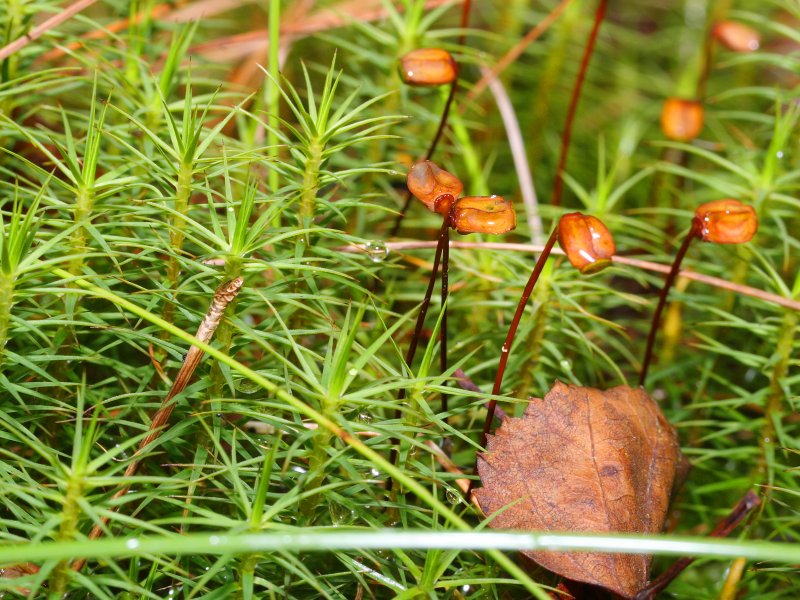
The moss is dark green when young and becomes brownish with age. Its stems grow in loose or dense tufts that can form extensive colonies, and are usually unbranched, although they occasionally fork.[1][2][3]
Its leaves are densely or relatively widely spaced along the stems, with typically shiny, golden-yellow sheaths. The leaf margins have teeth composed of single cells embedded in the margin, while the leaf surfaces have parallel photosynthetic ridges called lamellae, each five to nine cells in height.[4][5][6][7][8]
Its sporophyte capsule is brown to dark reddish brown and slightly rectangular to cubic in shape. It has four prominent wings and is inclined toward a horizontal position, while the golden-yellow to brownish calyptra completely covers it.[9][10][11]
Its stems most commonly measure 5 to 10 cm in length but can range from 2 to 70 cm. Its leaves typically measure 6 to 8 mm long and can reach 12 mm.[12][13][14]
Its seta measures 5 to 9 cm in length, and its capsules measure 3 to 6 mm. Its spores typically measure 5 to 8 μm and can reach 12 μm.[15][16][17]
Habitat
Common Haircap Moss typically grows in bogs, wet heathland and along forest streams. It occurs in regions with high humidity and rainfall.[18][19][20][21]
Behaviour
Its leaves curl and twist around the stem when conditions become too dry.[22]
Reproduction and life cycle
The species has separate male and female plants. Raindrops transfer sperm from male splash-cups to female plants containing eggs.[23][24]
The fertilized egg develops into a sporophyte bearing a spore capsule on a stalk.[25]
Classification of the Common Haircap Moss
| Kingdom | Plantae |
|---|---|
| Subkingdom | Bryobiotina |
| Phylum | Bryophyta |
| Class | Polytrichopsida |
| Order | Polytrichales |
| Family | Polytrichaceae (Aloe-mosses) |
| Genus | Polytrichum (Hair Moss) |
| Species | Polytrichum commune Hedw. |
Where the Common Haircap Moss is found
Checklists and occurrence records place Polytrichum commune in 44 countries. GBIF holds 122,086 georeferenced records of it.
Countries
- Aland Islands 10
- Andorra 17
- Australia 676
- Austria 858
- Belarus 85
- Belgium 1,737
- Brazil 345
- Canada 2,446
- Czechia 3,292
- Denmark 8,126
- Estonia 531
- Faroe Islands 17
- Finland 3,342
- France 3,925
- Germany 1,569
- Greenland 55
- Hungary 10
- Iceland 227
- Ireland 212
- Isle of Man 272
- Italy 55
- Japan 908
- Latvia 22
- Lithuania 54
- Luxembourg 72
- Mexico 37
- New Zealand 413
- Norway 4,432
- Poland 5,643
- Portugal 1,583
- Romania 24
- Russia 4,126
- Saint Pierre and Miquelon 3
- Slovakia 28
- Slovenia 15
- South Africa 606
- Spain 501
- Svalbard and Jan Mayen 11
- Sweden 36,181
- Switzerland 1,169
- The Netherlands 12,799
- Ukraine 253
- United Kingdom 16,801
- United States 8,598
Regions and cities with the most records
- Norrbotten, Sweden 8,122
- England, United Kingdom 8,095
- Västerbotten, Sweden 5,742
- Wales, United Kingdom 4,746
- Central Jutland, Denmark 3,646
- Scotland, United Kingdom 3,393
- Gelderland, The Netherlands 3,271
- Jämtland, Sweden 3,110
- Västra Götaland, Sweden 2,533
- Dalarna, Sweden 2,133
- Rossendale, United Kingdom 2,119
- Västernorrland, Sweden 2,067
- Blackburn, United Kingdom 2,014
- Bury, United Kingdom 1,957
- Amstelveen, The Netherlands 1,865
- Bolton, United Kingdom 1,808
- Värmland, Sweden 1,757
- Capital Region, Denmark 1,595
- Woerden, The Netherlands 1,552
- Gouda, The Netherlands 1,532
- South Denmark, Denmark 1,487
- Alphen aan den Rijn, The Netherlands 1,475
- Burnley, United Kingdom 1,471
- Drenthe, The Netherlands 1,401
- Overijssel, The Netherlands 1,364
- Komi, Russia 1,336
- Rochdale, United Kingdom 1,272
- Auvergne-Rhône-Alpes, France 1,241
- Hoofddorp, The Netherlands 1,233
- Azores, Portugal 1,225
- Silkeborg, Denmark 1,197
- Gävleborg, Sweden 1,172
- Apeldoorn, The Netherlands 1,135
- Wigan, United Kingdom 1,068
- Jönköping, Sweden 1,057
- Södermanland, Sweden 1,012
27 more countries have a few records outside this range
These countries hold a few records of Polytrichum commune but lie outside the range the checklists give for it. Such records are often zoo or garden specimens, museum material or vagrants, so the species is not counted as occurring there.
A number beside a place is its count of GBIF occurrence records. A place without a number comes from a checklist alone. Records show where a species has been observed or collected, which can include escapes and vagrants.
Common names
English
- Common Haircap Moss
- Common Hair-cap Moss
- Common Haircap
Names in 24 other languages
- Belarusian
- Зязюлін лён звычайны
- Chinese
- 土馬騣, 金髮蘚
- Czech
- ploník obecný
- Danish
- Almindelig jomfruhår
- Dutch
- Gewoon haarmos
- Estonian
- harilik karusammal, käolina
- Finnish
- korpikarhunsammal
- French
- Polytric commun
- German
- Gemeines Widertonmoos, Gwöhnliches Widertonmoos
- Hungarian
- Óriás szőrmoha
- Japanese
- ウマスギゴケ
- Korean
- 솔이끼
- Latvian
- Parastais dzegužlins
- Lithuanian
- Paprastasis gegužlinis
- Norwegian Bokmål
- grøftebjørnemose, storbjørnemose, vanlig bjørnemose
- Norwegian Nynorsk
- Vanleg Bjørnemose
- Polish
- Płonnik pospolity
- Russian
- Кукушкин лён обыкновенный, Политрихум обыкновенный
- Slovak
- ploník obyčajný
- Slovenian
- Lasasti kapičar
- Swedish
- björnmossa, gökråg, stor björnmossa, sumpbjörnmossa, vanlig björnmossa
- Ukrainian
- Рунянка звичайна
- liv
- Kõpsvȯrūks
- vep
- Kondjansamal
Synonyms
67 other scientific names have been used for this species and are now treated as synonyms of Polytrichum commune.
- Pogonatum madagassum (Hampe) A. Jaeger
- Polytrichum alpinum var. propinquum (R. Br.) I. Hagen
- Polytrichum assimile Hampe
- Polytrichum autranii Renauld & Cardot
- Polytrichum brachypelma Müll. Hal.
- Polytrichum buchananii Broth.
- Polytrichum cataractarum Müll. Hal.
- Polytrichum commue var. nigrescens Warnst.
- Polytrichum commune f. chalubinskii (Żmuda) Podp.
- Polytrichum commune f. falcifolium Warnst.
- Polytrichum commune f. fastigiatum (Wilson) H.A. Möller
- Polytrichum commune f. nigrescens (Warnst.) Albr. Rohn.
- Polytrichum commune f. nigrescens (Warnst.) Podp.
- Polytrichum commune f. uliginosum (Wallr.) Mönk.
- Polytrichum commune f. washingtonianum Grout
- Polytrichum commune subsp. cubicum Lindb.
- Polytrichum commune subsp. yuccifolium (Ehrh. ex Funck) Giacom.
- Polytrichum commune var. alatauense Paris
- Polytrichum commune var. brevifolium C.E.O. Jensen
- Polytrichum commune var. brevifolium Geh.
- Polytrichum commune var. brevirostre Papp
- Polytrichum commune var. canadense Kindb.
- Polytrichum commune var. chalubinskii Żmuda
- Polytrichum commune var. commune Hedw.
- Polytrichum commune var. cubicum (Lindb.) I. Hagen
- Polytrichum commune var. deflexifolium (Warnst.) Podp.
- Polytrichum commune var. ehrenbergii Lorentz
- Polytrichum commune var. fastigiatum Wilson
- Polytrichum commune var. minus Brid.
- Polytrichum commune var. minus De Not.
- Polytrichum commune var. montanum Wallr.
- Polytrichum commune var. nigrescens Warnst.
- Polytrichum commune var. pygmaeum Lindb.
- Polytrichum commune var. roemeri Warnst.
- Polytrichum commune var. scopularium Bréb.
- Polytrichum commune var. turfosum Velen.
- Polytrichum commune var. uliginosum Wallr.
- Polytrichum commune var. yuccifolium (Ehrh. ex Funck) Hook. & Taylor
- Polytrichum cubicum (Lindb.) Péterfi
- Polytrichum deflexifolium Warnst.
Showing 40 of 67.
Related species
-
 Juniper HaircapPolytrichum juniperinum
-
 Strict HaircapPolytrichum strictum
-
 Bristly Haircap MossPolytrichum piliferum
- Slender HaircapPolytrichum longisetum
- Polytrichum MossPolytrichum hyperboreum
- Ohio Haircap MossPolytrichum ohioense
- Bank HaircapPolytrichum formosum
- Swartz's Polytrichum MossPolytrichum swartzii
Compare
- Common Haircap Moss vs Common Smoothcap
- Common Haircap Moss vs Bristly Haircap Moss
- Common Haircap Moss vs Juniper Haircap
- Common Haircap Moss vs Juniper Haircap
- Common Haircap Moss vs Strict Haircap
- Common Haircap Moss vs Bristly Haircap Moss
- Common Haircap Moss vs Slender Haircap
- Common Haircap Moss vs Polytrichum Moss
Questions and answers
What is the scientific name of the Common Haircap Moss?
The scientific name of the Common Haircap Moss is Polytrichum commune. Written with its author, the full name is Polytrichum commune Hedw..
Which family does the Common Haircap Moss belong to?
Polytrichum commune belongs to the family Polytrichaceae, in the order Polytrichales and the class Polytrichopsida.
Where is the Common Haircap Moss found?
Checklists and occurrence records place Polytrichum commune in 44 countries, including Sweden, United Kingdom, The Netherlands, United States, Denmark and Poland.
What other names does the Common Haircap Moss have?
Polytrichum commune is also known in English as Common Hair-cap Moss and Common Haircap.
Sources
Passages the profile rests on
- The moss is dark green when young and becomes brownish with age. Source passage: “It is dark green in colour, but becomes brownish with age.” — English Wikipedia
- Its stems grow in loose or dense tufts that can form extensive colonies. Source passage: “The stems can occur in either loose or quite dense tufts, often forming extensive colonies.” — English Wikipedia
- Its stems are usually unbranched, although they occasionally fork. Source passage: “They range in stiffness from erect to decumbent (i.e. reclining) and are usually unbranched, though in rare cases they may be forked.” — English Wikipedia
- Its leaves are densely or relatively widely spaced along the stems. Source passage: “The leaves occur densely to rather distantly” — English Wikipedia
- Its leaf sheaths are typically shiny and golden yellow. Source passage: “This sheath is typically golden yellow and shiny” — English Wikipedia
- The leaf margins have teeth composed of single cells embedded in the margin. Source passage: “It is toothed from the base of the blade up to the apex, with the teeth being unicellular and embedded in the margin.” — English Wikipedia
- Its leaf surfaces have parallel photosynthetic ridges called lamellae. Source passage: “Another characteristic feature of the species (and the genus) is its parallel photosynthetic lamellae on the upper surfaces of the leaves.” — English Wikipedia
- Its lamellae have five to nine cells in height. Source passage: “The lamellae, ridges of cells that run along the leaf surface, are crenulate (i.e. with small rounded teeth) in profile and are 5 to 9 cells high.” — English Wikipedia
- Its sporophyte capsule is brown to dark reddish brown and slightly rectangular to cubic in shape. Source passage: “The capsule is 3 to 6 mm (0.12 to 0.24 in) long, slightly rectangular to cubic in shape, and brown to dark reddish brown in colour.” — English Wikipedia
- Its capsule has four prominent wings and is inclined toward a horizontal position. Source passage: “It is sharply 4 winged, inclined to horizontal, and glaucous when fresh.” — English Wikipedia
- Its calyptra completely covers the capsule and ranges from golden yellow to brownish. Source passage: “The calyptra is golden yellow to brownish and completely envelops the capsule.” — English Wikipedia
- Its stems most commonly measure 5 to 10 cm in length. Source passage: “The stems are most typically found at lengths of 5 to 10 cm (2.0 to 3.9 in)” — English Wikipedia
- Its stems can range from 2 to 70 cm in length. Source passage: “but can be as short as 2 cm (0.79 in) or as long as 70 cm (28 in).” — English Wikipedia
- Its leaves typically measure 6 to 8 mm long and can reach 12 mm. Source passage: “The leaves typically measure 6 to 8 mm (0.24 to 0.31 in) in length, but may be up to 12 mm (0.47 in) long.” — English Wikipedia
- Its seta measures 5 to 9 cm in length. Source passage: “The seta, or capsule stalk, is 5 to 9 cm (2.0 to 3.5 in) long” — English Wikipedia
- Its capsules measure 3 to 6 mm in length. Source passage: “The capsule is 3 to 6 mm (0.12 to 0.24 in) long” — English Wikipedia
- Its spores typically measure 5 to 8 μm and can reach 12 μm. Source passage: “The spores measure 5 to 8 μm (0.00020 to 0.00031 in), but may be up to 12 μm (0.00047 in).” — English Wikipedia
- The species typically grows in bogs. Source passage: “It typically grows in bogs, wet heathland and along forest streams.” — English Wikipedia
- The species typically grows in wet heathland. Source passage: “It typically grows in bogs, wet heathland and along forest streams.” — English Wikipedia
- The species typically grows along forest streams. Source passage: “It typically grows in bogs, wet heathland and along forest streams.” — English Wikipedia
- The species occurs in regions with high humidity and rainfall. Source passage: “is a species of moss found in many regions with high humidity and rainfall.” — English Wikipedia
- Its leaves curl and twist around the stem when conditions become too dry. Source passage: “Additionally, the leaves will curve and then twist around the stem when conditions become too dry” — English Wikipedia
- The species has separate male and female plants. Source passage: “The plants are sexually dioicous.” — English Wikipedia
- Raindrops transfer sperm from male splash-cups to female plants containing eggs. Source passage: “Fertilization occurs when raindrops splash sperm from male splash-cups onto female plants containing eggs.” — English Wikipedia
- The fertilized egg develops into a sporophyte bearing a spore capsule on a stalk. Source passage: “The fertilized egg develops into a sporophyte, which contains a spore capsule high above a stalk.” — English Wikipedia
- The species is widely distributed across temperate and boreal latitudes of the Northern Hemisphere. Source passage: “It is widely distributed throughout temperate and boreal latitudes in the Northern Hemisphere” — English Wikipedia
- The species also occurs in Mexico. Source passage: “and also found in Mexico” — English Wikipedia
- The species occurs on several Pacific Islands, including New Zealand. Source passage: “several Pacific Islands including New Zealand” — English Wikipedia
- The species is also found in Australia. Source passage: “and also in Australia.” — English Wikipedia
Data
- Catalogue of Life, 2026-10-16 XR cc by
- Global Biodiversity Information Facility CC BY 4.0
- Wikidata CC0
- GeoNames CC BY 4.0
- Wikimedia Commons per image; credit shown with each image
- Within the Catalogue of Life, this name comes from Bryophyte Nomenclator cc by
References
- Hedwig, J. (1801). In Species Muscorum Frondosorum. Joannis Ambrosii Barthii, Lipsiae. https://www.tropicos.org/reference/9010299 Link where the name was published
- Kariyawasam, I. U., Price, M. J., Bell, N. E., Long, D. G., Mill, R. R., & Hyvönen, J. (2021). Unearthing a lectotype for Polytrichum commune Hedw. (Bryophyta, Polytrichaceae). Taxon, 70(3), 653–659. https://www.tropicos.org/reference/100047084 Link
This species in other databases
Page built on 24 November 2026. See how the catalog is made and all sources and licences.
Cite this page
ScientificNames.org. (2026). Polytrichum commune (Common Haircap Moss). Retrieved November 24, 2026, from https://scientificnames.org/species/polytrichum-commune
“Polytrichum commune (Common Haircap Moss).” ScientificNames.org, 2026, scientificnames.org/species/polytrichum-commune. Accessed 24 Nov. 2026.
ScientificNames.org. “Polytrichum commune (Common Haircap Moss).” Accessed November 24, 2026. https://scientificnames.org/species/polytrichum-commune.
@misc{scientificnames_polytrichum_commune_common_haircap_moss,
  author = {{ScientificNames.org}},
  title = {Polytrichum commune (Common Haircap Moss)},
  year = {2026},
  url = {https://scientificnames.org/species/polytrichum-commune},
  note = {Accessed 2026-11-24}
}