Comparison
Bristly Haircap Moss vs Strict Haircap
Bristly Haircap Moss (Polytrichum piliferum) and Strict Haircap (Polytrichum strictum) both belong to the genus Polytrichum (hair moss) and part ways below it. Both are recorded in 36 countries.


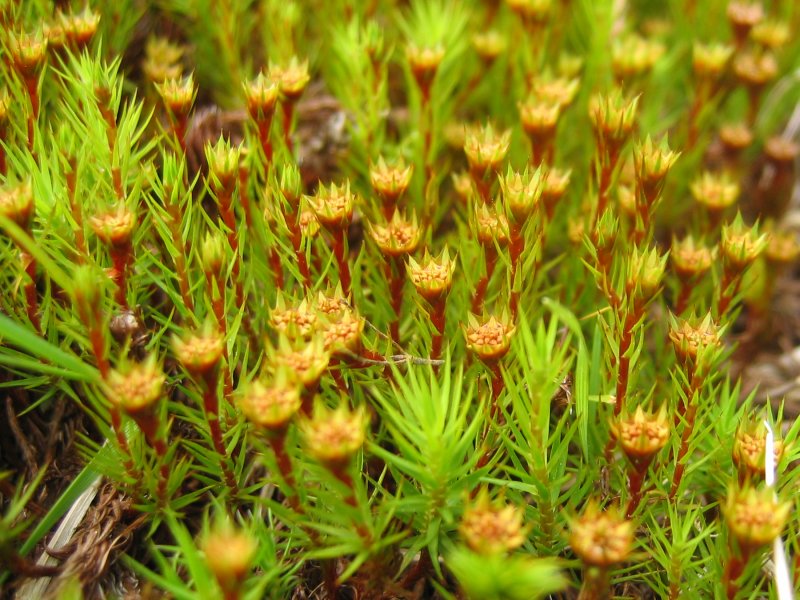
Strict Haircap
Polytrichum strictum
Kristian Peters -- Fabelfroh 16:07, 31 December 2006 (UTC), CC BY-SA 3.0, via Wikimedia Commons

Side by side
| Bristly Haircap Moss | Strict Haircap | |
|---|---|---|
| Scientific name | Polytrichum piliferum Hedw. | Polytrichum strictum Menzies ex Brid. |
| English name | Bristly Haircap Moss | Strict Haircap |
| Group | Mosses and liverworts | Mosses and liverworts |
| Class | Polytrichopsida | Polytrichopsida |
| Order | Polytrichales | Polytrichales |
| Family | Polytrichaceae Aloe-mosses | Polytrichaceae Aloe-mosses |
| Genus | Polytrichum Hair Moss | Polytrichum Hair Moss |
| Countries on record | 41 countries | 38 countries |
| GBIF occurrence records | 67,468 records | 38,290 records |
Rows where the two agree are shown in grey.
Where each is found
Both recorded in 36 countries
- Aland Islands
- Andorra
- Austria
- Belarus
- Belgium
- Canada
- Czechia
- Denmark
- Estonia
- Finland
- France
- Germany
- Greenland
- Hungary
- Iceland
- Ireland
- Isle of Man
- Italy
- Latvia
- Lithuania
- Norway
- Poland
- Portugal
- Romania
- Russia
- Saint Pierre and Miquelon
- Slovakia
- Slovenia
- Spain
- Svalbard and Jan Mayen
- Sweden
- Switzerland
- The Netherlands
- Ukraine
- United Kingdom
- United States
Only Bristly Haircap Moss (5)
Only Strict Haircap (2)
From Catalogue of Life checklists and GBIF occurrence records. A country missing from a list means no record is held, which is not proof of absence.
Checked facts
| Bristly Haircap Moss | Strict Haircap | |
|---|---|---|
| Appearance |
| No checked fact yet |
| Size |
| No checked fact yet |
| Habitat |
| No checked fact yet |
| Behaviour |
| No checked fact yet |
| Reproduction |
| No checked fact yet |
| Lifespan |
| No checked fact yet |
| Distribution |
| No checked fact yet |
| Conservation |
| No checked fact yet |
| Other |
| No checked fact yet |
In brief
Bristly Haircap Moss
Bristly haircap moss (Polytrichum piliferum Hedw.) is a perennial, evergreen moss in the family Polytrichaceae, order Polytrichales and class Polytrichopsida. It grows in open, exposed, relatively dry habitats, including shallow soil over rocks, sandy banks, gravel-covered ground and disturbed areas. Full profile
Compare something else
Page built on 24 November 2026 from the data on the two species pages, where every source is listed.
Cite this page
ScientificNames.org. (2026). Bristly Haircap Moss vs Strict Haircap. Retrieved November 24, 2026, from https://scientificnames.org/compare/bristly-haircap-moss-vs-strict-haircap
“Bristly Haircap Moss vs Strict Haircap.” ScientificNames.org, 2026, scientificnames.org/compare/bristly-haircap-moss-vs-strict-haircap. Accessed 24 Nov. 2026.
ScientificNames.org. “Bristly Haircap Moss vs Strict Haircap.” Accessed November 24, 2026. https://scientificnames.org/compare/bristly-haircap-moss-vs-strict-haircap.
@misc{scientificnames_bristly_haircap_moss_vs_strict_haircap,
  author = {{ScientificNames.org}},
  title = {Bristly Haircap Moss vs Strict Haircap},
  year = {2026},
  url = {https://scientificnames.org/compare/bristly-haircap-moss-vs-strict-haircap},
  note = {Accessed 2026-11-24}
}