Species · Mosses and liverworts
Bristly Haircap Moss Polytrichum piliferum
The scientific name of the Bristly Haircap Moss is Polytrichum piliferum. It is a species of bryophyte in the family Polytrichaceae (aloe-mosses), order Polytrichales.
- Scientific name
- Polytrichum piliferum Hedw.
- Common name
- Bristly Haircap Moss
- Genus
- Polytrichum
- Family
- Polytrichaceae (Aloe-mosses)
- Order
- Polytrichales
- Class
- Polytrichopsida
- Recorded in
- 41 countries
- Name status
- accepted in the Catalogue of Life

Overview
Bristly haircap moss (Polytrichum piliferum Hedw.) is a perennial, evergreen moss in the family Polytrichaceae, order Polytrichales and class Polytrichopsida. It grows in open, exposed, relatively dry habitats, including shallow soil over rocks, sandy banks, gravel-covered ground and disturbed areas.
Written 24 November 2026 from the sources listed below. Each statement was checked against the passage it cites; statements that could not be supported were removed.
Appearance
The species forms loose tufts with wine-reddish stems and bluish-green to grey shoots. Older plants develop a red-brown coloration, and the shorter leaves cluster near the tips of red stems to produce tapered shoots.[1][2][3]
The species has a tall, wiry, unbranched, dark-red stem. Its leaves are ribbed and generally erect, with slightly inward-curved blades when dry and outward-spreading leaves when moist.[4][5][6]
Each leaf lamella appears one cell wide and five to seven cells high in cross-section. The calyptra is hairy and whitish-brown.[7][8]
The moss grows to approximately 4 cm or less in height. Its leaves are generally 4–7 mm long, although they may be shorter in dry habitats, and its sporophyte seta is approximately 1–3 cm tall.[9][10][11]
Habitat
Bristly haircap moss favors open, exposed habitats and relatively dry environments. It occurs in acidic environments with low nutrient availability.[12][13][14]
Its habitats include shallow soil over rock outcrops, exposed sandy soils along banks, gravel-covered and disturbed ground, and rocks along road banks and in pastures. It also grows in shallow, well-drained sand or gravel over rocks and boulders.[15][16][17][18][19]
The species can withstand temperatures as high as 90–100°C.[20]
Behaviour
In sandy dry grasslands, bristly haircap moss prevents higher plants from growing.[21]
Reproduction and life cycle
The species is dioicous, with male and female reproductive structures occurring on separate plants. Its antheridia develop from cells beneath the leaves.[22][23]
Male reproductive shoots bear dark-red terminal antheridia surrounded by cup-shaped perigonial leaves. Sperm dispersal occurs through a splash-cup mechanism involving raindrops.[24][25]
The species commonly produces sporophytes, which generally mature during summer. Its sporangia are cube-shaped and inclined, becoming more horizontal at maturity.[26][27]
Conservation
The species was globally classified as secure (G5) on January 26, 2015. In Canada, it is classified as secure (N5).[28][29]
Uses
The species can serve as an indicator of nutrient levels in its habitat.[30]
Classification of the Bristly Haircap Moss
| Kingdom | Plantae |
|---|---|
| Subkingdom | Bryobiotina |
| Phylum | Bryophyta |
| Class | Polytrichopsida |
| Order | Polytrichales |
| Family | Polytrichaceae (Aloe-mosses) |
| Genus | Polytrichum (Hair Moss) |
| Species | Polytrichum piliferum Hedw. |
Where the Bristly Haircap Moss is found
Checklists and occurrence records place Polytrichum piliferum in 41 countries. GBIF holds 67,468 georeferenced records of it.
Countries
- Aland Islands 15
- Andorra 21
- Austria 276
- Belarus 48
- Belgium 2,528
- Bosnia and Herzegovina 3
- Bulgaria 13
- Canada 4,093
- Czechia 1,476
- Denmark 3,022
- Estonia 273
- Faroe Islands 11
- Finland 1,319
- France 3,513
- Germany 1,935
- Greenland 90
- Hungary 53
- Iceland 198
- Ireland 394
- Isle of Man 54
- Italy 60
- Latvia 11
- Lithuania 40
- Luxembourg 82
- Norway 2,264
- Poland 3,123
- Portugal 1,107
- Romania 5
- Russia 1,756
- Saint Pierre and Miquelon 3
- Serbia 4
- Slovakia 27
- Slovenia 23
- Spain 844
- Svalbard and Jan Mayen 67
- Sweden 4,696
- Switzerland 1,022
- The Netherlands 10,917
- Ukraine 398
- United Kingdom 15,118
- United States 6,566
Regions and cities with the most records
- England, United Kingdom 7,034
- Scotland, United Kingdom 3,699
- Gelderland, The Netherlands 3,591
- Wales, United Kingdom 3,519
- Ede, The Netherlands 1,838
- British Columbia, Canada 1,811
- Apeldoorn, The Netherlands 1,540
- Veenendaal, The Netherlands 1,421
- Arnhem, The Netherlands 1,395
- Central Jutland, Denmark 1,372
- Auvergne-Rhône-Alpes, France 1,299
- Drenthe, The Netherlands 1,243
- Amersfoort, The Netherlands 988
- Soest, The Netherlands 856
- Zeist, The Netherlands 795
- Rossendale, United Kingdom 751
- Utrecht, The Netherlands 732
- Limburg, The Netherlands 727
- Hilversum, The Netherlands 720
- Bury, United Kingdom 713
- Tilburg, The Netherlands 699
- Västra Götaland, Sweden 672
- Rochdale, United Kingdom 663
- Utrecht, The Netherlands 658
- Azores, Portugal 638
- Ontario, Canada 633
- Norrbotten, Sweden 630
- South Denmark, Denmark 609
- Oosterhout, The Netherlands 581
- Assen, The Netherlands 580
- Nijmegen, The Netherlands 576
- Burnley, United Kingdom 565
- Overijssel, The Netherlands 562
- Blackburn, United Kingdom 558
- Weert, The Netherlands 554
- Bolton, United Kingdom 548
20 more countries have a few records outside this range
These countries hold a few records of Polytrichum piliferum but lie outside the range the checklists give for it. Such records are often zoo or garden specimens, museum material or vagrants, so the species is not counted as occurring there.
- Antarctica 207
- Argentina 71
- Australia 4
- Chile 124
- China 27
- Democratic Republic of the Congo 21
- Falkland Islands 26
- French Southern Territories 12
- Georgia 36
- Heard Island and McDonald Islands 6
- Japan 210
- Kazakhstan 28
- Lesotho 4
- Pakistan 10
- Reunion 3
- Rwanda 10
- South Africa 58
- South Georgia and the South Sandwich Islands 57
- Tanzania 18
- Uganda 6
A number beside a place is its count of GBIF occurrence records. A place without a number comes from a checklist alone. Records show where a species has been observed or collected, which can include escapes and vagrants.
Common names
English
- Bristly Haircap Moss
- Bristly Haircap
Names in 17 other languages
- Chinese
- 毛尖金髮蘚
- Czech
- ploník chluponosný
- Danish
- Hårspidset jomfruhår
- Dutch
- Ruig haarmos
- Estonian
- liiv-karusammal
- Finnish
- karvakarhunsammal
- French
- polytric porte-poil
- German
- Glashaar-Widertonmoos
- Icelandic
- Gráhaddur
- Japanese
- ハリスギゴケ
- Lithuanian
- Žilsvasis gegužlinis
- Norwegian Bokmål
- rabbebjørnemose
- Polish
- Płonnik włosisty
- Russian
- Политрихум волосоносный
- Slovak
- ploník chĺpkatý
- Swedish
- hår-björnmossa, hårbjörnmossa
- Ukrainian
- Рунянка волосконосна
Synonyms
41 other scientific names have been used for this species and are now treated as synonyms of Polytrichum piliferum.
- Polytrichum antarcticum Cardot
- Polytrichum hirsutum V. Leroy bis
- Polytrichum hoppei Hornsch.
- Polytrichum laevipilum Hampe
- Polytrichum nanoglobulus Müll. Hal.
- Polytrichum noduliferum Dusén
- Polytrichum patagonicum Müll. Hal.
- Polytrichum piliferum f. epilosum Latzel
- Polytrichum piliferum f. fastigiatum (Lindb.) Margad.
- Polytrichum piliferum f. longisetum E. Bauer
- Polytrichum piliferum f. pauperum H.A. Möller
- Polytrichum piliferum f. procerum Bott.
- Polytrichum piliferum f. tectorum (Warnst.) Margad.
- Polytrichum piliferum f. trachynotum (Müll. Hal.) K.H. Walther
- Polytrichum piliferum f. tuberculosum (Müll. Hal.) K.H. Walther
- Polytrichum piliferum var. elegans E. Bauer
- Polytrichum piliferum var. fastigiatum (Lindb.) Bom. & Broth.
- Polytrichum piliferum var. flavipilum Luisier
- Polytrichum piliferum var. gracile Lindb.
- Polytrichum piliferum var. hoppei (Hornsch.) Dassen
- Polytrichum piliferum var. hoppei (Hornsch.) H.C.Hall
- Polytrichum piliferum var. horizontale Milde
- Polytrichum piliferum var. laevipilum (Hampe) Sull. & Lesq.
- Polytrichum piliferum var. proliferum Hartm.
- Polytrichum piliferum var. schiffneri E. Bauer
- Polytrichum piliferum var. tectorum Warnst.
- Polytrichum pilifolium Gray
- Polytrichum pilifolium Müll. Hal.
- Polytrichum pilosum Neck. ex Lindb.
- Polytrichum pilosum f. fastigiatum (Lindb.) Podp.
- Polytrichum pilosum f. longisetum (E. Bauer) Podp.
- Polytrichum pilosum f. procerum (Bott.) Podp.
- Polytrichum pilosum f. tectorum (Warnst.) Podp.
- Polytrichum pilosum var. brevipilum C.E.O. Jensen
- Polytrichum pilosum var. elegans (E. Bauer) Podp.
- Polytrichum pilosum var. fastigiatum Lindb.
- Polytrichum pilosum var. hoppei (Hornsch.) Lindb.
- Polytrichum pilosum var. pusillum H.A. Möller
- Polytrichum pilosum var. schiffneri (E. Bauer) Podp.
- Polytrichum trachynotum Müll. Hal.
Showing 40 of 41.
Subspecies and varieties
Related species
-
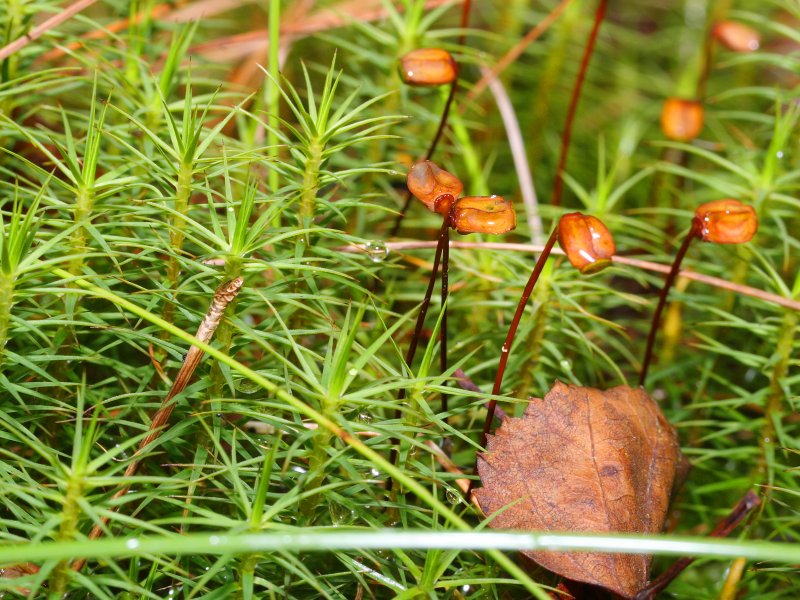 Common Haircap MossPolytrichum commune
-
 Juniper HaircapPolytrichum juniperinum
-
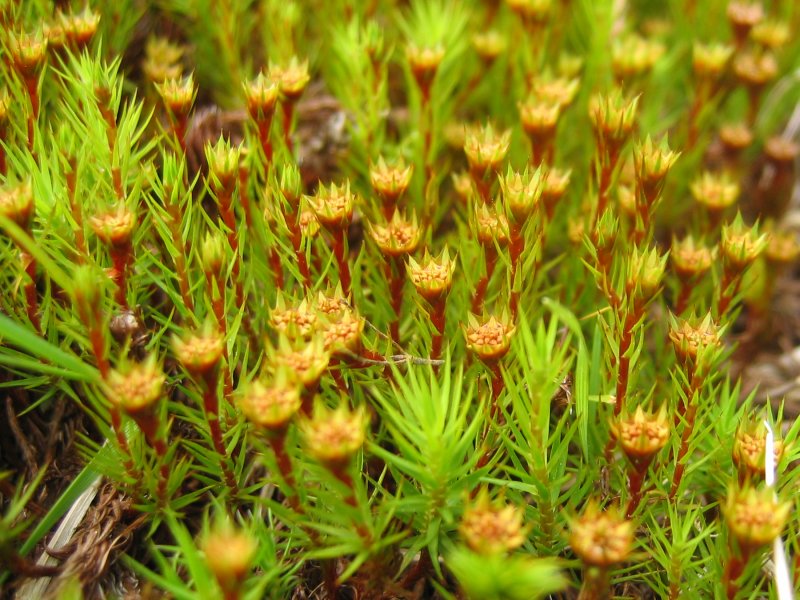 Strict HaircapPolytrichum strictum
- Slender HaircapPolytrichum longisetum
- Polytrichum MossPolytrichum hyperboreum
- Ohio Haircap MossPolytrichum ohioense
- Bank HaircapPolytrichum formosum
- Swartz's Polytrichum MossPolytrichum swartzii
Compare
- Bristly Haircap Moss vs Common Smoothcap
- Common Haircap Moss vs Bristly Haircap Moss
- Juniper Haircap vs Bristly Haircap Moss
- Bristly Haircap Moss vs Common Haircap Moss
- Bristly Haircap Moss vs Juniper Haircap
- Bristly Haircap Moss vs Strict Haircap
- Bristly Haircap Moss vs Slender Haircap
- Bristly Haircap Moss vs Polytrichum Moss
Questions and answers
What is the scientific name of the Bristly Haircap Moss?
The scientific name of the Bristly Haircap Moss is Polytrichum piliferum. Written with its author, the full name is Polytrichum piliferum Hedw..
Which family does the Bristly Haircap Moss belong to?
Polytrichum piliferum belongs to the family Polytrichaceae, in the order Polytrichales and the class Polytrichopsida.
Where is the Bristly Haircap Moss found?
Checklists and occurrence records place Polytrichum piliferum in 41 countries, including United Kingdom, The Netherlands, United States, Sweden, Canada and France.
What other names does the Bristly Haircap Moss have?
Polytrichum piliferum is also known in English as Bristly Haircap.
Where is haircap moss found?
Bristly haircap moss occurs in suitable habitats on every continent, including Antarctica. It grows in open, exposed and relatively dry habitats, including sandy soils, gravel-covered ground and shallow soil over rocks.[12][13][15][16][17][31]
Sources
Passages the profile rests on
- The species forms loose tufts with wine-reddish stems and bluish-green to grey shoots. Source passage: “forms loose tufts with wine-reddish stems. It is an acrocarpous moss that appears bluish-green to grey.” — English Wikipedia
- Older plants develop a red-brown coloration. Source passage: “becomes a red-brown colour as it grows older.” — English Wikipedia
- Its shorter leaves cluster near the tips of red stems, producing a tapered shoot shape. Source passage: “shorter leaves are located close together towards the tip of its red stems, giving the shoot a characteristic tapered shape.” — English Wikipedia
- The species has a tall, wiry, unbranched, dark-red stem. Source passage: “The stem is tall, wiry, unbranched, and a dark-red colour.” — English Wikipedia
- The leaves are ribbed and generally stand erect, with slightly inward-curved blades when dry. Source passage: “The leaves of P. piliferum are costate and often stand erect, straight, and slightly in-curved when dry” — English Wikipedia
- When moist, the leaves spread outward from the stem. Source passage: “erect-spreading when moist.” — English Wikipedia
- Its calyptra is hairy and whitish-brown. Source passage: “The calyptra of P. piliferum is hairy and a whitish-brown color.” — English Wikipedia
- Each leaf lamella appears one cell wide and five to seven cells high in cross-section. Source passage: “the cross section of each lamella appears 1 cell wide and 5 to 7 cells high.” — English Wikipedia
- The moss grows to approximately 4 cm or less in height. Source passage: “grows close to the ground (about 4 cm or less)” — English Wikipedia
- Its leaves are generally 4–7 mm long, although they may be shorter in dry habitats. Source passage: “These leaves can be anywhere from 4 mm to 7 mm long, although they may be shorter in dry areas.” — English Wikipedia
- Its sporophyte seta is approximately 1–3 cm tall. Source passage: “the red-brown seta that is approximately 1 cm to 3 cm in height.” — English Wikipedia
- The species favors open, exposed habitats. Source passage: “P. piliferum prefers more open and exposed areas.” — English Wikipedia
- It prefers relatively dry environments. Source passage: “P. piliferum also prefers a drier environment” — English Wikipedia
- It occurs in acidic environments with low nutrient availability. Source passage: “frequently found in areas that are acidic and low in nutrients” — English Wikipedia
- Its habitats include shallow soil over rock outcrops. Source passage: “shallow soil over outcrops” — English Wikipedia
- It grows on exposed sandy soils along banks. Source passage: “exposed sandy soils of banks” — English Wikipedia
- It occurs on gravel-covered and disturbed ground. Source passage: “gravel cover, and disturbed areas.” — English Wikipedia
- It can grow on rocks along road banks and in pastures. Source passage: “rocks on road banks or pastures.” — English Wikipedia
- It also inhabits shallow, well-drained sand or gravel over rocks and boulders. Source passage: “shallow and drained sand or gravel, like in ground over rocks and boulders.” — English Wikipedia
- The species can withstand temperatures as high as 90–100°C. Source passage: “is able to withstand temperatures as high as 90°C to 100°C.” — English Wikipedia
- In sandy dry grasslands, the species prevents higher plants from growing. Source passage: “In sandy dry grass lands the species prevents higher plants from growing.” — English Wikipedia
- The species is dioicous, with male and female reproductive structures occurring on separate plants. Source passage: “P. piliferum is dioicous, meaning that it has separate male and female plants.” — English Wikipedia
- Its antheridia develop from cells beneath the leaves. Source passage: “the antheridia develop from cells below the leaves.” — English Wikipedia
- It disperses sperm through a splash-cup mechanism involving raindrops. Source passage: “this moss utilizes the splash-cup mechanism to disperse the sperm it produces from its antheridia.” — English Wikipedia
- Male reproductive shoots bear dark-red terminal antheridia surrounded by cup-shaped perigonial leaves. Source passage: “The male shoots produce a dark-red, terminal antheridia that is surrounded by a cup-shaped whorl of perigonial leaves” — English Wikipedia
- The species commonly produces sporophytes that generally mature during summer. Source passage: “The sporophytes of P. piliferum are common and usually reach maturity during the summer.” — English Wikipedia
- Its sporangia are cube-shaped and inclined, becoming more horizontal at maturity. Source passage: “The sporangia are cube-like and inclined, but become more horizontal when mature.” — English Wikipedia
- The species was globally classified as secure (G5) on January 26, 2015. Source passage: “ranked globally as secure (G5) as of 1/26/2015” — English Wikipedia
- In Canada, the species is classified as secure (N5). Source passage: “In Canada, Polytrichum pilifeurm is ranked as secure (N5)” — English Wikipedia
- The species can serve as an indicator of nutrient levels in its habitat. Source passage: “they can be an excellent gauge for nutrient levels.” — English Wikipedia
- The species has a bipolar, cosmopolitan distribution and occurs in suitable habitats on every continent, including Antarctica. Source passage: “occurring in suitable habitats on all continents including Antarctica.” — English Wikipedia
Data
- Catalogue of Life, 2026-10-16 XR cc by
- Global Biodiversity Information Facility CC BY 4.0
- Wikidata CC0
- GeoNames CC BY 4.0
- Wikimedia Commons per image; credit shown with each image
- Within the Catalogue of Life, this name comes from Bryophyte Nomenclator cc by
References
- Hedwig, J. (1801). In Species Muscorum Frondosorum. Joannis Ambrosii Barthii, Lipsiae. https://www.tropicos.org/reference/9010299 Link where the name was published
- Hodgetts, N. G., Söderström, L., Blockeel, T. L., Caspari, S., Ignatov, M. S., Konstantinova, N. A., Lockhart, N., Papp, B., Schröck, C., Sim-Sim, M., Bell, D., Bell, N. E., Blom, H. H., Bruggeman-Nannenga, M. A., Brugués, M., Enroth, J., Flatberg, K. I., Garilleti, R., Hedenäs, L., et al. (2020). An annotated checklist of bryophytes of Europe, Macaronesia and Cyprus. Journal of Bryology, 42(1), 1–116. https://www.tropicos.org/reference/100039553 Link
This species in other databases
Page built on 24 November 2026. See how the catalog is made and all sources and licences.
Cite this page
ScientificNames.org. (2026). Polytrichum piliferum (Bristly Haircap Moss). Retrieved November 24, 2026, from https://scientificnames.org/species/polytrichum-piliferum
“Polytrichum piliferum (Bristly Haircap Moss).” ScientificNames.org, 2026, scientificnames.org/species/polytrichum-piliferum. Accessed 24 Nov. 2026.
ScientificNames.org. “Polytrichum piliferum (Bristly Haircap Moss).” Accessed November 24, 2026. https://scientificnames.org/species/polytrichum-piliferum.
@misc{scientificnames_polytrichum_piliferum_bristly_haircap_moss,
  author = {{ScientificNames.org}},
  title = {Polytrichum piliferum (Bristly Haircap Moss)},
  year = {2026},
  url = {https://scientificnames.org/species/polytrichum-piliferum},
  note = {Accessed 2026-11-24}
}