Comparison
Bog Haircap Moss vs Bristly Haircap Moss
Bog Haircap Moss (Polytrichum strictum) and Bristly Haircap Moss (Polytrichum piliferum) both belong to the genus Polytrichum (hair moss) and part ways below it. Both are recorded in 36 countries.
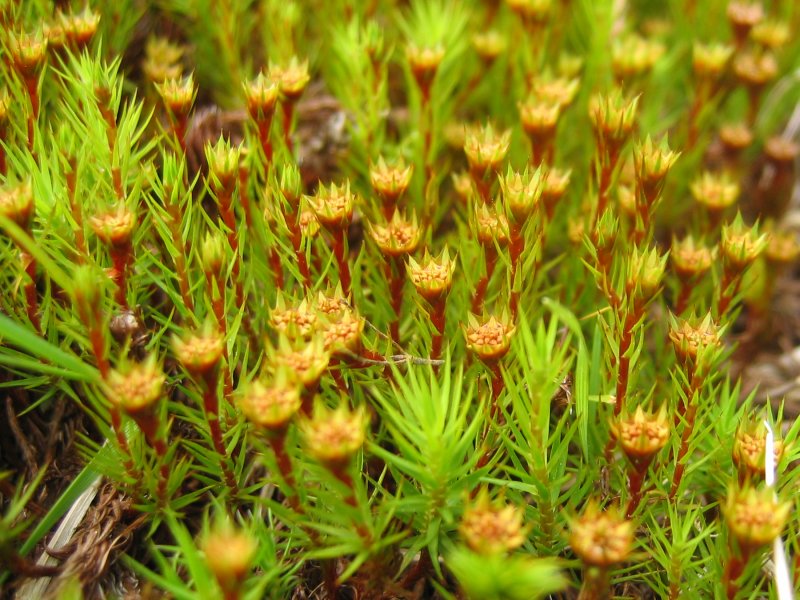
Bog Haircap Moss
Polytrichum strictum
Kristian Peters -- Fabelfroh 16:07, 31 December 2006 (UTC), CC BY-SA 3.0, via Wikimedia Commons


Side by side
| Bog Haircap Moss | Bristly Haircap Moss | |
|---|---|---|
| Scientific name | Polytrichum strictum Menzies ex Brid. | Polytrichum piliferum Hedw. |
| English name | Bog Haircap Moss | Bristly Haircap Moss |
| Group | Mosses and liverworts | Mosses and liverworts |
| Class | Polytrichopsida | Polytrichopsida |
| Order | Polytrichales | Polytrichales |
| Family | Polytrichaceae Aloe-mosses | Polytrichaceae Aloe-mosses |
| Genus | Polytrichum Hair Moss | Polytrichum Hair Moss |
| Countries on record | 38 countries | 41 countries |
| GBIF occurrence records | 38,290 records | 67,468 records |
Rows where the two agree are shown in grey.
Where each is found
Both recorded in 36 countries
- Aland Islands
- Andorra
- Austria
- Belarus
- Belgium
- Canada
- Czechia
- Denmark
- Estonia
- Finland
- France
- Germany
- Greenland
- Hungary
- Iceland
- Ireland
- Isle of Man
- Italy
- Latvia
- Lithuania
- Norway
- Poland
- Portugal
- Romania
- Russia
- Saint Pierre and Miquelon
- Slovakia
- Slovenia
- Spain
- Svalbard and Jan Mayen
- Sweden
- Switzerland
- The Netherlands
- Ukraine
- United Kingdom
- United States
Only Bog Haircap Moss (2)
Only Bristly Haircap Moss (5)
From Catalogue of Life checklists and GBIF occurrence records. A country missing from a list means no record is held, which is not proof of absence.
Checked facts
| Bog Haircap Moss | Bristly Haircap Moss | |
|---|---|---|
| Appearance |
|
|
| Size |
|
|
| Habitat |
|
|
| Behaviour |
|
|
| Reproduction |
|
|
| Lifespan | No checked fact yet |
|
| Distribution | No checked fact yet |
|
| Conservation |
|
|
| Uses |
| No checked fact yet |
| Similar species |
| No checked fact yet |
| Other | No checked fact yet |
|
In brief
Bog Haircap Moss
Polytrichum strictum inhabits peatlands, wet heaths, tundra, sedge meadows, and peaty forests, and occurs from low to high elevations. It forms dense tufts of slender stems with narrowly lanceolate leaves, reddish awns, and white, woolly rhizoids extending up the stems. Full profile
Bristly Haircap Moss
Bristly haircap moss (Polytrichum piliferum Hedw.) is a perennial, evergreen moss in the family Polytrichaceae, order Polytrichales and class Polytrichopsida. It grows in open, exposed, relatively dry habitats, including shallow soil over rocks, sandy banks, gravel-covered ground and disturbed areas. Full profile
Compare something else
Page built on 28 November 2026 from the data on the two species pages, where every source is listed.
Cite this page
ScientificNames.org. (2026). Bog Haircap Moss vs Bristly Haircap Moss. Retrieved November 28, 2026, from https://scientificnames.org/compare/bog-haircap-moss-vs-bristly-haircap-moss
“Bog Haircap Moss vs Bristly Haircap Moss.” ScientificNames.org, 2026, scientificnames.org/compare/bog-haircap-moss-vs-bristly-haircap-moss. Accessed 28 Nov. 2026.
ScientificNames.org. “Bog Haircap Moss vs Bristly Haircap Moss.” Accessed November 28, 2026. https://scientificnames.org/compare/bog-haircap-moss-vs-bristly-haircap-moss.
@misc{scientificnames_bog_haircap_moss_vs_bristly_haircap_moss,
  author = {{ScientificNames.org}},
  title = {Bog Haircap Moss vs Bristly Haircap Moss},
  year = {2026},
  url = {https://scientificnames.org/compare/bog-haircap-moss-vs-bristly-haircap-moss},
  note = {Accessed 2026-11-28}
}