Comparison
Potato vs Jimsonweed
Potato (Solanum tuberosum) and Jimsonweed (Datura stramonium) both belong to the subfamily Solanoideae and part ways below it. Both are recorded in 104 countries.


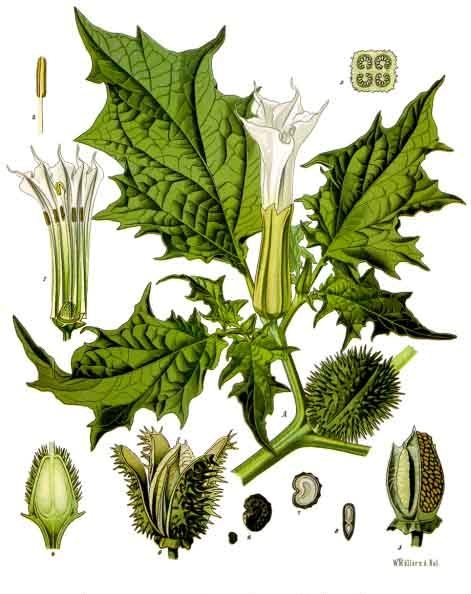
Jimsonweed
Datura stramonium
Franz Eugen Köhler, Köhler's Medizinal-Pflanzen, Public domain, via Wikimedia Commons

How they differ
Potato (Solanum tuberosum) is a herbaceous perennial, whereas Fireweed (Datura stramonium) is an annual herbaceous species. Potato produces underground stem tubers with helically arranged eyes, whereas Fireweed produces spiny, egg-shaped fruit capsules containing numerous seeds. Potato originated in southern Peru and extreme northwestern Bolivia, whereas Fireweed is native to Central America. Potato is cultivated for its edible starchy tubers, whereas Fireweed has been used in traditional medicine and for ceremonial and spiritual purposes.
| Potato | Jimsonweed | |
|---|---|---|
| Appearance | Potato has hairy stems and leaves bearing roughly four pairs of leaflets. | Fireweed has large, fragrant, trumpet-shaped or funnel-shaped flowers that are white to pinkish. |
| Flowers | Potato flowers range from white and pink to blue and purple, with yellow centres. | Fireweed flowers range from white to creamy or violet in color. |
| Reproduction | Each Potato fruit contains approximately 300 very small seeds. | Mature Fireweed seed capsules split into four chambers containing dozens of small black seeds each. |
| Habitat | The Andean subspecies of Potato is adapted to short-day conditions in mountainous equatorial and tropical regions. | Fireweed occurs along roadsides and around livestock enclosures enriched with dung. |
| Distribution | Potato originated in southern Peru and extreme northwestern Bolivia. | Fireweed grows wild in warm and temperate regions worldwide. |
| Conservation | Potato crops can suffer widespread destruction from late blight disease. | Fireweed is described as an aggressive invasive weed in temperate and tropical climates worldwide. |
| Uses | Potato starch is used in industrial applications. | Atropine obtained from Fireweed has been used in treatments for Parkinson's disease, peptic ulcers, diarrhea, and bronchial asthma. |
| Growth | Potato can grow to approximately one metre in height. | Fireweed is an annual herbaceous species. |
Written from the checked facts listed further down. Statements that the sources did not support were removed.
Side by side
| Potato | Jimsonweed | |
|---|---|---|
| Scientific name | Solanum tuberosum L. | Datura stramonium L. |
| English name | Potato | Jimsonweed |
| Group | Flowering plants | Flowering plants |
| Class | Magnoliopsida | Magnoliopsida |
| Order | Solanales | Solanales |
| Family | Solanaceae Nightshades | Solanaceae Nightshades |
| Genus | Solanum Nightshade | Datura Jimsonweed |
| Countries on record | 128 countries | 149 countries |
| GBIF occurrence records | 84,358 records | 176,154 records |
Rows where the two agree are shown in grey.
Where each is found
Both recorded in 104 countries
- Afghanistan
- Albania
- Algeria
- Argentina
- Armenia
- Australia
- Austria
- Bahamas
- Belarus
- Belgium
- Benin
- Bermuda
- Bhutan
- Bolivia
- Bonaire, Saint Eustatius and Saba
- Brazil
- Bulgaria
- Cabo Verde
- Canada
- Chile
- China
- Colombia
- Costa Rica
- Croatia
- Cuba
- Czechia
- Denmark
- Dominican Republic
- Ecuador
- Egypt
- Estonia
- Ethiopia
- Fiji
- France
- Georgia
- Germany
- Greece
- Guadeloupe
- Guatemala
- Guernsey
- Haiti
- Honduras
- Hungary
- India
- Iraq
- Ireland
- Israel
- Italy
- Ivory Coast
- Jamaica
- Japan
- Jersey
- Kazakhstan
- Kenya
- Laos
- Latvia
- Lesotho
- Libya
- Liechtenstein
- Lithuania
- Luxembourg
- Madagascar
- Malawi
- Mali
- Martinique
- Mauritania
- Mauritius
- Mexico
- Montenegro
- Montserrat
- Morocco
- Myanmar
- Nepal
- New Caledonia
- New Zealand
- Nicaragua
- Nigeria
- Norway
- Pakistan
- Panama
- Peru
- Poland
- Portugal
- Puerto Rico
- Romania
- Russia
- Saint Helena
- Slovakia
- Slovenia
- South Africa
- South Korea
- Spain
- Sweden
- Switzerland
- Taiwan
- The Netherlands
- Tunisia
- Turkey
- Uganda
- Ukraine
- United Kingdom
- United States
- Uzbekistan
- Venezuela
Only Potato (24)
- Aland Islands
- Azerbaijan
- Bangladesh
- Burkina Faso
- Cameroon
- Democratic Republic of the Congo
- Djibouti
- Faroe Islands
- Finland
- French Polynesia
- Iceland
- Indonesia
- Isle of Man
- Mayotte
- Moldova
- Mongolia
- Niue
- North Korea
- Paraguay
- Philippines
- Reunion
- Rwanda
- Uruguay
- Vietnam
Only Jimsonweed (45)
- Andorra
- Angola
- Anguilla
- Barbados
- Belize
- Central African Republic
- Chad
- Cyprus
- El Salvador
- Eswatini
- French Guiana
- Ghana
- Gibraltar
- Guinea
- Iran
- Kosovo
- Kyrgyzstan
- Lebanon
- Malta
- Mozambique
- Namibia
- North Macedonia
- Saint Barthelemy
- Saint Kitts and Nevis
- San Marino
- Saudi Arabia
- Serbia
- Seychelles
- South Sudan
- Sri Lanka
- Sudan
- Syria
- Tajikistan
- Tanzania
- Thailand
- Togo
- Tonga
- Trinidad and Tobago
- Turkmenistan
- Turks and Caicos Islands
- U.S. Virgin Islands
- United Arab Emirates
- Yemen
- Zambia
- Zimbabwe
From Catalogue of Life checklists and GBIF occurrence records. A country missing from a list means no record is held, which is not proof of absence.
Checked facts
| Potato | Jimsonweed | |
|---|---|---|
| Appearance |
|
|
| Size |
| No checked fact yet |
| Habitat |
|
|
| Diet |
| No checked fact yet |
| Behaviour | No checked fact yet |
|
| Reproduction |
|
|
| Distribution |
|
|
| Conservation |
|
|
| Uses |
|
|
| Name origin | No checked fact yet |
|
| Other | No checked fact yet |
|
In brief
Potato
Potato (Solanum tuberosum L.) is a herbaceous perennial flowering plant in the family Solanaceae, order Solanales and class Magnoliopsida. The species originated in southern Peru and extreme northwestern Bolivia. Potato produces edible underground stem tubers that contain starch and are consumed as a staple food in many parts of the world. Full profile
Jimsonweed
Datura stramonium L. is an annual flowering herb in the family Solanaceae, commonly called jimsonweed. It is native to Central America and grows wild in warm and temperate regions worldwide. It is distinguished by its fragrant, trumpet-shaped flowers and spiny seed capsules containing numerous black seeds. Full profile
Compare something else
Page built on 24 November 2026 from the data on the two species pages, where every source is listed.
Cite this page
ScientificNames.org. (2026). Potato vs Jimsonweed. Retrieved November 24, 2026, from https://scientificnames.org/compare/potato-vs-jimsonweed
“Potato vs Jimsonweed.” ScientificNames.org, 2026, scientificnames.org/compare/potato-vs-jimsonweed. Accessed 24 Nov. 2026.
ScientificNames.org. “Potato vs Jimsonweed.” Accessed November 24, 2026. https://scientificnames.org/compare/potato-vs-jimsonweed.
@misc{scientificnames_potato_vs_jimsonweed,
  author = {{ScientificNames.org}},
  title = {Potato vs Jimsonweed},
  year = {2026},
  url = {https://scientificnames.org/compare/potato-vs-jimsonweed},
  note = {Accessed 2026-11-24}
}