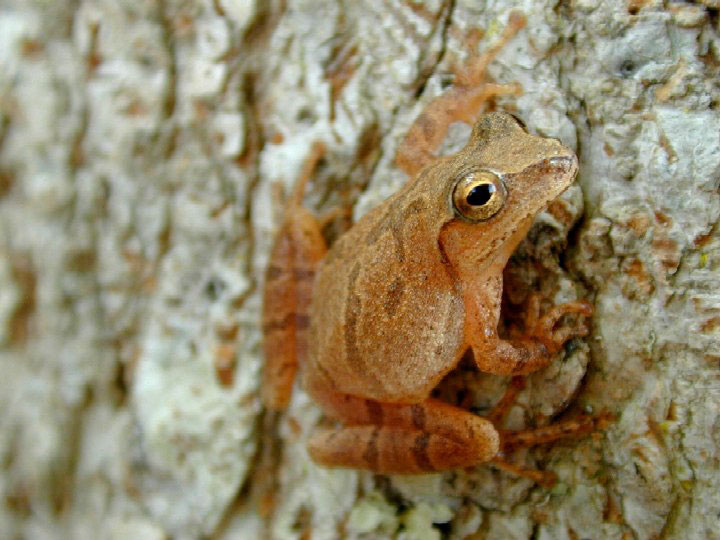
| Appearance | - The frog has a stocky body and a head that is broader than its body. English Wikipedia
- Its coloration ranges through shades of grey and brown, including sorghum brown, deep brownish-drab, and mars brown. English Wikipedia
- Adults have a triangular marking between the eyes and a white line along the upper lip. English Wikipedia
- Male frogs have a dark throat. English Wikipedia
- The frog's back usually has paired markings resembling reversed parentheses, which sometimes join to form an X. srelherp.uga.edu
- The concealed surfaces of its hind legs have yellow flash coloration. srelherp.uga.edu
| - The spring peeper typically has pink, tan, light brown, or gray skin and an X-shaped marking on its back. mdc.mo.gov
- The species has a cream-colored belly, a dark line across its head, and dark bars on its legs. mdc.mo.gov
- Spring peepers have adhesive pads on their fingertips and toe tips. mdc.mo.gov
- Females are generally lighter-colored and have bulkier abdomens than males. English Wikipedia
- The skin coloration of spring peepers can change within 15 to 45 minutes in response to temperature and light. English Wikipedia
|
|---|
| Size | | - Male spring peepers measure 18–30 mm in body length, while females measure 20–35 mm. English Wikipedia
|
|---|
| Habitat | - Its natural habitats include temperate forests, rivers, swamps, freshwater marshes, springs, and ponds. English Wikipedia
- It inhabits spring-fed hillsides, grassy pools, and ditches, often away from permanent water. English Wikipedia
- Its documented hillside habitats occur at elevations of approximately 365–1,341 m. English Wikipedia
- During the mating season, it commonly inhabits small grassy vernal ponds and temporary rainwater pools. animaldiversity.org
- After mating, individuals move to higher elevations and drier terrestrial habitats. animaldiversity.org
- The species prefers upland woodlands and forested hillsides, generally above 1,070 m. srelherp.uga.edu
- Its breeding habitats include shallow pools, roadside ditches, and quiet stream margins. srelherp.uga.edu
| - Spring peepers inhabit marshy woodland and non-wooded lowlands near ponds and swamps. animaldiversity.org
- The species commonly inhabits forests and regenerating woodlands near temporary or semipermanent wetlands. English Wikipedia
- Spring peepers frequently breed in fishless ponds and temporary pools. mdc.mo.gov
- Spring peepers generally remain close to the ground or concealed in leaf litter despite their climbing ability. animaldiversity.org
|
|---|
| Diet | - The species feeds on invertebrates, including insects, arachnids, and nematodes. English Wikipedia
- Its documented prey includes ants, beetles, cicadas, aphids, leafhoppers, flies, butterfly larvae, earthworms, centipedes, and spiders. English Wikipedia
- Beetles account for approximately 45 percent of its reported diet. animaldiversity.org
- Spiders account for approximately 25 percent of its reported diet. animaldiversity.org
| - Adult spring peepers eat small insects and spiders, including ants, beetles, and flies. animaldiversity.org
- Spring peeper tadpoles feed on algae, detritus, and microorganisms. animaldiversity.org
- Adult spring peepers forage among leaf litter and surface debris for small insects and spiders. mdc.mo.gov
|
|---|
| Behaviour | - The species is relatively solitary and generally interacts with other individuals only during the breeding season. animaldiversity.org
- Males may defend small breeding areas in ponds but do not defend territories generally. animaldiversity.org
- The species is secretive outside its breeding season. srelherp.uga.edu
- Males gather at woodland pools and call both during daylight and at night. srelherp.uga.edu
- Adults are rarely observed during summer and are presumed to shelter in leaf litter. srelherp.uga.edu
| - Male spring peepers produce clear, high-pitched calls that rise slightly in pitch at the end. mdc.mo.gov
- Male spring peepers repeat their calls approximately once per second. mdc.mo.gov
- Spring peeper choruses can resemble the sound of hundreds of small jingle bells. mdc.mo.gov
- Spring peepers are usually concealed during daylight and become active around dusk. mdc.mo.gov
- Spring peepers may become active during daylight when heavy rain persists. mdc.mo.gov
- Spring peepers generally migrate at night. English Wikipedia
- Male spring peepers establish small territories around breeding pools and compete through frequent calling. animaldiversity.org
- Females preferentially select larger males as mates. animaldiversity.org
- Some males use a satellite strategy, remaining near calling males without calling themselves to intercept females. English Wikipedia
|
|---|
| Reproduction | | - Spring peepers in northern regions generally breed between March and June. English Wikipedia
- Spring peepers in southern regions breed between October and March, depending on local temperature. English Wikipedia
- Female spring peepers typically lay approximately 900 eggs per clutch, although clutches can contain up to 1,000 eggs. English Wikipedia
- Female spring peepers deposit their eggs individually or in groups of two or three. English Wikipedia
- Spring peeper eggs are attached individually to dead leaves, grasses, or sticks in shallow water. mdc.mo.gov
- Spring peeper eggs generally hatch within 6–12 days. animaldiversity.org
- Spring peeper tadpoles typically undergo metamorphosis after 45–90 days. animaldiversity.org
- Spring peepers generally reach sexual maturity at two years of age. mdc.mo.gov
- Male spring peepers provide no parental care after fertilization. animaldiversity.org
|
|---|
| Conservation | - Habitat loss threatens the species in several states, including Maryland and North Carolina. English Wikipedia
- Maryland and North Carolina list the species as a species of concern. English Wikipedia
- The species is listed as Least Concern on the IUCN Red List. animaldiversity.org
- The species is considered to be declining in parts of its northern range. srelherp.uga.edu
| - Spring peepers are listed as protected in New Jersey and threatened in Kansas. animaldiversity.org
- Spring peepers have become threatened in some states where wetland habitat has declined. mdc.mo.gov
- Spring peepers may help control populations of insects. animaldiversity.org
|
|---|
| Uses | | |
|---|
| Similar species | - Its dorsal pattern resembles that of the spring peeper, Pseudacris crucifer. srelherp.uga.edu
- The spring peeper lacks the dark triangular marking between the eyes that distinguishes this species. srelherp.uga.edu
- Its call is more rapid and nasal than that of the upland chorus frog, Pseudacris feriarum. srelherp.uga.edu
- The Collinses' mountain chorus frog was formerly classified as a population of this species before being described separately in 2020. English Wikipedia
| - Spring peepers differ from some other Pseudacris species by lacking white lines on their lips. English Wikipedia
|
|---|