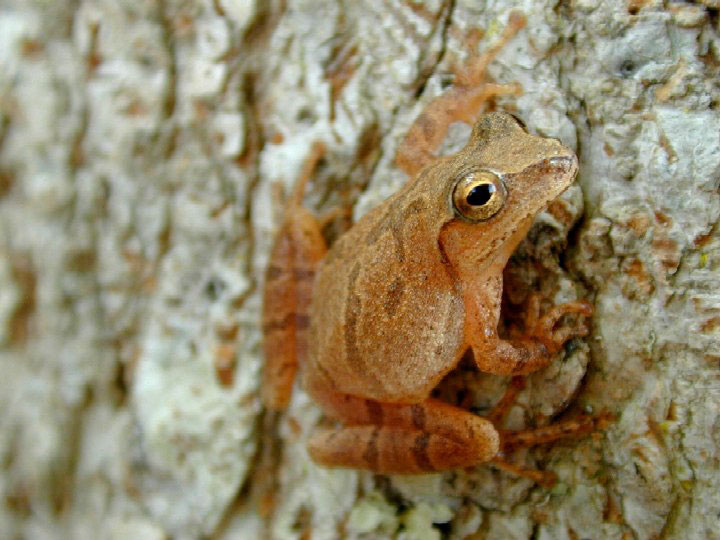
| Appearance | - Adults have gray or light brown dorsal skin with small dark brown spots and a white abdomen. animaldiversity.org
- The species has yellowish limbs and groins, while males have dusky-yellow necks. animaldiversity.org
- Adults have rough skin, shortened broad toe pads, and webbing between their toes. animaldiversity.org
- The species lacks the dark eye stripe characteristic of the Baja California Treefrog. nps.gov
| - The spring peeper typically has pink, tan, light brown, or gray skin and an X-shaped marking on its back. mdc.mo.gov
- The species has a cream-colored belly, a dark line across its head, and dark bars on its legs. mdc.mo.gov
- Spring peepers have adhesive pads on their fingertips and toe tips. mdc.mo.gov
- Females are generally lighter-colored and have bulkier abdomens than males. English Wikipedia
- The skin coloration of spring peepers can change within 15 to 45 minutes in response to temperature and light. English Wikipedia
|
|---|
| Size | | - Male spring peepers measure 18–30 mm in body length, while females measure 20–35 mm. English Wikipedia
|
|---|
| Habitat | - The species commonly inhabits streams with abundant boulders and cobbles in their channels. English Wikipedia
- Adults occupy canyon, desert, coastal, and mountain stream habitats. animaldiversity.org
- The species occurs in coastal sage habitats and streams at elevations from 0 to 2,290 m. animaldiversity.org
- In the Santa Monica Mountains and Simi Hills, the species occurs around coastal and canyon streams and rocky washes with permanent quiet pools. nps.gov
- During daylight, frogs shelter in small openings among boulders near the waterline. animaldiversity.org
- During fall and winter, frogs move to higher rock crevices to avoid drainage from heavy rainfall. animaldiversity.org
| - Spring peepers inhabit marshy woodland and non-wooded lowlands near ponds and swamps. animaldiversity.org
- The species commonly inhabits forests and regenerating woodlands near temporary or semipermanent wetlands. English Wikipedia
- Spring peepers frequently breed in fishless ponds and temporary pools. mdc.mo.gov
- Spring peepers generally remain close to the ground or concealed in leaf litter despite their climbing ability. animaldiversity.org
|
|---|
| Diet | - Adult frogs eat insects, spiders, centipedes, and other invertebrates. nps.gov
- Tadpoles consume plant material, periphyton from algal mats, and organic detritus. animaldiversity.org
- Tadpoles feed on organic detritus and plant material. nps.gov
| - Adult spring peepers eat small insects and spiders, including ants, beetles, and flies. animaldiversity.org
- Spring peeper tadpoles feed on algae, detritus, and microorganisms. animaldiversity.org
- Adult spring peepers forage among leaf litter and surface debris for small insects and spiders. mdc.mo.gov
|
|---|
| Behaviour | - The species is predominantly nocturnal. animaldiversity.org
- Frogs undergo aestivation during periods of extreme heat or cold. animaldiversity.org
- Adults rarely remain in water outside breeding or predator-avoidance situations. animaldiversity.org
- The species undergoes torpor from December through March. animaldiversity.org
- Males use repeated, loud, low-pitched quacking calls to attract females during breeding. animaldiversity.org
- Males produce warning calls to intimidate competing males and defend their territories. animaldiversity.org
- Males display aggression and territoriality toward other males through combat and threatening vocalizations. animaldiversity.org
- The species has been observed cohabiting streams with fish that consume invertebrates. animaldiversity.org
| - Male spring peepers produce clear, high-pitched calls that rise slightly in pitch at the end. mdc.mo.gov
- Male spring peepers repeat their calls approximately once per second. mdc.mo.gov
- Spring peeper choruses can resemble the sound of hundreds of small jingle bells. mdc.mo.gov
- Spring peepers are usually concealed during daylight and become active around dusk. mdc.mo.gov
- Spring peepers may become active during daylight when heavy rain persists. mdc.mo.gov
- Spring peepers generally migrate at night. English Wikipedia
- Male spring peepers establish small territories around breeding pools and compete through frequent calling. animaldiversity.org
- Females preferentially select larger males as mates. animaldiversity.org
- Some males use a satellite strategy, remaining near calling males without calling themselves to intercept females. English Wikipedia
|
|---|
| Reproduction | - The breeding season generally extends from February to early October. nps.gov
- Breeding begins in early February after winter rainfall declines. animaldiversity.org
- Males attract females to breeding ponds and aquatic areas using mating calls. animaldiversity.org
- Mating occurs through inguinal amplexus, with males gripping females around their hips. animaldiversity.org
- Tadpoles undergo metamorphosis approximately 40–75 days after hatching. nps.gov
- Juveniles generally reach sexual maturity at approximately two years of age. animaldiversity.org
- Both parents leave the breeding ponds after spawning, indicating little or no parental care. animaldiversity.org
| - Spring peepers in northern regions generally breed between March and June. English Wikipedia
- Spring peepers in southern regions breed between October and March, depending on local temperature. English Wikipedia
- Female spring peepers typically lay approximately 900 eggs per clutch, although clutches can contain up to 1,000 eggs. English Wikipedia
- Female spring peepers deposit their eggs individually or in groups of two or three. English Wikipedia
- Spring peeper eggs are attached individually to dead leaves, grasses, or sticks in shallow water. mdc.mo.gov
- Spring peeper eggs generally hatch within 6–12 days. animaldiversity.org
- Spring peeper tadpoles typically undergo metamorphosis after 45–90 days. animaldiversity.org
- Spring peepers generally reach sexual maturity at two years of age. mdc.mo.gov
- Male spring peepers provide no parental care after fertilization. animaldiversity.org
|
|---|
| Distribution | - The species occurs in coastal southern California and northern Baja California, Mexico. amphibiaweb.org
| No checked fact yet |
|---|
| Conservation | - The species is not considered threatened by the IUCN. English Wikipedia
- Habitat fragmentation may reduce genetic diversity among populations. English Wikipedia
- Tadpoles are sensitive to elevated nitrite concentrations associated with agricultural and urban runoff. nps.gov
- Exposure to ultraviolet radiation may reduce embryonic survival. English Wikipedia
- Rainbow trout and two-striped garter snakes prey on the species in stream ponds. English Wikipedia
- Invasive green sunfish prey on adult California tree frogs. English Wikipedia
| - Spring peepers are listed as protected in New Jersey and threatened in Kansas. animaldiversity.org
- Spring peepers have become threatened in some states where wetland habitat has declined. mdc.mo.gov
- Spring peepers may help control populations of insects. animaldiversity.org
|
|---|
| Uses | No checked fact yet | |
|---|
| Similar species | No checked fact yet | - Spring peepers differ from some other Pseudacris species by lacking white lines on their lips. English Wikipedia
|
|---|