Comparison

Spring Peeper vs California Tree Frog

Spring Peeper (Pseudacris crucifer) and California Tree Frog (Pseudacris cadaverina) both belong to the genus Pseudacris (chorus frog) and part ways below it. Both are recorded in 1 country.
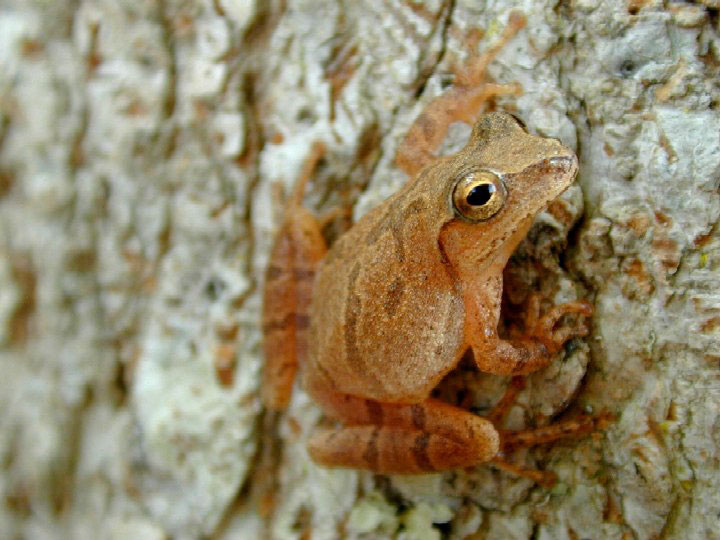
Spring Peeper

Spring Peeper

Pseudacris crucifer

USGS, Public domain, via Wikimedia Commons

California Tree Frog

California Tree Frog

Pseudacris cadaverina

Polyman586, CC0, via Wikimedia Commons

Side by side

Spring PeeperCalifornia Tree Frog
Scientific namePseudacris crucifer (Wied-Neuwied, 1838)Pseudacris cadaverina (Cope, 1866)
English nameSpring PeeperCalifornia Tree Frog
GroupAmphibiansAmphibians
ClassAmphibia AmphibiansAmphibia Amphibians
OrderAnura FrogsAnura Frogs
FamilyHylidae HylidsHylidae Hylids
GenusPseudacris Chorus FrogPseudacris Chorus Frog
Named in18381866
Red List categoryLeast ConcernLeast Concern
Environmentfreshwater, terrestrialNot recorded
Countries on record2 countries2 countries
GBIF occurrence records81,811 records9,539 records

Rows where the two agree are shown in grey.

Where each is found

Both recorded in 1 country

Only Spring Peeper (1)

Only California Tree Frog (1)

From Catalogue of Life checklists and GBIF occurrence records. A country missing from a list means no record is held, which is not proof of absence.

Checked facts

Spring PeeperCalifornia Tree Frog
Appearance
  • The spring peeper typically has pink, tan, light brown, or gray skin and an X-shaped marking on its back. mdc.mo.gov
  • The species has a cream-colored belly, a dark line across its head, and dark bars on its legs. mdc.mo.gov
  • Spring peepers have adhesive pads on their fingertips and toe tips. mdc.mo.gov
  • Females are generally lighter-colored and have bulkier abdomens than males. English Wikipedia
  • The skin coloration of spring peepers can change within 15 to 45 minutes in response to temperature and light. English Wikipedia
No checked fact yet
Size
  • Male spring peepers measure 18–30 mm in body length, while females measure 20–35 mm. English Wikipedia
No checked fact yet
Habitat
  • Spring peepers inhabit marshy woodland and non-wooded lowlands near ponds and swamps. animaldiversity.org
  • The species commonly inhabits forests and regenerating woodlands near temporary or semipermanent wetlands. English Wikipedia
  • Spring peepers frequently breed in fishless ponds and temporary pools. mdc.mo.gov
  • Spring peepers generally remain close to the ground or concealed in leaf litter despite their climbing ability. animaldiversity.org
No checked fact yet
Diet
  • Adult spring peepers eat small insects and spiders, including ants, beetles, and flies. animaldiversity.org
  • Spring peeper tadpoles feed on algae, detritus, and microorganisms. animaldiversity.org
  • Adult spring peepers forage among leaf litter and surface debris for small insects and spiders. mdc.mo.gov
No checked fact yet
Behaviour
  • Male spring peepers produce clear, high-pitched calls that rise slightly in pitch at the end. mdc.mo.gov
  • Male spring peepers repeat their calls approximately once per second. mdc.mo.gov
  • Spring peeper choruses can resemble the sound of hundreds of small jingle bells. mdc.mo.gov
  • Spring peepers are usually concealed during daylight and become active around dusk. mdc.mo.gov
  • Spring peepers may become active during daylight when heavy rain persists. mdc.mo.gov
  • Spring peepers generally migrate at night. English Wikipedia
  • Male spring peepers establish small territories around breeding pools and compete through frequent calling. animaldiversity.org
  • Females preferentially select larger males as mates. animaldiversity.org
  • Some males use a satellite strategy, remaining near calling males without calling themselves to intercept females. English Wikipedia
No checked fact yet
Reproduction
  • Spring peepers in northern regions generally breed between March and June. English Wikipedia
  • Spring peepers in southern regions breed between October and March, depending on local temperature. English Wikipedia
  • Female spring peepers typically lay approximately 900 eggs per clutch, although clutches can contain up to 1,000 eggs. English Wikipedia
  • Female spring peepers deposit their eggs individually or in groups of two or three. English Wikipedia
  • Spring peeper eggs are attached individually to dead leaves, grasses, or sticks in shallow water. mdc.mo.gov
  • Spring peeper eggs generally hatch within 6–12 days. animaldiversity.org
  • Spring peeper tadpoles typically undergo metamorphosis after 45–90 days. animaldiversity.org
  • Spring peepers generally reach sexual maturity at two years of age. mdc.mo.gov
  • Male spring peepers provide no parental care after fertilization. animaldiversity.org
No checked fact yet
Conservation
  • Spring peepers are listed as protected in New Jersey and threatened in Kansas. animaldiversity.org
  • Spring peepers have become threatened in some states where wetland habitat has declined. mdc.mo.gov
  • Spring peepers may help control populations of insects. animaldiversity.org
No checked fact yet
UsesNo checked fact yet
Similar species
  • Spring peepers differ from some other Pseudacris species by lacking white lines on their lips. English Wikipedia
No checked fact yet

In brief

Spring Peeper

Pseudacris crucifer inhabits forests, woodlands, marshy lowlands, and areas near ponds, swamps, and temporary wetlands. It typically has an X-shaped marking on its back, adhesive pads on its fingertips and toe tips, and skin that can change color in response to temperature and light. Full profile

Compare something else

Page built on 24 November 2026 from the data on the two species pages, where every source is listed.

Cite this page

ScientificNames.org. (2026). Spring Peeper vs California Tree Frog. Retrieved November 24, 2026, from https://scientificnames.org/compare/spring-peeper-vs-california-tree-frog