Comparison

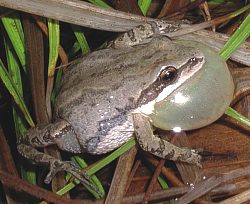
Illinois Chorus Frog vs Western Chorus Frog

Illinois Chorus Frog (Pseudacris illinoensis) and Western Chorus Frog (Pseudacris triseriata) both belong to the genus Pseudacris (chorus frog) and part ways below it. Both are recorded in 1 country.

Illinois Chorus Frog

Illinois Chorus Frog

Pseudacris illinoensis

Stanley Trauth, CC BY-SA 2.5, via Wikimedia Commons

Western Chorus Frog

Western Chorus Frog

Pseudacris triseriata

The original uploader was Pfinge at French Wikipedia., CC BY-SA 3.0, via Wikimedia Commons

Side by side

Illinois Chorus FrogWestern Chorus Frog
Scientific namePseudacris illinoensis Smith, 1951Pseudacris triseriata (Wied-Neuwied, 1838)
English nameIllinois Chorus FrogWestern Chorus Frog
GroupAmphibiansAmphibians
ClassAmphibia AmphibiansAmphibia Amphibians
OrderAnura FrogsAnura Frogs
FamilyHylidae HylidsHylidae Hylids
GenusPseudacris Chorus FrogPseudacris Chorus Frog
Named in19511838
Red List categoryNot recordedLeast Concern
Countries on record1 country2 countries
GBIF occurrence records1,030 records17,666 records

Rows where the two agree are shown in grey.

Where each is found

Both recorded in 1 country

Only Western Chorus Frog (1)

From Catalogue of Life checklists and GBIF occurrence records. A country missing from a list means no record is held, which is not proof of absence.

Checked facts

Illinois Chorus FrogWestern Chorus Frog
Appearance
  • Adults have smooth skin and coloration ranging from greenish-grey, reddish, olive, to brown. English Wikipedia
  • Adults typically have three dark longitudinal stripes running down their backs. English Wikipedia
  • The dorsal stripes may be broken, reduced, or absent in some individuals. English Wikipedia
  • The underside is generally white or cream-colored with scattered dark flecks. English Wikipedia
  • A white stripe runs along the upper lip, while a dark stripe extends from the snout across the eye and along each side. English Wikipedia
  • Some individuals have a dark triangular marking on the head. English Wikipedia
  • Tadpoles have rounded gray or brown bodies, transparent tail fins, and dark flecks. English Wikipedia
Size
Habitat
  • Adults inhabit open, damp environments including marshes, meadows, forest edges, fallow fields, bottomland swamps, and floodplains. animaldiversity.org
  • The species can occupy rural, urban, and agricultural environments. macalester.edu
  • Tadpoles and froglets occur in shallow ponds, temporary pools, ditches, marshes, swamps, river backwaters, and lake edges. macalester.edu
Diet
  • Adults consume small invertebrates including flies, mosquitoes, ants, beetles, moths, caterpillars, grasshoppers, and spiders. English Wikipedia
  • Young froglets feed on small prey including mites, midges, and springtails. English Wikipedia
  • Tadpoles feed on periphyton, filamentous algae, diatoms, and pollen. English Wikipedia
  • Tadpoles can scavenge when food is available. English Wikipedia
Behaviour
  • Males and occasionally females produce calls in large choruses. English Wikipedia
  • Male calls attract potential mates to breeding sites. English Wikipedia
  • The call can be heard from approximately half a mile away. English Wikipedia
  • Individual calling bouts typically last 0.5 to 2 seconds. English Wikipedia
  • When disturbed, individuals stop calling and retreat underwater or into nearby terrestrial cover. English Wikipedia
  • Individuals use leaf litter, logs, rocks, and loose soil as winter hibernation shelters. English Wikipedia
  • The species rarely climbs despite belonging to the treefrog family. animaldiversity.org
  • Individuals are largely solitary outside breeding gatherings. animaldiversity.org
  • Individuals can tolerate partial freezing of their body water during winter. animaldiversity.org
  • The species has an average home range of approximately 2,116 square metres, including its breeding pond. animaldiversity.org
Reproduction
  • The breeding season generally extends from March through May, depending on geographic location. macalester.edu
  • Females produce approximately 500 to 1,500 eggs per breeding season. English Wikipedia
  • Individual egg clusters generally contain between 20 and 300 eggs. English Wikipedia
  • Females attach gelatinous egg clusters to submerged weeds or grasses near the edges of shallow water bodies. English Wikipedia
  • Eggs generally hatch within 3 to 14 days after being laid. animaldiversity.org
  • Tadpoles generally metamorphose within 40 to 90 days after hatching. animaldiversity.org
  • Males fertilize eggs externally while females lay them. animaldiversity.org
  • There is no known parental involvement after females have deposited their eggs. animaldiversity.org
  • Females generally reach sexual maturity during their second or third year. macalester.edu
Distribution
  • The species occurs in southwestern Illinois, eastern Missouri, and northeastern Arkansas. animaldiversity.org
  • Illinois populations are known from four geographically separated sandy-soil areas. herpetology.inhs.illinois.edu
  • The species' range is restricted to isolated sandy wetlands along the Mississippi and Illinois rivers. English Wikipedia
  • The species occurs in Canada and the United States. English Wikipedia
  • The documented range extends from Canada to the Gulf of Mexico and from New Jersey to central Arizona. English Wikipedia
Conservation
  • The species is classified as Least Concern on the IUCN list. English Wikipedia
  • The species is listed as threatened in the Great Lakes/St. Lawrence–Canadian Shield region under Canada's Species at Risk Act. English Wikipedia
  • Populations are declining in certain areas despite the species' adaptability to human activity. English Wikipedia
UsesNo checked fact yet
  • The species serves as an indicator of environmental pollution and ecosystem health. English Wikipedia
  • Changes in morphology or reproductive success can indicate environmental pollution or toxic substances. English Wikipedia
  • The species helps control populations of small insects and other prey organisms. animaldiversity.org
Similar speciesNo checked fact yet
OtherNo checked fact yet

In brief

Illinois Chorus Frog

The Illinois Chorus Frog is Pseudacris illinoensis, originally described by Smith in 1951. It occurs in southwestern Illinois, eastern Missouri, and northeastern Arkansas. Adults have light tan or grey bodies with reddish-brown dorsal blotches, robust forearms, and granular skin. Full profile

Western Chorus Frog

Pseudacris triseriata occurs in Canada and the United States, with a documented range extending from Canada to the Gulf of Mexico and from New Jersey to central Arizona. Adults typically have three dark longitudinal stripes running down their backs, although these may be broken, reduced, or absent in some individuals. Full profile

Compare something else

Page built on 28 November 2026 from the data on the two species pages, where every source is listed.

Cite this page

ScientificNames.org. (2026). Illinois Chorus Frog vs Western Chorus Frog. Retrieved November 28, 2026, from https://scientificnames.org/compare/illinois-chorus-frog-vs-western-chorus-frog