Species · Amphibians
Illinois Chorus Frog Pseudacris illinoensis
The scientific name of the Illinois Chorus Frog is Pseudacris illinoensis. It is a species of amphibian in the family Hylidae (hylids), order Anura. The name dates from 1951.
- Scientific name
- Pseudacris illinoensis Smith, 1951
- Common name
- Illinois Chorus Frog
- Genus
- Pseudacris
- Family
- Hylidae (Hylids)
- Order
- Anura
- Class
- Amphibia
- Recorded in
- 1 country
- Name status
- accepted in the Catalogue of Life

Overview
The Illinois Chorus Frog is Pseudacris illinoensis, originally described by Smith in 1951. It occurs in southwestern Illinois, eastern Missouri, and northeastern Arkansas. Adults have light tan or grey bodies with reddish-brown dorsal blotches, robust forearms, and granular skin.
Written 27 November 2026 from the sources listed below. Each statement was checked against the passage it cites; statements that could not be supported were removed.
Appearance
Adults are light tan or grey with reddish-brown irregular blotches on their dorsal surfaces. They typically have a V-shaped or Y-shaped marking between the eyes and elongated lateral markings extending from the tympanum across the eye to the snout.[1][2][3]
Adults have white or cream-colored undersides without distinct markings. Their bodies are stout and toadlike, with robust forearms and granular rather than smooth skin.[4][5][6]
Males develop a dark throat during the breeding season. Tadpoles have dark brown dorsal and lateral coloration with tan undersides, while froglets are generally grey or brown and lack adult coloration patterns.[7][8][9]
Adults have an average snout-vent length of 28 mm and can reach a maximum length of 47 mm. Adult females average 7.22 g in body mass, while adult males average 6.44 g.[10][11][12][13]
Average mouth width is 9.89 mm, with measurements ranging from 6.61 to 14.14 mm depending on sex.[14]
Habitat
The Illinois Chorus Frog inhabits prairies, wetlands, and occasionally agricultural fields. It requires moist, soft, sandy soils.[15][16]
Individuals spend most of their lives underground in burrows and may overwinter at depths of up to 25 cm. They burrow in sand and breed in nearby flooded fields, ditches, and vernal ponds.[17][18][19]
During breeding, individuals occupy flooded fields, wetlands, ponds, and vernal pools.[20]
Diet
The Illinois Chorus Frog's diet consists of small insects.[21]
Behaviour
The species is typically solitary outside the breeding season but becomes social during breeding. Individuals dig forward using their stout forelegs rather than digging backward and use a breaststroke-like motion to excavate sandy burrows.[22][23][24]
The breeding call consists of clear, high-pitched whistles. Male advertisement calls consist of a single note or pulse and attract females.[25][26]
Males produce aggression calls consisting of four to seven pulses during conflicts with other males. Some males attract females through calling while nearby satellite males intercept attracted females.[27][28]
Individuals enter brumation and overwinter beneath rocks, logs, or leaf litter.[29]
Reproduction and life cycle
The breeding season begins in February and continues into March. Males remain in breeding habitats for four to ten weeks, while females generally emerge for less than two weeks per breeding season.[30][31][32]
Eggs are deposited in small jelly-covered clusters attached to underwater twigs and branches. Individual clusters contain between eight and 79 eggs.[33][34]
Tadpoles complete metamorphosis between 30 and 90 days after hatching. Individuals reach sexual maturity after approximately one year, although females typically begin breeding when they are closer to two years old.[35][36][37]
Conservation
The Illinois Chorus Frog is classified as threatened in Illinois. Its range is restricted to isolated sandy wetlands along the Mississippi and Illinois rivers.[38][39]
Drainage and cultivation of breeding ponds and adult habitats threaten the species. Sand mining is also identified as a threat.[40][41]
Laser land-levelling has eliminated 61% of the species' range in Arkansas.[42]
The Monroe County population in Illinois has not been verified for several decades. The Madison County population is restricted to a very small sandy area and has not been verified in several years.[43][44]
Illinois populations are known from four geographically separated sandy-soil areas.[45]
Similar species
The upland chorus frog, western chorus frog, and boreal chorus frog are listed as similar species.[46]
Classification of the Illinois Chorus Frog
| Kingdom | Animalia |
|---|---|
| Phylum | Chordata |
| Subphylum | Vertebrata |
| Infraphylum | Gnathostomata |
| Parvphylum | Osteichthyes |
| Megaclass | Tetrapoda |
| Class | Amphibia (Amphibians) |
| Order | Anura (Frogs) |
| Family | Hylidae (Hylids) |
| Genus | Pseudacris (Chorus Frog) |
| Species | Pseudacris illinoensis Smith, 1951 |
Where the Illinois Chorus Frog is found
Checklists and occurrence records place Pseudacris illinoensis in 1 country across North America. GBIF holds 1,030 georeferenced records of it.
Countries
Regions and cities with the most records
- Illinois, United States 28
- Missouri, United States 17
- Granite City, United States 9
- Collinsville, United States 8
- Spanish Lake, United States 8
- East Saint Louis, United States 7
- Edwardsville, United States 7
- St. Louis, United States 7
- Alton, United States 6
- Ferguson, United States 5
- Florissant, United States 5
- Old Jamestown, United States 5
- Upper Alton, United States 5
- Fairview Heights, United States 4
- Sikeston, United States 3
- University City, United States 3
Range as the checklists state it
North America
A number beside a place is its count of GBIF occurrence records. A place without a number comes from a checklist alone. Records show where a species has been observed or collected, which can include escapes and vagrants.
Common names
English
- Illinois Chorus Frog
Names in 2 other languages
- Russian
- Иллинойская поющая квакша
- Spanish
- Rana de Coro de Ilinois
Synonyms
3 other scientific names have been used for this species and are now treated as synonyms of Pseudacris illinoensis.
- Pseudacris streckeri illinoensis Smith, 1951
- Pseudacris triseriata illinoensis Smith, 1951
- Pseudacris triseriata illinoisensis Smith, 1951
Related species
-
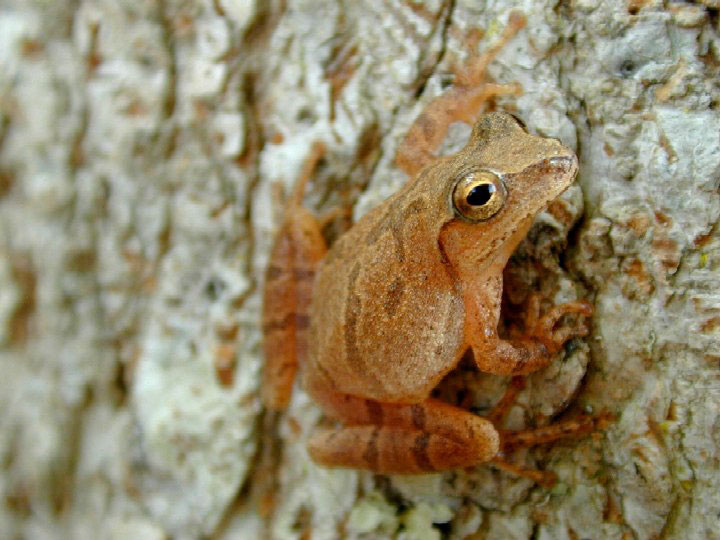 Spring PeeperPseudacris crucifer
-
 Pacific Tree FrogPseudacris regilla
-
 Boreal Chorus FrogPseudacris maculata
-
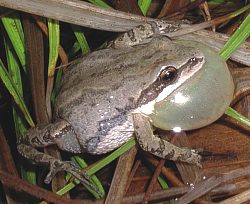 Western Chorus FrogPseudacris triseriata
-
 Little Grass FrogPseudacris ocularis
-
 California Tree FrogPseudacris cadaverina
-
 Upland Chorus FrogPseudacris feriarum
-
 Ornate Chorus FrogPseudacris ornata
Compare
Questions and answers
What is the scientific name of the Illinois Chorus Frog?
The scientific name of the Illinois Chorus Frog is Pseudacris illinoensis. Written with its author, the full name is Pseudacris illinoensis Smith, 1951.
Which family does the Illinois Chorus Frog belong to?
Pseudacris illinoensis belongs to the family Hylidae, in the order Anura and the class Amphibia.
Where is the Illinois Chorus Frog found?
Checklists and occurrence records place Pseudacris illinoensis in 1 country: United States.
What type of frogs live in Illinois?
The Illinois Chorus Frog occurs in southwestern Illinois.[47]
How big does a chorus frog get?
Adult Illinois Chorus Frogs have an average snout-vent length of 28 mm and can reach a maximum length of 47 mm.[10][11]
What do chorus tree frogs eat?
The Illinois Chorus Frog eats small insects.[21]
Where do chorus frogs live?
The Illinois Chorus Frog occurs in southwestern Illinois, eastern Missouri, and northeastern Arkansas. It inhabits prairies, wetlands, and occasionally agricultural fields, requiring moist, soft, sandy soils.[15][16][47]
What is the main diet of frogs?
The Illinois Chorus Frog's diet consists of small insects.[21]
What is the diet of a tree frog?
The Illinois Chorus Frog eats small insects.[21]
Sources
Passages the profile rests on
- Adults are light tan or grey with reddish-brown irregular blotches on their dorsal surfaces. Source passage: “Adult Illinois chorus frogs are light tan or grey with reddish-brown, irregular, often elongated blotches on their dorsal sides.” — animaldiversity.org
- Adults typically have a V-shaped or Y-shaped dorsal marking between their eyes. Source passage: “Typically, they have a distinctive "V" or "Y"-shaped dorsal blotch between their eyes and one small blotch underneath each eye.” — animaldiversity.org
- Adults have elongated lateral markings extending from the tympanum across the eye to the snout. Source passage: “They also have an elongated lateral blotch on either side of their head that extends from their tympanum, across their eye, to their snout.” — animaldiversity.org
- Adults have white or cream-colored undersides without distinct markings. Source passage: “They have dark, greenish-black tail stubs and white or cream-colored venters with no clear markings” — animaldiversity.org
- The species has robust forearms and a stout, toadlike body. Source passage: “Key Characters: Stout toadlike body; no toe pads; robust forearms;” — herpetology.inhs.illinois.edu
- Its skin is granular rather than smooth. Source passage: “Skin granular rather than smooth.” — herpetology.inhs.illinois.edu
- Tadpoles have dark brown dorsal and lateral coloration and tan ventral coloration. Source passage: “Illinois chorus frog tadpoles have dark brown dorsal and lateral coloration and tan ventral coloration.” — animaldiversity.org
- Froglets are generally grey or brown and lack the adult coloration patterns. Source passage: “Froglets are typically grey or brown and lack the patterns present in adults.” — animaldiversity.org
- Males develop a dark throat during the breeding season. Source passage: “Throat (vocal pouch) of male dark during breeding season.” — herpetology.inhs.illinois.edu
- Adults have an average snout-vent length of 28 mm. Source passage: “Both sexes have an average snout-vent length (SVL) of 19 mm as froglets and 28 mm as adults,” — animaldiversity.org
- Adults can reach a maximum length of 47 mm. Source passage: “although adults can reach a maximum of 47 mm in length.” — animaldiversity.org
- Adult females average 7.22 g in body mass. Source passage: “Females have an average body mass of 7.22 g” — animaldiversity.org
- Adult males average 6.44 g in body mass. Source passage: “whereas males average 6.44 g.” — animaldiversity.org
- The average mouth width is 9.89 mm, with measurements ranging from 6.61 to 14.14 mm depending on sex. Source passage: “Illinois chorus frogs have an average mouth width of 9.89 mm, though this ranges from from 6.61 mm to 14.14 mm, depending on the sex.” — animaldiversity.org
- The species inhabits prairies, wetlands, and occasionally agricultural fields. Source passage: “Illinois chorus frogs inhabit prairies, wetlands, and occasionally agricultural fields.” — animaldiversity.org
- It requires habitats with moist, soft, sandy soils. Source passage: “They require habitats with moist, soft, sandy soils.” — animaldiversity.org
- The species burrows in sand and breeds in nearby flooded fields, ditches, and vernal ponds. Source passage: “Burrows in sand and emerges after heavy, early spring rains to breed in nearby flooded fields, ditches, and other vernal ponds.” — herpetology.inhs.illinois.edu
- Individuals spend most of their lives underground in burrows. Source passage: “They spend most of the year in underground burrows” — animaldiversity.org
- Individuals may overwinter underground at depths of up to 25 cm. Source passage: “They may also burrow as deep as 25 cm underground to avoid freezin” — animaldiversity.org
- During breeding, individuals occupy flooded fields, wetlands, ponds, and vernal pools. Source passage: “they occupy flooded fields, wetlands, ponds, or vernal pools.” — animaldiversity.org
- The species' diet consists of small insects. Source passage: “Diet consists of small insects.” — herpetology.inhs.illinois.edu
- The species is typically solitary outside the breeding season but becomes social during breeding. Source passage: “Illinois chorus frogs are typically solitary, but are social during the breeding season.” — animaldiversity.org
- Individuals dig forward using their stout forelegs rather than digging backward. Source passage: “Unusual because it digs forward with its stout front legs, rather than backward like the spadefoot and toads.” — herpetology.inhs.illinois.edu
- The species uses a breaststroke-like motion to dig sandy burrows. Source passage: “the Illinois chorus frog is described as the only frog that uses a breast stroke motion to dig its sandy burrows.” — English Wikipedia
- Male advertisement calls consist of a single note or pulse and attract females. Source passage: “whereas advertisement calls consist of a single note or pulse and are used to attract females.” — animaldiversity.org
- The breeding call consists of clear, high-pitched whistles. Source passage: “Breeding call is a series of clear high-pitched whistles.” — herpetology.inhs.illinois.edu
- Males produce aggression calls consisting of four to seven pulses during conflicts with other males. Source passage: “Aggression calls range from 4 to 7 pulses in length and are used during conflicts with other males,” — animaldiversity.org
- Some males attract females through calling while nearby satellite males intercept attracted females. Source passage: “Typically, some individuals, referred to as calling males, produce advertisement calls while others, referred to as satellite males, remain nearby and intercept females that are attracted by calling males.” — animaldiversity.org
- Individuals enter brumation and overwinter beneath rocks, logs, or leaf litter. Source passage: “Illinois chorus frogs enter brumation and overwinter under rocks, logs, or leaf litter.” — animaldiversity.org
- The breeding season begins in February and continues into March. Source passage: “Illinois chorus frogs have a breeding season that begins in February and continues into March.” — animaldiversity.org
- Males remain in breeding habitats for four to ten weeks during the breeding season. Source passage: “During breeding season, males emerge from brumation and remain within breeding habitats for 4 to 10 weeks.” — animaldiversity.org
- Females generally emerge for less than two weeks per breeding season. Source passage: “Females are less active, typically emerging for less than two weeks per season.” — animaldiversity.org
- Individual egg clusters contain between eight and 79 eggs. Source passage: “Individual clusters can contain anywhere from 8 to 79 eggs.” — animaldiversity.org
- Eggs are deposited in small jelly-covered clusters attached to underwater twigs and branches. Source passage: “Eggs are laid in small, jelly-covered clusters attached to twigs and branches underwater.” — herpetology.inhs.illinois.edu
- Tadpoles complete metamorphosis between 30 and 90 days after hatching. Source passage: “Illinois chorus frog tadpoles complete metamorphosis between 30 and 90 days after hatching.” — animaldiversity.org
- Individuals reach sexual maturity after approximately one year. Source passage: “Illinois chorus frogs reach sexual maturity after one year,” — animaldiversity.org
- Females typically begin breeding when they are closer to two years old. Source passage: “but they typically do not breed until they are closer to two years old.” — animaldiversity.org
- The species' range is restricted to isolated sandy wetlands along the Mississippi and Illinois rivers. Source passage: “Its range is restricted to isolated sandy wetlands along the banks of the Mississippi River and a major tributary, the Illinois River.” — English Wikipedia
- The species is classified as threatened in Illinois. Source passage: “Status: Threatened in Illinois.” — herpetology.inhs.illinois.edu
- Drainage and cultivation of breeding ponds and adult habitats threaten the species. Source passage: “Threats include drainage and cultivation of breeding ponds and adult habitat and sand mining.” — herpetology.inhs.illinois.edu
- Sand mining is identified as a threat to the species. Source passage: “Threats include drainage and cultivation of breeding ponds and adult habitat and sand mining.” — herpetology.inhs.illinois.edu
- Laser land-levelling has eliminated 61% of the species' range in Arkansas. Source passage: “its use by rice paddy operators, has eliminated 61% of the subspecies' range in this southern state.” — English Wikipedia
- The Monroe County population in Illinois has not been verified for several decades. Source passage: “The Monroe County population has not been verified in several decades and its status is unknown.” — herpetology.inhs.illinois.edu
- The Madison County population is restricted to a very small sandy area and has not been verified in several years. Source passage: “The Madison County population is restricted to a very small area of sand and has also not been verified in several years.” — herpetology.inhs.illinois.edu
- Illinois populations are known from four geographically separated sandy-soil areas. Source passage: “Known in Illinois from four disjunct areas of sandy soils.” — herpetology.inhs.illinois.edu
- The upland chorus frog, western chorus frog, and boreal chorus frog are listed as similar species. Source passage: “Similar Species: Upland Chorus Frog, Western Chorus Frog, Boreal Chorus Frog.” — herpetology.inhs.illinois.edu
- The species occurs in southwestern Illinois, eastern Missouri, and northeastern Arkansas. Source passage: “they occupy a small range along the Illinois and Mississippi River from southwestern Illinois, through eastern Missouri, to the northeastern tip of Arkansas, near the Obion River.” — animaldiversity.org
Data
- Catalogue of Life, 2026-10-16 XR cc by
- Global Biodiversity Information Facility CC BY 4.0
- Wikidata CC0
- GeoNames CC BY 4.0
- Wikimedia Commons per image; credit shown with each image
- Within the Catalogue of Life, this name comes from The Integrated Taxonomic Information System cc0
References
- Crother, Brian I., Jeff Boundy, Frank T. Burbrink, et al. / Moriarty, John J., ed. (2008). Scientific and Standard English Names of Amphibians and Reptiles of North America North of Mexico, With Comments Regarding Confidence in Our Understanding, Sixth Ed. Herpetological Circular No. 37.
This species in other databases
Page built on 28 November 2026. See how the catalog is made and all sources and licences.
Cite this page
ScientificNames.org. (2026). Pseudacris illinoensis (Illinois Chorus Frog). Retrieved November 28, 2026, from https://scientificnames.org/species/pseudacris-illinoensis
“Pseudacris illinoensis (Illinois Chorus Frog).” ScientificNames.org, 2026, scientificnames.org/species/pseudacris-illinoensis. Accessed 28 Nov. 2026.
ScientificNames.org. “Pseudacris illinoensis (Illinois Chorus Frog).” Accessed November 28, 2026. https://scientificnames.org/species/pseudacris-illinoensis.
@misc{scientificnames_pseudacris_illinoensis_illinois_chorus_frog,
  author = {{ScientificNames.org}},
  title = {Pseudacris illinoensis (Illinois Chorus Frog)},
  year = {2026},
  url = {https://scientificnames.org/species/pseudacris-illinoensis},
  note = {Accessed 2026-11-28}
}