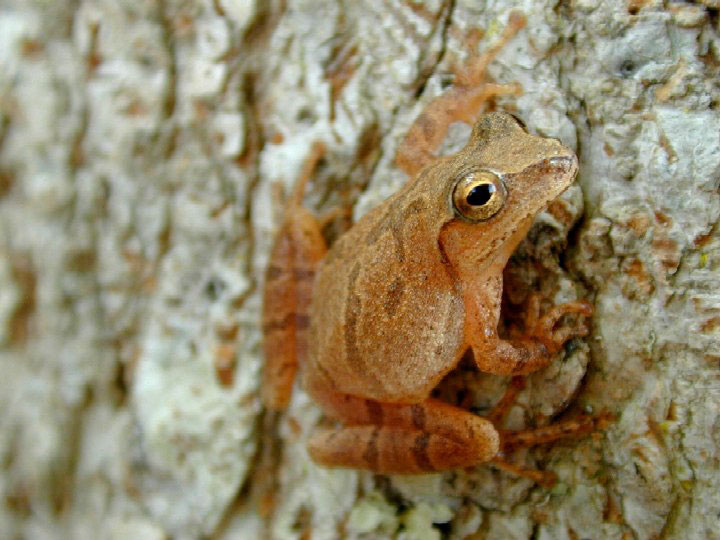
| Appearance | - Adult individuals have brown, gray, or tan skin. animaldiversity.org
- Adults have three longitudinal stripes or linear rows of spots on their backs. animaldiversity.org
- A white line extends along the pointed snout and upper lip, while dark bands occur around the eyes. animaldiversity.org
- Male individuals have olive or rusty-orange throats, whereas females have lighter-colored throats. animaldiversity.org
- The skin is mostly smooth, with some granular bumps on the back. animaldiversity.org
- Tadpoles have a light stripe extending from the eye to the tail. animaldiversity.org
- Tadpoles have brown dorsal tail surfaces that often contain black spots, while their ventral tail surfaces are lighter. animaldiversity.org
- The species has a narrow head and body with a pointed snout. amphibiaweb.org
| - The spring peeper typically has pink, tan, light brown, or gray skin and an X-shaped marking on its back. mdc.mo.gov
- The species has a cream-colored belly, a dark line across its head, and dark bars on its legs. mdc.mo.gov
- Spring peepers have adhesive pads on their fingertips and toe tips. mdc.mo.gov
- Females are generally lighter-colored and have bulkier abdomens than males. English Wikipedia
- The skin coloration of spring peepers can change within 15 to 45 minutes in response to temperature and light. English Wikipedia
|
|---|
| Size | | - Male spring peepers measure 18–30 mm in body length, while females measure 20–35 mm. English Wikipedia
|
|---|
| Habitat | - The species inhabits temperate forests, temperate grasslands, shrub-dominated wetlands, swamps, freshwater marshes, intermittent freshwater marshes, ponds, open excavations, seasonally flooded agricultural land, canals, and ditches. English Wikipedia
- Juveniles inhabit wet meadows and forested wetlands. animaldiversity.org
- Mature individuals move from wetlands and meadows into pine forests. animaldiversity.org
- Adults can inhabit areas near limestone sinkholes, particularly those bordering wet prairies in southern Florida. animaldiversity.org
- The species also occurs in areas with sandy soil in Alabama. animaldiversity.org
- During breeding, individuals use ponds, bogs, marshes, and occasionally floodplains. animaldiversity.org
- Breeding habitats include vernal pools, roadside ditches, woodland ponds, Carolina bays, and flooded fields. animaldiversity.org
- Additional breeding habitats include weedy margins of shallow flatwoods ponds and flooded pine-hardwood ditches. animaldiversity.org
| - Spring peepers inhabit marshy woodland and non-wooded lowlands near ponds and swamps. animaldiversity.org
- The species commonly inhabits forests and regenerating woodlands near temporary or semipermanent wetlands. English Wikipedia
- Spring peepers frequently breed in fishless ponds and temporary pools. mdc.mo.gov
- Spring peepers generally remain close to the ground or concealed in leaf litter despite their climbing ability. animaldiversity.org
|
|---|
| Diet | No checked fact yet | - Adult spring peepers eat small insects and spiders, including ants, beetles, and flies. animaldiversity.org
- Spring peeper tadpoles feed on algae, detritus, and microorganisms. animaldiversity.org
- Adult spring peepers forage among leaf litter and surface debris for small insects and spiders. mdc.mo.gov
|
|---|
| Behaviour | - Young froglets generally remain close to their birth ponds for several weeks. animaldiversity.org
- Male individuals form large choruses and call from temporary or shallow permanent waterbodies. animaldiversity.org
- Male calling activity becomes more pronounced immediately after heavy rainfall. animaldiversity.org
- Male individuals select heavily vegetated calling sites to reduce predation risk. animaldiversity.org
- The species has separate male and female sexes. animaldiversity.org
- Southern Chorus Frogs are nocturnal and saltatorial. animaldiversity.org
- The species exhibits social behaviour primarily during the breeding season. animaldiversity.org
- Individuals migrate between wetlands and shallow waters during breeding and upland pine forests during the rest of the year. animaldiversity.org
| - Male spring peepers produce clear, high-pitched calls that rise slightly in pitch at the end. mdc.mo.gov
- Male spring peepers repeat their calls approximately once per second. mdc.mo.gov
- Spring peeper choruses can resemble the sound of hundreds of small jingle bells. mdc.mo.gov
- Spring peepers are usually concealed during daylight and become active around dusk. mdc.mo.gov
- Spring peepers may become active during daylight when heavy rain persists. mdc.mo.gov
- Spring peepers generally migrate at night. English Wikipedia
- Male spring peepers establish small territories around breeding pools and compete through frequent calling. animaldiversity.org
- Females preferentially select larger males as mates. animaldiversity.org
- Some males use a satellite strategy, remaining near calling males without calling themselves to intercept females. English Wikipedia
|
|---|
| Reproduction | | - Spring peepers in northern regions generally breed between March and June. English Wikipedia
- Spring peepers in southern regions breed between October and March, depending on local temperature. English Wikipedia
- Female spring peepers typically lay approximately 900 eggs per clutch, although clutches can contain up to 1,000 eggs. English Wikipedia
- Female spring peepers deposit their eggs individually or in groups of two or three. English Wikipedia
- Spring peeper eggs are attached individually to dead leaves, grasses, or sticks in shallow water. mdc.mo.gov
- Spring peeper eggs generally hatch within 6–12 days. animaldiversity.org
- Spring peeper tadpoles typically undergo metamorphosis after 45–90 days. animaldiversity.org
- Spring peepers generally reach sexual maturity at two years of age. mdc.mo.gov
- Male spring peepers provide no parental care after fertilization. animaldiversity.org
|
|---|
| Distribution | - The Southern Chorus Frog is native to the southeastern United States. English Wikipedia
- The species occurs along the southeastern United States coast, including Florida, southern Georgia, eastern South Carolina, and eastern North Carolina. animaldiversity.org
- Its western distribution reaches the southernmost parts of Alabama and Mississippi. animaldiversity.org
- The species has a separate population in southeastern Virginia. animaldiversity.org
- The species is absent from the Everglades and Florida Keys. animaldiversity.org
| No checked fact yet |
|---|
| Conservation | | - Spring peepers are listed as protected in New Jersey and threatened in Kansas. animaldiversity.org
- Spring peepers have become threatened in some states where wetland habitat has declined. mdc.mo.gov
- Spring peepers may help control populations of insects. animaldiversity.org
|
|---|
| Uses | No checked fact yet | |
|---|
| Similar species | No checked fact yet | - Spring peepers differ from some other Pseudacris species by lacking white lines on their lips. English Wikipedia
|
|---|