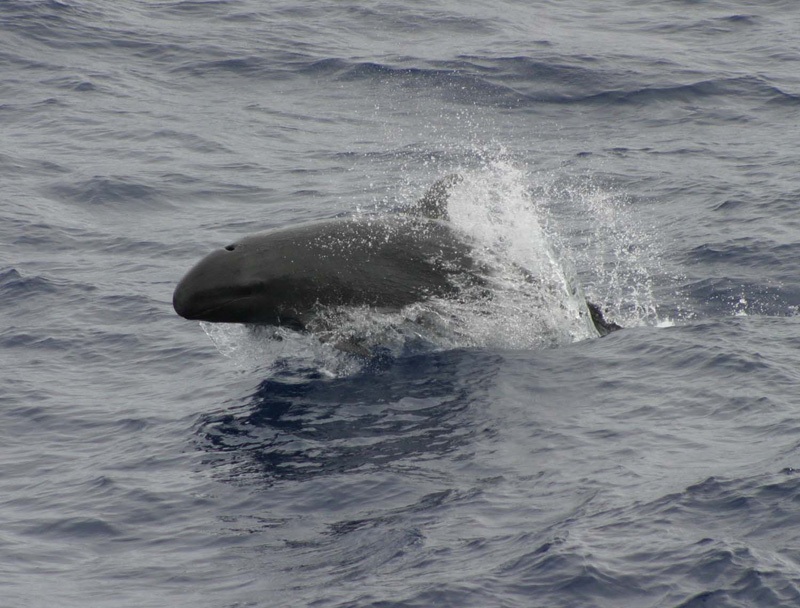
| Appearance | - The false killer whale has a slender, dark gray or black body with a slightly lighter underside. English Wikipedia
- The species has an elongated, tapered head without a distinct beak. English Wikipedia
- Its dorsal fin is sickle-shaped. English Wikipedia
- Its flippers are narrow, short and pointed, with a distinctive bulge along their leading edges. English Wikipedia
- Its teeth are conical, with 14–21 teeth in the upper jaw and 16–24 in the lower jaw. English Wikipedia
- The melon organ in its forehead is larger in males than in females. English Wikipedia
| - Newborn orcas have yellowish or orange-colored white markings. English Wikipedia
- Orcas have large, rounded pectoral fins that resemble paddles. English Wikipedia
- Male orcas have dorsal fins approximately 1.8 metres high, more than twice the height of female dorsal fins. English Wikipedia
- The orca has a blunt snout without the beak characteristic of other dolphin species. English Wikipedia
- Individual orcas can be identified by distinctive markings and damage patterns on their dorsal fins and saddle patches. English Wikipedia
|
|---|
| Size | No checked fact yet | - Adult male orcas typically measure 6–8 metres in length and weigh more than 6 tonnes. English Wikipedia
- Adult female orcas generally measure 5–7 metres long and weigh approximately 3–4 tonnes. English Wikipedia
- Newborn orcas measure approximately 2.4 metres and weigh around 180 kilograms. English Wikipedia
- Adult male orcas in the North Pacific can reach approximately 8.2 metres in length. adfg.alaska.gov
- Male orcas can weigh up to approximately 6,000 kilograms. adfg.alaska.gov
|
|---|
| Habitat | - The species inhabits tropical and subtropical marine waters. English Wikipedia
- It generally inhabits open-ocean and deep-water environments but sometimes occurs near oceanic islands. English Wikipedia
- The species prefers deep water in the open ocean away from land. australian.museum
| - Orcas inhabit marine environments ranging from Arctic and Antarctic waters to tropical seas. English Wikipedia
- Orcas generally favor higher-latitude coastal waters over open-ocean environments. English Wikipedia
- Orcas occur in freshwater rivers on occasion, including the Columbia River, where individuals have been recorded 160 kilometres upstream. English Wikipedia
|
|---|
| Diet | | - Orcas prey on fish, cephalopods, marine mammals, seabirds, and sea turtles. English Wikipedia
- Some North Pacific resident orca populations obtain approximately 96 percent of their diet from salmon. English Wikipedia
- Chinook salmon constitutes approximately 65 percent of the salmon consumed by northeast Pacific resident orcas. English Wikipedia
- Resident orcas in Alaska primarily consume fish, including salmon, herring, halibut, and cod. adfg.alaska.gov
- Transient orcas primarily prey on marine mammals, including harbor seals and Dall's porpoises in the AT1 population. adfg.alaska.gov
- Chinook salmon contributed approximately half of the Southern Resident orcas' diet during autumn in the studied period. pmc.ncbi.nlm.nih.gov
- Chinook salmon contributed approximately 70–80 percent of the Southern Resident orcas' diet during mid-winter and early spring. pmc.ncbi.nlm.nih.gov
- Chinook salmon contributed nearly all of the Southern Resident orcas' diet during spring. pmc.ncbi.nlm.nih.gov
|
|---|
| Behaviour | | - Orcas are highly social animals, with some populations forming stable family groups organized along maternal lines. English Wikipedia
- Orcas use sophisticated hunting techniques and vocalizations that can be specific to individual social groups. English Wikipedia
- Orcas can use echolocation to detect prey and other objects by emitting clicks and interpreting returning echoes. English Wikipedia
- Orcas sometimes hunt cooperatively by forcing schooling herring into tight groups using bubbles or flashes of their white undersides. English Wikipedia
- Orcas may briefly beach themselves to capture seals and sea lions near shorelines. adfg.alaska.gov
- Alaskan orca pods generally contain fewer than 40 individuals. adfg.alaska.gov
- Resident orca populations generally have smaller home ranges and return annually to predictable locations. adfg.alaska.gov
- Transient orca populations have larger home ranges and move through local areas less predictably than resident populations. adfg.alaska.gov
|
|---|
| Reproduction | | - Female orcas are believed to become sexually active at an average age of approximately 15 years. adfg.alaska.gov
- Female orcas generally give birth at intervals of three to eight years. adfg.alaska.gov
- The gestation period of orcas is estimated to last between 16 and 18 months. adfg.alaska.gov
- Most orca births in the North Pacific appear to occur between autumn and spring. adfg.alaska.gov
|
|---|
| Lifespan | No checked fact yet | - Male orcas may live for at least 50 years, while females may reach at least 80 years. adfg.alaska.gov
|
|---|
| Distribution | No checked fact yet | - Orcas occur in all oceans and most seas worldwide. English Wikipedia
- Important study areas for orcas include Iceland, Norway, Argentina's Valdés Peninsula, the Crozet Islands, New Zealand, and the western coast of North America. English Wikipedia
|
|---|
| Conservation | - The IUCN classifies the species as Near Threatened. English Wikipedia
- The Hawaiian population was recognized as endangered by the United States National Oceanic and Atmospheric Administration in November 2012. English Wikipedia
- Incidental deaths associated with fishing operations are a threat to the species. australian.museum
- Some populations, particularly those off Japan and parts of Asia, are deliberately hunted. australian.museum
- The species is captured for the oceanarium trade. australian.museum
- Fishing-gear entanglement can cause drowning, restricted circulation and impaired hunting ability. English Wikipedia
- The species is covered by the Agreement on the Conservation of Small Cetaceans of the Baltic, North East Atlantic, Irish and North Seas. English Wikipedia
| - The IUCN classifies the orca's conservation status as data deficient because its different population types may represent separate species. English Wikipedia
- Some local orca populations face threats from prey depletion, habitat destruction, pollution, capture for marine parks, and conflicts with fisheries. English Wikipedia
- Southern Resident orcas were added to the United States Endangered Species list in late 2005. English Wikipedia
- Insufficient prey availability has been identified as a significant risk factor limiting the recovery of Southern Resident orcas. pmc.ncbi.nlm.nih.gov
- Low Chinook salmon abundance has been associated with reduced fecundity and survival in Southern Resident orcas. pmc.ncbi.nlm.nih.gov
|
|---|
| Uses | - False killer whales have been kept in public aquariums in Japan, the United States, the Netherlands, Hong Kong and Australia. English Wikipedia
| No checked fact yet |
|---|
| Similar species | - The false killer whale's closest living relatives include Risso's dolphin, the melon-headed whale, the pygmy killer whale and pilot whales. English Wikipedia
- The species can hybridize with the common bottlenose dolphin to produce fertile offspring known as wholphins. English Wikipedia
| No checked fact yet |
|---|
| Name origin | - The common name refers to the resemblance between the species' skull and that of the killer whale. English Wikipedia
| - The common name killer whale is thought to have originated from sailors' observations of orcas hunting larger whales. English Wikipedia
|
|---|
| Other | No checked fact yet | - Orcas are the largest living members of the oceanic dolphin family. English Wikipedia
- The average daily food consumption of an orca is approximately 227 kilograms. English Wikipedia
|
|---|