Comparison
Whisk Fern vs Flat Fork Fern
Whisk Fern (Psilotum nudum) and Flat Fork Fern (Psilotum × complanatum) both belong to the genus Psilotum (fork ferns) and part ways below it. Both are recorded in 16 countries.
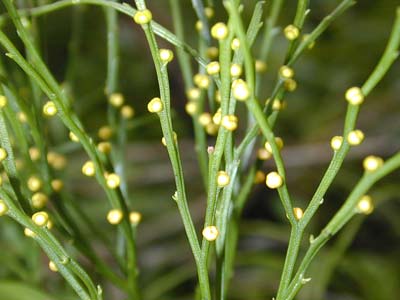

Flat Fork Fern
Psilotum × complanatum
Side by side
| Whisk Fern | Flat Fork Fern | |
|---|---|---|
| Scientific name | Psilotum nudum (L.) P.Beauv. | Psilotum × complanatum Sw. |
| English name | Whisk Fern | Flat Fork Fern |
| Group | Ferns and allies | Ferns and allies |
| Class | Polypodiopsida Fern | Polypodiopsida Fern |
| Order | Psilotales | Psilotales |
| Family | Psilotaceae Fork Fern Family | Psilotaceae Fork Fern Family |
| Genus | Psilotum Fork Ferns | Psilotum Fork Ferns |
| Red List category | Least Concern | Not recorded |
| Countries on record | 134 countries | 16 countries |
| GBIF occurrence records | 20,727 records | 1,214 records |
Rows where the two agree are shown in grey.
Where each is found
Both recorded in 16 countries
- Brazil
- Cuba
- Dominican Republic
- Ecuador
- El Salvador
- Guadeloupe
- Guatemala
- Haiti
- Honduras
- Jamaica
- Mexico
- Montserrat
- Puerto Rico
- Saint Vincent and the Grenadines
- United States
- Venezuela
Only Whisk Fern (118)
- American Samoa
- Angola
- Antigua and Barbuda
- Argentina
- Australia
- Bahamas
- Bangladesh
- Belgium
- Belize
- Benin
- Bermuda
- Bhutan
- Bolivia
- Bonaire, Saint Eustatius and Saba
- British Indian Ocean Territory
- British Virgin Islands
- Cabo Verde
- Cameroon
- Canada
- Cayman Islands
- Chile
- China
- Christmas Island
- Colombia
- Comoros
- Cook Islands
- Costa Rica
- Democratic Republic of the Congo
- Dominica
- Equatorial Guinea
- Eswatini
- Fiji
- Finland
- France
- French Guiana
- French Polynesia
- Gabon
- Germany
- Ghana
- Gibraltar
- Grenada
- Guam
- Guinea
- Hong Kong
- India
- Indonesia
- Japan
- Kenya
- Kiribati
- Laos
- Lesotho
- Liberia
- Macao
- Madagascar
- Malawi
- Malaysia
- Maldives
- Marshall Islands
- Martinique
- Mauritius
- Mayotte
- Micronesia
- Mozambique
- Myanmar
- Nauru
- Nepal
- New Caledonia
- New Zealand
- Nicaragua
- Nigeria
- Niue
- Norfolk Island
- Northern Mariana Islands
- Pakistan
- Palau
- Panama
- Papua New Guinea
- Paraguay
- Peru
- Philippines
- Pitcairn
- Portugal
- Reunion
- Saint Barthelemy
- Saint Helena
- Saint Kitts and Nevis
- Saint Lucia
- Samoa
- Sao Tome and Principe
- Saudi Arabia
- Senegal
- Seychelles
- Singapore
- Solomon Islands
- South Africa
- South Korea
- Spain
- Sri Lanka
- Suriname
- Taiwan
- Tanzania
- Thailand
- Timor Leste
- Tokelau
- Tonga
- Trinidad and Tobago
- Tuvalu
- U.S. Virgin Islands
- Uganda
- United Kingdom
- United States Minor Outlying Islands
- Uruguay
- Vanuatu
- Vietnam
- Wallis and Futuna
- Yemen
- Zambia
- Zimbabwe
From Catalogue of Life checklists and GBIF occurrence records. A country missing from a list means no record is held, which is not proof of absence.
Checked facts
| Whisk Fern | Flat Fork Fern | |
|---|---|---|
| Appearance |
| No checked fact yet |
| Size |
| No checked fact yet |
| Habitat |
| No checked fact yet |
| Reproduction |
| No checked fact yet |
| Distribution |
| No checked fact yet |
| Uses |
| No checked fact yet |
| Other |
| No checked fact yet |
In brief
Whisk Fern
Psilotum nudum grows mostly as an epiphyte in moist habitats and occurs across tropical and subtropical regions, with documented populations in several other locations. It has green, branching, Y-shaped stems with greatly reduced, scale-like appendages and underground rhizomes instead of true roots. Full profile
Compare something else
Page built on 24 November 2026 from the data on the two species pages, where every source is listed.
Cite this page
ScientificNames.org. (2026). Whisk Fern vs Flat Fork Fern. Retrieved November 24, 2026, from https://scientificnames.org/compare/whisk-fern-vs-flat-fork-fern
“Whisk Fern vs Flat Fork Fern.” ScientificNames.org, 2026, scientificnames.org/compare/whisk-fern-vs-flat-fork-fern. Accessed 24 Nov. 2026.
ScientificNames.org. “Whisk Fern vs Flat Fork Fern.” Accessed November 24, 2026. https://scientificnames.org/compare/whisk-fern-vs-flat-fork-fern.
@misc{scientificnames_whisk_fern_vs_flat_fork_fern,
  author = {{ScientificNames.org}},
  title = {Whisk Fern vs Flat Fork Fern},
  year = {2026},
  url = {https://scientificnames.org/compare/whisk-fern-vs-flat-fork-fern},
  note = {Accessed 2026-11-24}
}