Species · Ferns and allies
Whisk Fern Psilotum nudum
The scientific name of the Whisk Fern is Psilotum nudum. It is a species of fern or lycophyte in the family Psilotaceae (fork fern family), order Psilotales.
- Scientific name
- Psilotum nudum (L.) P.Beauv.
- Common name
- Whisk Fern
- Genus
- Psilotum
- Family
- Psilotaceae (Fork Fern Family)
- Order
- Psilotales
- Class
- Polypodiopsida
- Red List category
- LC Least Concern
- Recorded in
- 134 countries
- Name status
- accepted in the Catalogue of Life
Overview
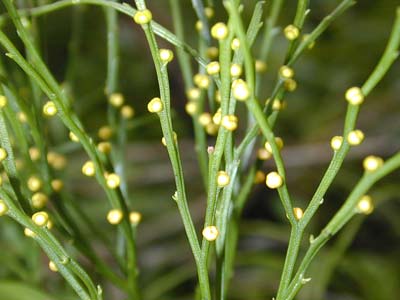
Psilotum nudum grows mostly as an epiphyte in moist habitats and occurs across tropical and subtropical regions, with documented populations in several other locations. It has green, branching, Y-shaped stems with greatly reduced, scale-like appendages and underground rhizomes instead of true roots.
Written 24 November 2026 from the sources listed below. Each statement was checked against the passage it cites; statements that could not be supported were removed.
Appearance
Whisk Fern has green, Y-shaped stems with many branches. Its scale-like appendages, called enations, resemble miniature leaves but are greatly reduced and lack internal vascular tissues.[1][2][3][4]
The species lacks true roots and has underground rhizomes instead. These rhizomes have a central vascular arrangement called a protostele, without a central pith, and their xylem is composed entirely of tracheids.[5][6][7]
The epidermal layer of its photosynthetic above-ground rhizomes contains stomata for gas exchange.[8]
The underground central stem measures 2–3 mm in diameter under uncrowded growing conditions and 0.7–3.5 mm under crowded growing conditions.[9][10]
Habitat
Whisk Fern commonly grows as an epiphyte in tropical areas and grows mostly as an epiphyte in moist habitats. In south-eastern Australia, it usually grows in rock crevices.[11][12][13]
Water and mineral absorption occurs through underground, horizontally creeping rhizomes. These rhizomes sometimes occur in association with symbiotic fungi.[14][15]
The species occurs in tropical Africa, Central America, tropical and subtropical North America, and South America. Its documented distribution also includes tropical Asia, Australia, Hawaii, southern Japan, Lord Howe Island, and New Zealand.[16][17]
The species has isolated populations in southwestern Europe, including Los Alcornocales in Cádiz province, Spain. It occurs naturally on all the main Hawaiian Islands.[18][19]
Reproduction and life cycle
Whisk Fern reproduces by producing spores. Spore-bearing synangia may occur at the tips of the aerial axes and develop through the fusion of three adjacent sporangia.[20][21][22]
The species can also reproduce vegetatively through multicellular structures called gemmae. These contain starch reserves and contribute to the development of new rhizomes.[23][24]
When grown without a fungal symbiont, spores and gametophytes require a sugar source for growth and gamete production.[25]
Uses
Whisk Fern was historically cultivated as an ornamental plant in Japanese gardens. It has also been used to make traditional Hawaiian leis.[26][27]
Hawaiians historically collected its spores and used them as talcum powder beneath loincloths to prevent chafing. Its spores were also historically used medicinally as a purge.[28][29]
Its branches were historically tied together to make small brooms. The species has also been used in a traditional Hawaiian children's game involving interlocking and pulling branch stems.[30][31]
The chemical diversity of its organs and tissues has been studied using mass spectrometry.[32]
Classification of the Whisk Fern
| Kingdom | Plantae |
|---|---|
| Subkingdom | Pteridobiotina |
| Phylum | Tracheophyta |
| Class | Polypodiopsida (Fern) |
| Order | Psilotales |
| Family | Psilotaceae (Fork Fern Family) |
| Genus | Psilotum (Fork Ferns) |
| Species | Psilotum nudum (L.) P.Beauv. |
Where the Whisk Fern is found
Checklists and occurrence records place Psilotum nudum in 134 countries across Africa, Asia, Europe, North America, Oceania and South America. GBIF holds 20,727 georeferenced records of it.
Countries where it is native or its origin is not stated
- American Samoa 11
- Angola 2
- Antigua and Barbuda 1
- Argentina 89
- Australia 2,241
- Bahamas 62
- Bangladesh
- Belgium 5
- Belize 24
- Benin 46
- Bermuda 38
- Bhutan
- Bolivia 59
- Bonaire, Saint Eustatius and Saba 13
- Brazil 850
- British Indian Ocean Territory 34
- British Virgin Islands 8
- Cabo Verde 20
- Cameroon 2
- Canada 8
- Cayman Islands 5
- Chile 4
- China 400
- Christmas Island 8
- Colombia 31
- Comoros 26
- Cook Islands 84
- Costa Rica 49
- Cuba 296
- Democratic Republic of the Congo 81
- Dominica 27
- Dominican Republic 79
- Ecuador 59
- El Salvador 10
- Equatorial Guinea 14
- Eswatini 2
- Fiji 126
- Finland 4
- France 17
- French Guiana 13
- French Polynesia 429
- Gabon 50
- Germany 3
- Ghana 2
- Gibraltar 4
- Grenada 10
- Guadeloupe 46
- Guam 35
- Guatemala 25
- Guinea
- Haiti 38
- Honduras 49
- Hong Kong 94
- India 48
- Indonesia 221
- Jamaica 138
- Japan 1,229
- Kenya 2
- Kiribati 22
- Laos 3
- Lesotho 1
- Liberia 8
- Macao 26
- Madagascar 60
- Malawi
- Malaysia 53
- Maldives 18
- Marshall Islands 25
- Martinique 31
- Mauritius 43
- Mayotte 28
- Mexico 151
- Micronesia 56
- Montserrat 9
- Mozambique 2
- Myanmar 2
- Nauru 3
- Nepal 2
- New Caledonia 264
- New Zealand 730
- Nicaragua
- Nigeria
- Niue 33
- Norfolk Island 50
- Northern Mariana Islands 35
- Pakistan 5
- Palau 49
- Panama 17
- Papua New Guinea 230
- Paraguay 67
- Peru 52
- Philippines 58
- Pitcairn 23
- Puerto Rico 162
- Reunion 592
- Saint Barthelemy 4
- Saint Helena 3
- Saint Kitts and Nevis 6
- Saint Lucia 5
- Saint Vincent and the Grenadines 9
- Samoa 50
- Sao Tome and Principe 7
- Saudi Arabia 2
- Senegal 1
- Seychelles 271
- Singapore 14
- Solomon Islands 69
- South Africa 126
- South Korea 48
- Spain 136
- Sri Lanka 28
- Suriname 2
- Taiwan 3,863
- Tanzania 20
- Thailand 68
- Timor Leste 12
- Tokelau 3
- Tonga 55
- Trinidad and Tobago 6
- Tuvalu 5
- U.S. Virgin Islands 11
- Uganda
- United Kingdom 6
- United States 5,532
- United States Minor Outlying Islands 4
- Uruguay 11
- Vanuatu 75
- Venezuela 8
- Vietnam 56
- Wallis and Futuna 7
- Yemen 1
- Zambia 11
- Zimbabwe 3
Countries where it has been introduced
Regions and cities with the most records
- Banqiao, Taiwan 2,982
- New Taipei City, Taiwan 2,974
- Taipei, Taiwan 2,950
- Neihu, Taiwan 2,932
- Shulin, Taiwan 2,853
- Xizhi, Taiwan 2,815
- Taipei, Taiwan 2,662
- Danshui, Taiwan 2,481
- Florida, United States 2,432
- Sanxia, Taiwan 1,567
- Yingge, Taiwan 1,307
- Hawaii, United States 1,186
- New South Wales, Australia 952
- Queensland, Australia 849
- Honolulu, United States 461
- East Honolulu, United States 406
- Taiwan, Taiwan 385
- Keelung, Taiwan 349
- Pearl City, United States 346
- Kendall, United States 328
- California, United States 316
- Auckland, New Zealand 309
- Flagami, United States 302
- Lauderhill, United States 297
- Davie, United States 295
- Coral Gables, United States 293
- Plantation, United States 292
- Little Havana, United States 288
- Sydney, Australia 286
- Auckland, New Zealand 279
- Margate, United States 279
- Coconut Creek, United States 277
- Fort Lauderdale, United States 273
- Pompano Beach, United States 260
- Kendale Lakes, United States 259
- Tamarac, United States 256
Range as the checklists state it
Spain (S-Spain); Canary Isl. [I] (Tenerife [I], Lanzarote [I]); Madeira [I] (Funchal [I]); Cape Verde Isl. (Santo Antao Isl., Ilha de Sao Nicolau, Ilha Brava); Senegal; Guinea; Liberia; Ghana; Benin; Nigeria; Cameroon; Bioko Isl. [Fernando Poo]; São Tomé; Annobon Isl.; Equatorial Guinea (Rio Muni); Gabon; Congo [Brazzaville]; D. R. Congo [Zaire]; Uganda; Kenya; Pemba Isl.; Tanzania; Angola; Zambia; Malawi; Zimbabwe; Mozambique; South Africa (Limpopo, Mpulamanga, Free State, KwaZulu-Natal, E-Cape Prov.); Lesotho; Eswatini [Swaziland]; Ascension Isl.; Madagascar; Comores (Mayotte); Mauritius; La Réunion; Rodrigues; Îles Glorieuses; Aldabra (Cosmoledo Isl.), Seychelles (incl. Coetivy Isl.); Agalega Isl.; Chagos Arch. (Diego Garcia); Russian Far East (Kuril Isl.); Saudi Arabia; Yemen (N-Yemen); China (Anhui, Chongqing, Fujian, Guangdong, Guangxi, Guizhou, Hainan, Hunan, Jiangsu, Jiangxi, Macao, Shaanxi, Sichuan, Yunnan, Zhejiang); South Korea (Cheju Isl.); Japan; Ogasawara Isl. (Chichijima, Minamijima, Anijima, Otohtojima, Hahajima, Meijima); Taiwan; Pakistan; Nepal; Bhutan; India (Andhra Pradesh, Arunachal Pradesh, Assam State, Bihar, Chhattisgarh, Himachal Pradesh, Karnataka, Kerala, Madhya Pradesh, Maharashtra, Meghalaya, Mizoram, Nagaland, Odisha, Punjab, Sikkim, Tamil Nadu, Uttarakhand, Uttar Pradesh, West Bengal); Lakshadweep Isl. [Laccadives]; Maldives; Sri Lanka; Bangladesh; Andaman Isl.; Nicobar Isl.; Myanmar; Thailand (widespread); Laos; Vietnam; peninsular Malaysia (widespread); Singapore; Borneo (Sabah, Sarawak); Sulawesi; Palawan; Philippines; Lesser Sunda Isl. (Bali); East Timor; Moluccas (Seram); Christmas Isl. [Austr.]; New Guinea (Irian Jaya, Papua New Guinea, d'Entrecasteaux Arch.: Normanby Isl., Louisiade Arch.: Sudest Isl.); Bismarck Arch. (incl. Admiralty Isl.); Solomon Isl. (Baga, Bougainville, Choiseul, Santa Ysabel, Kolombangara, Malaita, Mono, Tulagi, Guadalcanal, Ranongga, Rennell); Australia (Western Australia, Northern Territory, Queensland, South Australia, Victoria, New South Wales); Lord Howe Isl.; Norfolk Isl.; New Zealand (North Isl., Poor Knights Isl.); Kermadec Isl.; Santa Cruz Isl.; New Caledonia (incl. Loyalty Isl.); Rotuma Isl.; Tonga (Late Isl., Tongatapu, 'Eua, Kao, Niuatoputapu); Niue; Fiji (Viti Levu, Vanua Levu, Beqa Isl., Taveuni); Wallis & Futuna (Futuna Isl., Alofi, 'Uvea, Wallis); American Samoa (Ofu); [Western] Samoa (Savai'i, 'Upolu); Tuvalu (Nui Atoll, +Funafuti, Nanumea, Vaitupu, Nukulaelae, Niutao); Tokelau (Nukunonu, Fakaofo, Swains Isl.); Gilbert Isl. (Butaritari, Tarawa); Banaba [Ocean] Isl.; Nauru; N-Line Isl. (Palmyra, Washington, Fanning); S-Line Isl. (Caroline Atoll); Cook Isl. (Rarotonga, Mangaia, Penrhyn, Rakahanga, Manihiki, Pukapuka, Nassau, Suwarrow, Palmerston, Aitutaki, Manuae, Takutea, Mitiaro, Atiu, Mauke); Marquesas Isl. (Eiao, Nuku Hiva, Ua Huka, Ua Pou, Hiva Oa, Tahuata, Fatu Hiva); Society Isl. (Maupiti, Tahiti, Tahaa, Moorea, Huahine, Tetiaroa Atoll, Tupai); Gambier Isl. (Mangareva); Tuamotu Arch. (Makatea, Rangiroa, Ahii, Takaroa, Manihi, Kaehi, Tahanea, Toau, Faite, Taenga, Makemo, Taiaro, Takapoto Atoll); Austral Isl. (Rapa Iti, Rurutu, Tubuai, Maria Rocks, Rimatara, Raivavae); Pitcairn Isl.; Henderson Isl.; +Easter Isl.; Palau (Babeldaob, Koror, Ngarakabesang, Malakal, Ulebsechel, Sonsorol); Northern Marianas (Pagan, Anatahan, Rota Isl., Saipan); Guam; Fed. States of Micronesia (Sonsorol, Yap, Truk, Moen, Fefan, Piis, Nukuoro, Kapingamarangi, Pohnpei, Kosrae); Marshall Isl.. (Enewetok, Kwajalein, Majuro, Arno, Jaluit); Hawaii (Niihau, Kauai, Oahu, Molokai, Lanai, Maui, Hawaii Isl., Midway Isl.); USA (Alabama, Arkansas, Arizona, Florida, Georgia, Louisiana, Mississippi, North Carolina, South Carolina, Texas); Bermuda; Mexico (Campeche, Chiapas, Colima, Ciudad de Mexico, Guerrero, Jalisco, México State, Morelos, Oaxaca, Sonora, Tabasco, Tamaulipas, Veracruz, Yucatán); Revillagigedos Isl. (Isla Socorro); Guatemala; Belize; El Salvador; Honduras; Nicaragua; Costa Rica; Isla del Coco; Panama; Bahamas; Turks & Caicos Isl.; Cuba; Cayman Isl. (Grand Cayman); Jamaica; Hispaniola (Haiti, Dominican Republic); Puerto Rico; Virgin Isl. (Tortola, Virgin Gorda, St. John, St. Thomas); St. Martin/St. Maarten; St. Barthélémy; Saba; Nevis; St. Kitts; Redonda; Montserrat; Guadeloupe (incl. La Desirade); Marie-Galante; Dominica; Martinique; St. Lucia; St. Vincent; Grenada; Trinidad; Colombia (Antioquia, Caquetá, Chocó, Huila, Nariño, Valle); Venezuela (Amazonas, Anzoátegui, Aragua, Carabobo, Cojedes, Venezuela Distrito Federal, Falcón, Guárico, Lara, Mérida, Miranda, Monagas, Nueva Esparta, Sucre, Yaracuy); Surinam; French Guiana; Ecuador; Galápagos; Peru; Bolivia (Beni, Cochabamba, La Paz, Pando, Santa Cruz); Brazil (Acre, Amazonas, Bahia, Ceará, Brasilia Distrito Federal, Espírito Santo, Goiás, Maranhão, Minas Gerais, Mato Grosso do Sul, Mato Grosso, Pará, Paraíba, Pernambuco, Paraná, Rio Grande do Norte, Rio de Janeiro, Rondônia, Rio Grande do Sul, Santa Catarina, São Paulo, Sergipe, Tocantins); Ilha da Trindade; Paraguay (Alto Paraná, Amambay, Caaguazu, Canindeyu, Central, Concepcion, Cordillera, Paraguari, San Pedro); Uruguay (Rocha, Tacuarembó); Argentina (Corrientes, Misiones, Salta)
A number beside a place is its count of GBIF occurrence records. A place without a number comes from a checklist alone. Records show where a species has been observed or collected, which can include escapes and vagrants.
Common names
English
- Whisk Fern
- Skeleton Fork Fern
Names in 3 other languages
- Korean
- Sol-ip-ran
- Spanish
- helecho escoba
- Swedish
- kvastormbunke
Synonyms
31 other scientific names have been used for this species and are now treated as synonyms of Psilotum nudum.
- Bernhardia antillarum Müll.Berol.
- Bernhardia antillarum Müll.Hal.
- Bernhardia capensis Müll.Hal.
- Bernhardia deppeana Müll.Berol.
- Bernhardia deppeana Müll.Hal.
- Bernhardia dichotoma Willd.
- Bernhardia novae-hollandiae Müll.Hal.
- Bernhardia novae-hollandiae K.Mull.
- Bernhardia oahuensis Müll.Berol.
- Bernhardia oahuensis Müll.Hal.
- Hoffmannia aphylla Willd.
- Hoffmannia uxpanapense Cast.-Campos & Baut.-Bello
- Lycopodium nudum L.
- Psilotum domingense Gand.
- Psilotum flabellatum Gand.
- Psilotum floridanum Michx.
- Psilotum heterocarpum Colenso
- Psilotum neocaledonicum Gand.
- Psilotum novae-zelandiae Gand.
- Psilotum nudum (L.) Griseb.
- Psilotum nudum var. fallicinum (Domin) Domin
- Psilotum nudum var. molesworthiae Iranzo, Prada & Salvo
- Psilotum nudum var. molesworthiae (L.) P.Beauv.
- Psilotum nudum var. molesworthii Iranzo, Prada & Salvo
- Psilotum nudum var. normale Domin
- Psilotum triquetrum Sw.
- Psilotum triquetrum f. insulare Brade
- Psilotum triquetrum var. fallacinum Domin
- Psilotum triquetrum var. gracile Grev. & Hook.
- Psilotum triquetrum var. latum Desv.
- Tristeca nuda (L.) P.Beauv. ex J.St.-Hil.
Questions and answers
What is the scientific name of the Whisk Fern?
The scientific name of the Whisk Fern is Psilotum nudum. Written with its author, the full name is Psilotum nudum (L.) P.Beauv..
Which family does the Whisk Fern belong to?
Psilotum nudum belongs to the family Psilotaceae, in the order Psilotales and the class Polypodiopsida.
Where is the Whisk Fern found?
Checklists and occurrence records place Psilotum nudum in 134 countries, including United States, Taiwan, Australia, Japan, Brazil and New Zealand.
What is the conservation status of the Whisk Fern?
The IUCN Red List category recorded for Psilotum nudum is Least Concern (LC).
What other names does the Whisk Fern have?
Psilotum nudum is also known in English as Skeleton Fork Fern.
Why is Psilotum called whisk fern?
Its above-ground stems have many branches bearing greatly reduced, scale-like appendages called enations.[1][2][3]
Are whisk ferns weeds?
Whisk Fern is sometimes encountered as a weed in greenhouses.[33]
What is unique about the whisk fern gametophyte?
When grown without a fungal symbiont, its gametophytes require a sugar source for growth and gamete production.[25]
Sources
Passages the profile rests on
- The species has green, Y-shaped stems bearing greatly reduced leaf-like appendages called enations. Source passage: “It is green, with sporangia that produces spores. Whisk ferns have Y shaped stems.” — English Wikipedia
- Its leaf-like enations are greatly reduced rather than completely absent. Source passage: “The leaves are not actually absent but greatly reduced.” — English Wikipedia
- The species has many branches on its above-ground rhizomes, bearing scale-like appendages called enations. Source passage: “above-ground rhizomes have many branches with scale-like appendages called enations.” — pmc.ncbi.nlm.nih.gov
- The enations resemble miniature leaves but lack internal vascular tissues. Source passage: “These structural outgrowths resemble miniature leaves but, unlike true leaves, have no internal vascular tissues.” — pmc.ncbi.nlm.nih.gov
- The species lacks true roots and possesses underground rhizomes instead. Source passage: “it lacks roots and instead possesses underground rhizomes.” — English Wikipedia
- Its underground rhizomes have a central vascular arrangement called a protostele, without a central pith. Source passage: “The underground rhizome contains a protostele, a vascular region arrangement in which the central xylem is surrounded by phloem and lacks a central pith.” — English Wikipedia
- The xylem of the underground rhizome is composed entirely of tracheids. Source passage: “The xylem is composed entirely of tracheids and is exarch.” — English Wikipedia
- The epidermal layer of its photosynthetic above-ground rhizomes contains stomata for gas exchange. Source passage: “The epidermal layer of the photosynthetic above-ground rhizomes contains stomata for gas exchange” — pmc.ncbi.nlm.nih.gov
- The underground central stem measures 2–3 mm in diameter under uncrowded growing conditions. Source passage: “they have similarly equal dimeters of 2 to 3 mm in an uncrowded conditions” — English Wikipedia
- The underground central stem measures 0.7–3.5 mm in diameter under crowded growing conditions. Source passage: “the diamter is 0.7 to 3.5mm in crowded conditions.” — English Wikipedia
- The species commonly grows as an epiphyte in tropical areas. Source passage: “In tropical areas, this plant is often epiphytic” — English Wikipedia
- In south-eastern Australia, the species usually grows in rock crevices. Source passage: “in more temperate areas, such as south-eastern Australia, it is usually found growing in rock crevices.” — English Wikipedia
- The species grows mostly as an epiphyte in moist habitats. Source passage: “Plants grow mostly as epiphytes (using other plants as physical support) in moist habitats.” — pmc.ncbi.nlm.nih.gov
- Water and mineral absorption occurs through underground, horizontally creeping rhizomes. Source passage: “Water and mineral absorption occurs through underground, horizontally creeping rhizomes” — pmc.ncbi.nlm.nih.gov
- The underground rhizomes sometimes occur in association with symbiotic fungi. Source passage: “sometimes in association with symbiotic fungi (mycorrhizae)” — pmc.ncbi.nlm.nih.gov
- The species occurs in tropical Africa, Central America, tropical and subtropical North America, and South America. Source passage: “P. nudum is found in tropical Africa, Central America, tropical and subtropical North America, South America” — English Wikipedia
- Its documented distribution includes tropical Asia, Australia, Hawaii, southern Japan, Lord Howe Island, and New Zealand. Source passage: “tropical Asia, Australia, Hawaii, southern Japan, Lord Howe Island, New Zealand” — English Wikipedia
- The species has isolated populations in southwestern Europe, including Los Alcornocales in Cádiz province, Spain. Source passage: “with a few isolated populations in SW Europe ("Los Alcornocales", Spain, Cádiz province).” — English Wikipedia
- The species occurs naturally on all the main Hawaiian Islands. Source passage: “The species is naturally found on all the main Hawaiian Islands.” — English Wikipedia
- The species reproduces by producing spores. Source passage: “It reporduces by spores.” — English Wikipedia
- Spore-bearing synangia may occur at the tips of the aerial axes. Source passage: “synagia (spore-bearing reproductive structure) may occur at the tips of the aerial axes.” — English Wikipedia
- The synangia develop through the fusion of three adjacent sporangia. Source passage: “spore-containing synangia, which result from the fusion of three adjacent sporangia” — pmc.ncbi.nlm.nih.gov
- The species can reproduce vegetatively through multicellular structures called gemmae. Source passage: “Psilotum nudum can reproduce vegetatively through small, multicellular structures known as gemmae.” — English Wikipedia
- The gemmae contain starch reserves and contribute to the development of new rhizomes. Source passage: “Gemmae contains starch reserves and help in the development of new rhizomes.” — English Wikipedia
- Spores and gametophytes require a sugar source for growth and gamete production when grown without a fungal symbiont. Source passage: “P. nudum spores and gametophytes require a sugar source to support growth and gamete production in the absence of a fungal symbiont.” — English Wikipedia
- The species was historically cultivated as an ornamental plant in Japanese gardens. Source passage: “The plant, which grows wild in southern Japan, was once much cultivated in Japanese gardens as an ornamental plant.” — English Wikipedia
- The species has been used to make traditional Hawaiian leis. Source passage: “The species is still often used in making traditional Hawaiian leis.” — English Wikipedia
- Hawaiians historically collected its spores and used them as talcum powder beneath loincloths to prevent chafing. Source passage: “the Hawaiians collected large quantities of the spores and used them like talcum powder, under the loincloth to prevent chafing.” — English Wikipedia
- Its spores were historically used medicinally as a purge. Source passage: “The spores were also used medicinally as a purge.” — English Wikipedia
- Its branches were historically tied together to make small brooms. Source passage: “alludes to its use in the past as a small broom, made by tying a handful of its branches together.” — English Wikipedia
- The species has been used in a traditional Hawaiian children's game involving interlocking and pulling branch stems. Source passage: “Twigs of the Moa were interlocked and the players pulled on the ends.” — English Wikipedia
- The species has been studied for the chemical diversity of its organs and tissues using mass spectrometry. Source passage: “In this study, extracts of several Psilotum organs and tissues were analyzed by Gas Chromatography – Mass Spectrometry (GC-MS) and High Performance Liquid Chromatography – Quadrupole Time of Flight – Mass Spectrometry (HPLC-QTOF-MS).” — pmc.ncbi.nlm.nih.gov
- The species is sometimes encountered as a weed in greenhouses. Source passage: “It is sometimes found in cultivation (either accidentally, as a weed in greenhouses, or deliberately, in the form of a number of cultivars).” — English Wikipedia
Data
- Catalogue of Life, 2026-10-16 XR cc by
- Global Biodiversity Information Facility CC BY 4.0
- Wikidata CC0
- GeoNames CC BY 4.0
- Wikimedia Commons per image; credit shown with each image
- Within the Catalogue of Life, this name comes from Checklist of Ferns and Lycophytes of the World cc by
References
- P.Beauv. Prodr. Aethéogam. 112 (1805). where the name was published
This species in other databases
Page built on 24 November 2026. See how the catalog is made and all sources and licences.
Cite this page
ScientificNames.org. (2026). Psilotum nudum (Whisk Fern). Retrieved November 24, 2026, from https://scientificnames.org/species/psilotum-nudum
“Psilotum nudum (Whisk Fern).” ScientificNames.org, 2026, scientificnames.org/species/psilotum-nudum. Accessed 24 Nov. 2026.
ScientificNames.org. “Psilotum nudum (Whisk Fern).” Accessed November 24, 2026. https://scientificnames.org/species/psilotum-nudum.
@misc{scientificnames_psilotum_nudum_whisk_fern,
  author = {{ScientificNames.org}},
  title = {Psilotum nudum (Whisk Fern)},
  year = {2026},
  url = {https://scientificnames.org/species/psilotum-nudum},
  note = {Accessed 2026-11-24}
}