Comparison

Madagascar Sandgrouse vs Chestnut-bellied Sandgrouse

Madagascar Sandgrouse (Pterocles personatus) and Chestnut-bellied Sandgrouse (Pterocles exustus) both belong to the genus Pterocles (sandgrouse) and part ways below it.
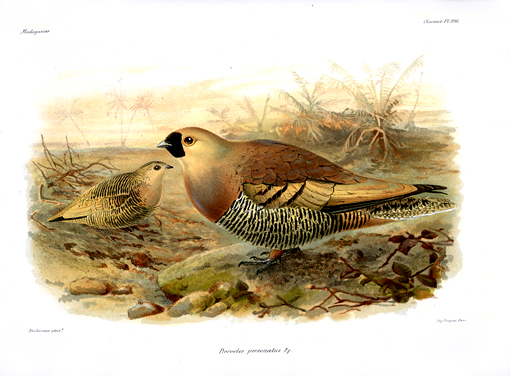
Madagascar Sandgrouse

Madagascar Sandgrouse

Pterocles personatus

John Gerrard Keulemans (8 June 1842 - 29 March 1912), Public domain, via Wikimedia Commons

Chestnut-bellied Sandgrouse

Chestnut-bellied Sandgrouse

Pterocles exustus

Rejichandran, CC BY-SA 4.0, via Wikimedia Commons

Side by side

Madagascar SandgrouseChestnut-bellied Sandgrouse
Scientific namePterocles personatus Gould, 1843Pterocles exustus Temminck, 1825
English nameMadagascar SandgrouseChestnut-bellied Sandgrouse
GroupBirdsBirds
ClassAves BirdAves Bird
OrderPterocliformes SandgrousePterocliformes Sandgrouse
FamilyPteroclidae SandgrousePteroclidae Sandgrouse
GenusPterocles SandgrousePterocles Sandgrouse
Named in18431825
Red List categoryLeast ConcernLeast Concern
Countries on record1 country30 countries
GBIF occurrence records1,211 records33,608 records

Rows where the two agree are shown in grey.

Where each is found

Only Madagascar Sandgrouse (1)

Only Chestnut-bellied Sandgrouse (30)

From Catalogue of Life checklists and GBIF occurrence records. A country missing from a list means no record is held, which is not proof of absence.

Checked facts

Madagascar SandgrouseChestnut-bellied Sandgrouse
Appearance
  • The Madagascar sandgrouse is a plump, short-legged bird with a short tail. English Wikipedia
  • Adult females lack the black facial area surrounding the beak found in males. English Wikipedia
  • Adult females have blackish-brown crowns and napes streaked with buff. English Wikipedia
  • Adult females have pinkish-buff breasts with dark barring along the sides. English Wikipedia
  • Juveniles resemble females but have browner barring and more muted overall colouring. English Wikipedia
  • Both sexes have black underwings. English Wikipedia
  • The species has a brownish appearance and a body shape resembling that of a large dove. ebird.org
  • Males have a black front and plain wings marked with three black bars. ebird.org
  • Females have fine black markings across their backs. ebird.org
  • The species has a small to medium-sized brownish body and an elongated, pointed tail when flying. English Wikipedia
  • When on the ground, the species has short legs and a small head. English Wikipedia
  • The species extends its neck when it becomes wary. English Wikipedia
  • The species exhibits sexual dimorphism in its plumage coloration. English Wikipedia
  • Male chestnut-bellied sandgrouse have sandy-brown upperparts, a thin black breast band, and a solid chestnut belly. ebird.org
  • Females have dull-buff upper plumage marked with dark-brown streaks and bars. English Wikipedia
  • The Nile Valley subspecies has darker and greyer coloration on its head, mantle, and breast than the nominate subspecies. English Wikipedia
  • The olivascens subspecies has greyer olive coloration on its upperparts and wings. English Wikipedia
SizeNo checked fact yet
Habitat
  • The species inhabits dry, open areas of mostly level ground with grasses and sparse vegetation. English Wikipedia
  • Its habitat includes the spiny forests of southeastern Madagascar. English Wikipedia
Diet
Behaviour
  • The species usually occurs in family-sized groups of three or four birds. English Wikipedia
  • The species sometimes forms groups containing twelve or more birds. English Wikipedia
  • The species can run but seldom does so. English Wikipedia
  • When disturbed, individuals may initially freeze before moving away or taking flight. English Wikipedia
  • Groups generally fly away together and land a short distance from their original location. English Wikipedia
  • The species communicates using a low, rapid, hoarse repeated call or a single note repeated every few seconds. English Wikipedia
  • Individuals tend to gather at watering locations in the early morning and late afternoon. English Wikipedia
  • The species sometimes gathers in flocks of several hundred birds at watering locations. English Wikipedia
  • Individuals sometimes wade into water while drinking. English Wikipedia
  • During breeding, individuals carry water to their young in their breast feathers. English Wikipedia
  • The species may rest on sandbanks during the day. English Wikipedia
Reproduction
  • Adult Madagascar sandgrouse form monogamous pairs. English Wikipedia
  • Nests are ground depressions often situated beside trees or shrubs, within vegetation clumps, or among rocks or bushes. English Wikipedia
  • Nests are sparsely lined with dried grasses and occasionally a twig or snail shell. English Wikipedia
  • Nests are sometimes decorated with a ring of leaves collected from elsewhere. English Wikipedia
  • A typical clutch contains three greenish-brown eggs with abundant dark-brown blotches. English Wikipedia
  • Both sexes participate in incubating the eggs. English Wikipedia
  • Adults generally remain on their nests until an approaching intruder comes within 10 metres. English Wikipedia
  • The species reaches sexual maturity one year after hatching. English Wikipedia
  • During breeding, males develop fresh, brightly coloured plumage and elongated central tail feathers. English Wikipedia
  • The species nests in shallow depressions scratched into the ground. English Wikipedia
  • The species builds its nests in exposed locations without attempting to conceal them. English Wikipedia
  • The eggs are pale grey-stone or yellowish-stone with brown spots and blotches and grey or lavender secondary markings. English Wikipedia
  • In captivity, females perform most of the incubation. English Wikipedia
  • Males have been observed incubating eggs at night in the wild. English Wikipedia
  • Hatchlings in the Thar and Sindh deserts leave the nest shortly after hatching. English Wikipedia
Distribution
  • The Madagascar sandgrouse is endemic to Madagascar. English Wikipedia
  • The species occurs in the drier southern and western regions of Madagascar. English Wikipedia
  • The species is common in western and southern Madagascar but less common farther north. English Wikipedia
  • The species occurs across northern and central Africa and extends eastward into western and southern Asia. English Wikipedia
  • The floweri subspecies is endemic to Egypt's Nile Valley. English Wikipedia
  • The hindustan subspecies occurs in southeastern Iran, Pakistan, and India. English Wikipedia
  • The erlangeri subspecies occurs in southwestern Saudi Arabia, Yemen, and Oman. English Wikipedia
  • The ellioti subspecies occurs in southeastern Sudan, eastern Eritrea, northern Ethiopia, and Somalia. English Wikipedia
  • The olivascens subspecies occurs in southeastern South Sudan, southwestern Ethiopia, Kenya, and northern Tanzania. English Wikipedia
  • The nominate subspecies occurs in Senegal, Gambia, Mauritania, and Sudan. English Wikipedia
ConservationNo checked fact yet
Other
  • The species was most recently assessed for the IUCN Red List in 2024. iucnredlist.org

In brief

Madagascar Sandgrouse

The Madagascar Sandgrouse is a plump, short-legged bird with a short tail. It is endemic to Madagascar and occurs in the drier southern and western regions of the island. Full profile

Chestnut-bellied Sandgrouse

Pterocles exustus inhabits dry, open environments across northern and central Africa and western and southern Asia. It has water-absorbing breast feathers that transport water to its nest for its young. Full profile

Compare something else

Page built on 28 November 2026 from the data on the two species pages, where every source is listed.

Cite this page

ScientificNames.org. (2026). Madagascar Sandgrouse vs Chestnut-bellied Sandgrouse. Retrieved November 28, 2026, from https://scientificnames.org/compare/madagascar-sandgrouse-vs-chestnut-bellied-sandgrouse