Species · Birds
Madagascar Sandgrouse Pterocles personatus
The scientific name of the Madagascar Sandgrouse is Pterocles personatus. It is a species of bird in the family Pteroclidae (sandgrouse), order Pterocliformes. The name dates from 1843.
- Scientific name
- Pterocles personatus Gould, 1843
- Common name
- Madagascar Sandgrouse
- Genus
- Pterocles
- Family
- Pteroclidae (Sandgrouse)
- Order
- Pterocliformes
- Class
- Aves
- Red List category
- LC Least Concern
- Recorded in
- 1 country
- Name status
- accepted in the Catalogue of Life
Overview
The Madagascar Sandgrouse is a plump, short-legged bird with a short tail. It is endemic to Madagascar and occurs in the drier southern and western regions of the island.
Written 26 November 2026 from the sources listed below. Each statement was checked against the passage it cites; statements that could not be supported were removed.
Appearance
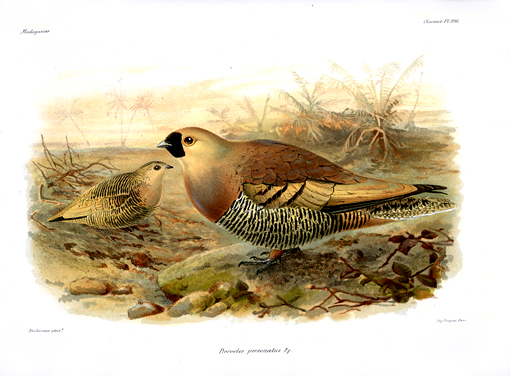
The Madagascar Sandgrouse has a brownish appearance and a body shape resembling that of a large dove. It is plump, short-legged and has a short tail.[1][2]
Adult females lack the black facial area surrounding the beak found in males. Their crowns and napes are blackish-brown and streaked with buff, and their pinkish-buff breasts have dark barring along the sides. They also have fine black markings across their backs.[3][4][5][6]
Juveniles resemble females but have browner barring and more muted overall colouring. Both sexes have black underwings.[7][8]
Males have a black front and plain wings marked with three black bars.[9]
Habitat
The Madagascar Sandgrouse inhabits dry, open areas of mostly level ground with grasses and sparse vegetation. Its habitat includes the spiny forests of southeastern Madagascar.[10][11]
The species is endemic to Madagascar and occurs in the drier southern and western regions. It is common in western and southern Madagascar but less common farther north.[12][13][14]
Diet
The Madagascar Sandgrouse forages on the ground for seeds during the day.[15]
Behaviour
The Madagascar Sandgrouse usually occurs in family-sized groups of three or four birds. It sometimes forms groups containing twelve or more birds.[16][17]
The species can run but seldom does so. When disturbed, individuals may initially freeze before moving away or taking flight. Groups generally fly away together and land a short distance from their original location.[18][19][20]
The species communicates using a low, rapid, hoarse repeated call or a single note repeated every few seconds.[21]
Individuals tend to gather at watering locations in the early morning and late afternoon. Sometimes, several hundred birds gather in flocks at these locations, and individuals may wade into the water while drinking.[22][23][24]
During breeding, individuals carry water to their young in their breast feathers. The species may also rest on sandbanks during the day.[25][26]
Reproduction and life cycle
Adult Madagascar Sandgrouse form monogamous pairs. Nests are ground depressions often situated beside trees or shrubs, within vegetation clumps, or among rocks or bushes.[27][28]
Nests are sparsely lined with dried grasses and occasionally a twig or snail shell. They are sometimes decorated with a ring of leaves collected from elsewhere.[29][30]
A typical clutch contains three greenish-brown eggs with abundant dark-brown blotches. Both sexes participate in incubating the eggs.[31][32]
Adults generally remain on their nests until an approaching intruder comes within 10 metres.[33]
Conservation
The Madagascar Sandgrouse is classified as Least Concern on the IUCN Red List. It has a wide geographic range within Madagascar, and its population trend is reported as stable.[34][35][36]
Hunting occurs in some parts of its range but is not considered a substantial threat. The number of mature individuals is unknown.[37][38]
The species was most recently assessed for the IUCN Red List in 2024.[39]
Classification of the Madagascar Sandgrouse
| Kingdom | Animalia |
|---|---|
| Phylum | Chordata |
| Subphylum | Vertebrata |
| Infraphylum | Gnathostomata |
| Parvphylum | Osteichthyes |
| Megaclass | Tetrapoda |
| Class | Aves (Bird) |
| Order | Pterocliformes (Sandgrouse) |
| Family | Pteroclidae (Sandgrouse) |
| Genus | Pterocles (Sandgrouse) |
| Species | Pterocles personatus Gould, 1843 |
Where the Madagascar Sandgrouse is found
Checklists and occurrence records place Pterocles personatus in 1 country across Africa. GBIF holds 1,211 georeferenced records of it.
Countries
Regions and cities with the most records
- Amboasary, Madagascar 188
- Toliara, Madagascar 85
- Sakaraha, Madagascar 36
- Mahajanga, Madagascar 10
- Morondava, Madagascar 10
- Soalala, Madagascar 10
Range as the checklists state it
Africa
A number beside a place is its count of GBIF occurrence records. A place without a number comes from a checklist alone. Records show where a species has been observed or collected, which can include escapes and vagrants.
Common names
English
- Madagascar Sandgrouse
- MASA
- Madagascan Sandgrouse
Names in 27 other languages
- Arabic
- قطا مدغشقري
- Catalan
- ganga de Madagascar
- Chinese
- 馬達加斯加沙雞, 马岛沙鸡
- Czech
- stepokur madagaskarský
- Danish
- Madagascar Sandhøne
- Dutch
- Madagaskarzandhoen
- Esperanto
- madagaskara stepkoko
- Estonian
- madagaskari vuril
- Finnish
- madagaskarinhietakyyhky
- French
- Ganga masqué
- German
- Madagaskar-Flughuhn, Madagaskarflughuhn
- Hungarian
- álarcos pusztaityúk
- Italian
- Grandule del Madagascar
- Japanese
- マダガスカルサケイ
- Lithuanian
- madagaskarinė smiltvištė
- Malagasy
- Katrakatra
- Norwegian
- madagaskarsandhøne
- Polish
- stepówka madagaskarska
- Portuguese
- cortiçol-de-madagáscar, cortiçol-malgaxe
- Russian
- Мадагаскарский рябок
- Serbian
- Madagaskarska sadža
- Slovak
- stepiar maskový
- Spanish
- Ganga malgache
- Swedish
- madagaskarflyghöna
- Turkish
- Madagaskar Bağırtlağı
- Ukrainian
- рябок мадагаскарський
- Welsh
- iâr diffeithwch Madagasgar
Related species
-
 Pin-tailed SandgrousePterocles alchata
-
 Namaqua SandgrousePterocles namaqua
-
 Black-bellied SandgrousePterocles orientalis
-
 Chestnut-bellied SandgrousePterocles exustus
-
 Spotted SandgrousePterocles senegallus
-
 Lichtenstein's SandgrousePterocles lichtensteinii
-
 Crowned SandgrousePterocles coronatus
-
 Double-banded SandgrousePterocles bicinctus
Compare
Questions and answers
What is the scientific name of the Madagascar Sandgrouse?
The scientific name of the Madagascar Sandgrouse is Pterocles personatus. Written with its author, the full name is Pterocles personatus Gould, 1843.
Which family does the Madagascar Sandgrouse belong to?
Pterocles personatus belongs to the family Pteroclidae, in the order Pterocliformes and the class Aves.
Where is the Madagascar Sandgrouse found?
Checklists and occurrence records place Pterocles personatus in 1 country: Madagascar.
What is the conservation status of the Madagascar Sandgrouse?
The IUCN Red List category recorded for Pterocles personatus is Least Concern (LC).
What other names does the Madagascar Sandgrouse have?
Pterocles personatus is also known in English as MASA and Madagascan Sandgrouse.
What birds are only found in Madagascar?
The Madagascar Sandgrouse is endemic to Madagascar. It occurs in the drier southern and western regions of the island.[12][13]
Are sandgrouse endangered?
The Madagascar Sandgrouse is classified as Least Concern on the IUCN Red List. Its population trend is reported as stable, and hunting is not considered a substantial threat.[34][37][36]
What do sandgrouse eat?
The Madagascar Sandgrouse forages on the ground for seeds during the day.[15]
What are some interesting facts about sandgrouses?
The Madagascar Sandgrouse usually occurs in family-sized groups of three or four birds, although it sometimes gathers in flocks of several hundred at watering locations. During breeding, individuals carry water to their young in their breast feathers. Both sexes participate in incubating the eggs.[16][23][25][32]
Sources
Passages the profile rests on
- The Madagascar sandgrouse is a plump, short-legged bird with a short tail. Source passage: “The Madagascar sandgrouse is a plump bird with a short tail and legs” — English Wikipedia
- The species has a brownish appearance and a body shape resembling that of a large dove. Source passage: “Brownish bird that is shaped like a large dove.” — ebird.org
- Adult females lack the black facial area surrounding the beak found in males. Source passage: “The adult female lacks the black round the beak” — English Wikipedia
- Adult females have blackish-brown crowns and napes streaked with buff. Source passage: “having a blackish-brown crown and nape streaked with buff” — English Wikipedia
- Adult females have pinkish-buff breasts with dark barring along the sides. Source passage: “The breast is pinkish-buff with dark barring at the sides” — English Wikipedia
- Females have fine black markings across their backs. Source passage: “female has fine black markings across the back.” — ebird.org
- Juveniles resemble females but have browner barring and more muted overall colouring. Source passage: “The juvenile resembles the female but the barring is more brown than black and the general colouring is more muted.” — English Wikipedia
- Both sexes have black underwings. Source passage: “both sexes have black underwings” — English Wikipedia
- Males have a black front and plain wings marked with three black bars. Source passage: “Male has a black front and plain wing with three black bars” — ebird.org
- The species inhabits dry, open areas of mostly level ground with grasses and sparse vegetation. Source passage: “Its habitat is dry open areas of mainly level ground with grasses and sparse vegetation” — English Wikipedia
- Its habitat includes the spiny forests of southeastern Madagascar. Source passage: “and includes the spiny forests of the southeastern part of the island.” — English Wikipedia
- The Madagascar sandgrouse is endemic to Madagascar. Source passage: “It is endemic to Madagascar” — English Wikipedia
- The species occurs in the drier southern and western regions of Madagascar. Source passage: “where it is found in the drier southern and western part of the country.” — English Wikipedia
- The species is common in western and southern Madagascar but less common farther north. Source passage: “is common in the west and south of the country, though less common further north.” — English Wikipedia
- The species forages on the ground for seeds during the day. Source passage: “During the day it feeds on the ground, walking around foraging for seeds.” — English Wikipedia
- The species usually occurs in family-sized groups of three or four birds. Source passage: “The Madagascar sandgrouse usually occurs in family-sized groups of three or four” — English Wikipedia
- The species sometimes forms groups containing twelve or more birds. Source passage: “but sometimes forms larger groups of a dozen birds or more.” — English Wikipedia
- The species can run but seldom does so. Source passage: “It can run, but seldom does so.” — English Wikipedia
- When disturbed, individuals may initially freeze before moving away or taking flight. Source passage: “When disturbed, it may freeze at first, but soon either slinks away or flushes abruptly.” — English Wikipedia
- Groups generally fly away together and land a short distance from their original location. Source passage: “The group will fly off together landing a short distance away.” — English Wikipedia
- The species communicates using a low, rapid, hoarse repeated call or a single note repeated every few seconds. Source passage: “It communicates with the other birds using a low, rapid, hoarse "ag-ag-ag-ag", or a similar single note repeated every couple of seconds.” — English Wikipedia
- Individuals tend to gather at watering locations in the early morning and late afternoon. Source passage: “In the early morning or late afternoon it tends to congregate at watering locations” — English Wikipedia
- The species sometimes gathers in flocks of several hundred birds at watering locations. Source passage: “It sometimes congregates in flocks of several hundred for this purpose” — English Wikipedia
- Individuals sometimes wade into water while drinking. Source passage: “When drinking it sometimes wades into the water” — English Wikipedia
- During breeding, individuals carry water to their young in their breast feathers. Source passage: “with the objective of carrying water to the young in the sodden breast feathers.” — English Wikipedia
- The species may rest on sandbanks during the day. Source passage: “and may rest on sandbanks during the day.” — English Wikipedia
- Adult Madagascar sandgrouse form monogamous pairs. Source passage: “The adult birds form monogamous pairs” — English Wikipedia
- Nests are ground depressions often situated beside trees or shrubs, within vegetation clumps, or among rocks or bushes. Source passage: “The nest is a depression on the ground, often beside a tree or shrub, in a clump of vegetation or among rocks or bushes.” — English Wikipedia
- Nests are sparsely lined with dried grasses and occasionally a twig or snail shell. Source passage: “It is sparsely lined with some dried grasses, and an odd twig or snail shell.” — English Wikipedia
- Nests are sometimes decorated with a ring of leaves collected from elsewhere. Source passage: “It is sometimes decorated with a ring of leaves round the edge, apparently gathered from elsewhere and brought to the nest site.” — English Wikipedia
- A typical clutch contains three greenish-brown eggs with abundant dark-brown blotches. Source passage: “The usually three eggs are greenish-brown, liberally blotched with dark brown.” — English Wikipedia
- Both sexes participate in incubating the eggs. Source passage: “Both sexes share the incubation” — English Wikipedia
- Adults generally remain on their nests until an approaching intruder comes within 10 metres. Source passage: “will stay tight on the nest if approached, flushing when the intruder is 10 m (30 ft) or less from the nest.” — English Wikipedia
- The species is classified as Least Concern on the IUCN Red List. Source passage: “The Madagascar sandgrouse is listed by the IUCN Red List of Threatened Species as being of "Least Concern".” — English Wikipedia
- The species has a wide geographic range within Madagascar. Source passage: “This is because it has a wide range within Madagascar” — English Wikipedia
- The species' population trend is reported as stable. Source passage: “Population trend Stable” — datazone.birdlife.org
- Hunting occurs in some parts of the species' range but is not considered a substantial threat. Source passage: “It is hunted in some areas, but this is not considered to be a substantial threat.” — English Wikipedia
- The number of mature individuals is unknown. Source passage: “Number of mature individuals Unknown” — datazone.birdlife.org
- The species was most recently assessed for the IUCN Red List in 2024. Source passage: “has most recently been assessed for The IUCN Red List of Threatened Species in 2024.” — iucnredlist.org
Data
- Catalogue of Life, 2026-10-16 XR cc by
- Global Biodiversity Information Facility CC BY 4.0
- Wikidata CC0
- GeoNames CC BY 4.0
- Wikimedia Commons per image; credit shown with each image
- Within the Catalogue of Life, this name comes from The Integrated Taxonomic Information System cc0
References
- Peters, James L. (1937). Check-List of Birds of the World, Vol. 3.
- Gill, Frank, & and Minturn Wright. (2006). Birds of the World: Recommended English Names.
- Dickinson, E. C., and J. V. Remsen Jr., eds. (2013). The Howard and Moore Complete Checklist of the Birds of the World, 4th Edition, Vol. 1 Non-Passerines.
This species in other databases
Page built on 27 November 2026. See how the catalog is made and all sources and licences.
Cite this page
ScientificNames.org. (2026). Pterocles personatus (Madagascar Sandgrouse). Retrieved November 27, 2026, from https://scientificnames.org/species/pterocles-personatus
“Pterocles personatus (Madagascar Sandgrouse).” ScientificNames.org, 2026, scientificnames.org/species/pterocles-personatus. Accessed 27 Nov. 2026.
ScientificNames.org. “Pterocles personatus (Madagascar Sandgrouse).” Accessed November 27, 2026. https://scientificnames.org/species/pterocles-personatus.
@misc{scientificnames_pterocles_personatus_madagascar_sandgrouse,
  author = {{ScientificNames.org}},
  title = {Pterocles personatus (Madagascar Sandgrouse)},
  year = {2026},
  url = {https://scientificnames.org/species/pterocles-personatus},
  note = {Accessed 2026-11-27}
}